- Image by isriya via Flickr
Last week, Simon & Schuster announced it would be selling digital copies of its books on Scribd. This is interesting news because it signals that major trade publishers are (finally) beginning to look for additional venues to sell digital copies of their books, and because it transforms Scribd from a host of miscellaneous documents into a potentially significant e-bookseller.
Unlike scholarly and professional publishing where there is a reasonably heterogeneous ecosystem of e-book aggregators and platform providers (albeit targeted to institutions, not individuals), the trade book world is shaping up to be a duopoly, with Amazon playing Coke to Google’s Pepsi (Sony is the RC Cola of this now over-extended metaphor). The only other obvious player is Apple (Dr. Pepper), with a growing base of iPhone readers and a long-rumored tablet device (possibly) under development.
All this makes the entrance of Scribd into the market worth watching.
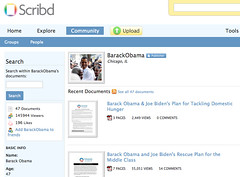
I visited Scribd’s offices just off Union Square in San Francisco last November to find out what they were up to. “Think YouTube but for documents,” is how Mike McGuinness, head of business development, described Scribd to me. Basically, anyone can post any document to Scribd. Documents display in a reader they call iPaper. iPaper is essentially a light PDF reader (it’s built on Adobe technology). iPaper has two advantages over simply linking to a PDF:
- A reader can browse through a document without leaving the Web page s/he is on
- Documents can be in many places at once, increasing discoverability while maintaining some control over the document
For example, below is a letter from President Obama to Senators Kennedy and Baucus on the latest health care reform initiative. The document lives on Scribd. Yet it also lives here in the Scholarly Kitchen, and potentially on thousands of other blogs and Web sites. As it is transported to this blog in the form of a widget, there remains some control of the document (it is harder to alter the document and there is always a link back to Scribd). One can an also download a standard PDF of the document and view it on any ebook reader that can read a PDF file—meaning the Sony Reader and the new Kindle DX. Scribd is also about to release an iPhone app (of course).
For publishers who wish to sell content on Scribd, they offer e-commerce and digital rights management (DRM), which limits what one can do (download, print, transfer to another device, etc.). The difference for publishers between Scribd and Google/Amazon (Googlezon) is that Scribd allows publishers to set any price they wish and only takes a relatively small 20% of sales.
I purchased The Twitter Book by Tim O’Reilly (yes, that Tim O’Reilly) and Sara Milstein for $15.99 on Scribd. In addition to reading the book via iPaper, I was able to download a standard PDF file, which contained no DRM. I’m free to transfer the book to any device that can read it.
It remains to be seen whether Scribd can convince other large publishers to participate and whether they can compete with the Google/Amazon/Sony/Apple juggernauts (iGooglezony). It’s possible they’ll be able to compete—remember that YouTube trounced Google Video (Google, of course, responded by buying YouTube, but the point about the potential competitiveness of a smart start-up holds).
Publishers would be wise to participate in viable digital sales channels, such as Scribd, as they emerge. If they don’t, the danger is that the publishing industry will follow the music industry, where for all intents and purposes there is only one online distribution channel.
Dr. Pepper anyone?
![Reblog this post [with Zemanta]](http://img.zemanta.com/reblog_e.png?x-id=07e625c7-40c4-4557-b425-ec830647b3e7)

Discussion
6 Thoughts on "Simon & Schuster to Sell E-books on Scribd"

Scholarly publishers are warming up to Scribd, too. World Bank Publications has recently signed an agreement to sell over 1000 e-books from Scribd. Surprisingly, the first World Bank book purchased from Scribd was really a “niche” one: “Angola: Oil, Broad-based Growth, and Equity” . What is amazing is the statistics on the “views”: our publications have been viewed nearly 19,000 times in the period June 1 – June 19, 2009, and nearly 1000 people added them to their favourites. For a very academic publisher with an average print-run of 2000 copies per book, this is quite amazing.

Here’s a good recent article on the dangers of consolidation of media into a small number of gatekeepers:
http://www.internetevolution.com/document.asp?doc_id=178058&page_number=1
I’m particularly interested in Scribd’s copyright management system:
http://www.scribd.com/copyright
Because of the nature of documents, they may have a leg up on things like YouTube or music sites, as one assumes it’s easier to recognize common text than it is video or audio. I like that they add anything from a DMCA takedown notice to their banned database, and that they’re willing to work with publishers in a preemptive manner, letting you upload copyrighted works which they’ll block from the site.

i have the same hope w/r/t format portability, whether that’s managed by selling content drm-free, or by providing readability/registration on multiple devices. also holding out some hope that amazon, like apple before it, will eventually change its business model of exclusivity for paid content. (i may have a kindle, but nobody owns me, man…)