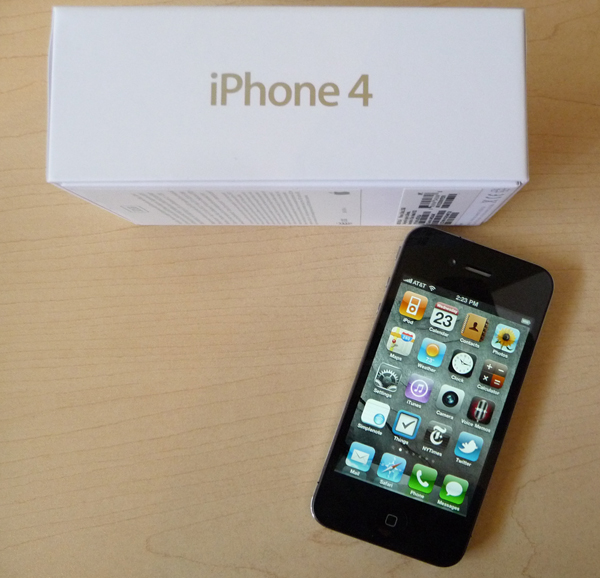
I was woken up this Wednesday morning to the sound of FedEx ringing my buzzer.
FedEx: Is this what I think it is? Aren’t these supposed to come out tomorrow?
Me: Um, possibly. I would think your truck would be full of them. No?
FedEx: I don’t think so. This is the first one I’ve delivered. I can hold on to it for you and come back tomorrow. It might be, ah, slightly used however.
Me: Um, no thanks. I’ll take it now.
I will leave the technical reviews to others and just focus on what the new iPhone 4 means for publishers, and particularly STM and scholarly publishers.
There are, to my mind, four items of note:
1. The screen. Simply put, the screen is breathtaking. You have not seen a high-fidelity screen until you see the iPhone 4’s Retina Display. I was skeptical that this would be a big selling point—after all, the screens on the iPhone 3G and 3GS are pretty nice. But this new display is a big selling point. The Retina Display makes the old screens look muted, like being viewed through the wrong lens at the optometrist’s office.
Why does this matter to publishers? First, images from journals and books will look amazing on this screen. They will probably look better than they do on a desktop monitor, laptop display, or in print. Many STM publishers have a lot of images covering a panoply of the visual world: astronomy, fluid dynamics, medicine, microbiology, zoology, chemistry, and so on. Image-centric apps will really stand out. But a simple image view of an article on the mobile Web will also be pleasure to view with this screen.
Second, it is just about a sure bet that the next version of the iPad will be upgraded to the Retina Display (and other tablet makers are no doubt today figuring out how they can match this level of fidelity). Ebooks, textbooks, magazines, and journal articles will look stunning (and these things look great on the iPad now). The ability to zoom in with this kind of fidelity on a radiographic image, micrograph, or other image is something you just can’t do on paper. This will set the electronic reading experience apart for some kinds of image-heavy content.
2. Annotation. Annotation is here. As David Crotty observed a few weeks ago here in the Scholarly Kitchen, you can now read and annotate PDF files and store them in iBooks. You could annotate PDF previously with 3rd party apps, but now it is natively supported. It still needs some work, and iBooks is not the ideal mobile repository for downloaded journal articles, but the basic tools are there– and they will get better. You can now annotate a PDF while reading on your iPhone and have that PDF synchronized to your desktop, laptop, and tablet PC. Vendors of third-party software like Papers are also working on better management of articles for mobile devices. There are some obvious challenges around interoperability, but we’re getting very close to functionality that is “good enough” for most scholars.
3. Advertising. Support for in-app advertising is included in the iOS 4 operating system. While I don’t think this is a big development for most STM and scholarly publishers, it will matter to those in clinical medicine and other fields where advertising has traditionally been a significant source of revenue. STM publishers may be able to deploy the ad technology in novel ways, however. For example, think of an application built by a society publisher (e.g., an image database, journal application, or other resource) that uses the in-app advertisements as alerts to let members know about upcoming meetings, legislative action, or other society developments. Such “house ads” could be a powerful communication vehicle even for those organizations that don’t view them as a revenue stream.
4. Sensor inputs. I like to think of mobile devices through the lens of Star Trek as this is something they got right in that show (not so much the beaming — I’m still waiting on that). Star Trek, of course, brought us the Communicator, which later become a reality in the form of the cellular flip phone. The show also made use of the Tricorder, a device with numerous sensor inputs that could record all kinds of data (visual, scientific, medical) while in the field. The Tricorder is now here, and it is called the iPhone 4. With HD video, dual 5 megapixel cameras, and a growing array of other sensors (2 microphones, a compass, an accelerometer, various antennas, a light sensor, a GPS system, and now a gyroscope), the iPhone 4 is getting to the point where one can use it as a fairly robust data input device. The possibilities for STM are endless. The main point here is that this is not just a data consuming device; it is also a very sophisticated data input device.
These four things, in concert, present some very interesting considerations for publishers.
Beam me up (though please, after I’ve had my coffee).

Discussion
6 Thoughts on "The iPhone 4 Unboxed: Early Observations for Publishers"

Hey, aren’t we on vacation?
Some quick thoughts on upgrading a 3GS to the new operating system, iOS4, as some of us aren’t eligible for upgrades until February of next year (and why bother at that point with the iPhone5 likely out a few months later?):
The big immediate improvements are:
1) Folders–so happy to have a system where I can easily organize all those apps I’ve collected over the last few years. I’ve cut down from 6 screens-worth to a little over 2.
2) Consolidation of e-mail inboxes–as someone who uses multiple e-mail addresses, work, personal, etc., checking all of these on an iPhone meant constant hopping back and forth, mailbox to mailbox. iOS4 now offers a view of “all inboxes”, a nice time saver.
Just starting to play around with iBooks–who doesn’t love Winnie The Pooh?

We are indeed on vacation but I was thinking a vacation is a good time to play around with the new iPhone 4. After all, one would not want to be distracted with the shiny new object at the office.
Yes, e-mail consolidation and folders are big improvements for users. I already have a folder for the growing hoard of STM publisher applications (at least two of which, I noticed, are from authors of this blog).
Also multi-tasking is finally here.
I didn’t list these as I don’t see them as game changers for publishers (perhaps multi-tasking should have been listed and some publisher applications might make use of it). But I will certain use them.

Excellent posting Mike … am still waiting for the FedEx man here …
One suggestion that comes to mind though, could the Scholarly Kitchen bloggers do a top 10 publishing (and maybe non publishing) Apps review … the ones you use and like … and maybe will use on your holiday 😉 we all appreciate your input and postings, happy vacation to all, Adrian
Ps, most used non publishing App by myself this month is the ESPN Soccer World Cup App … it’s even taken me away from my trusted BBC website, must be a fairly good App to do that, or is it just we are all getting used to using Apps more than websites these days with the introduction of iPad, new iPhone and improved Apps ??
Ah, the ESPN World Cup App (USA! USA! USA!) – where would we be without you? Probably sober and not at bar at 10 am on a weekday (wait, are people reading this?).
That is a good idea. I’ll see what we can round up in terms of publishing app reviews.