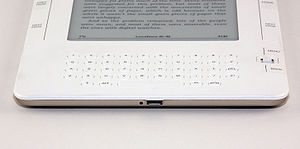
- Image via Wikipedia

This is a short post simply to call attention to another post by Peter Brantley. Brantley has a bone to pick with Amazon, and after reading his post a couple of times, I think he’s right.
What’s at issue is whether a few large organizations that have entered the publishing world (the accused are, obviously, Amazon, Google, and Apple) have too much influence in the industry. Sometimes bigger is better, sometimes it isn’t. I for one feel uncomfortable when any aspect of human expression falls under the inordinate influence of a large commercial enterprise. I don’t feel that way about, say, coffee shops or straight razors, though perhaps I should.
Brantley notes that Amazon’s “gift” to authors — the promise of a 70% royalty — comes with unacceptable strings attached. Under the Amazon plan, the publisher or author sets the price of an ebook and gets a royalty of 70%. Sounds good so far. But if another vendor is selling the same book at a lower price, Amazon has the right to match it, without further consultation with the author. If the author prices the book at $9.95 and a competitor begins to sell it for $5.95, Amazon immediately lowers the price, and thus the royalty paid to the author.
What’s increasingly clear is that authors and publishers are struggling to maintain control of the marketing and pricing of their products. Part of this is because of the ongoing platform wars, in which technology companies devalue content in order to create support for their own technological solution; part of this, at least in the U.S., is the legal prohibition against having manufacturers set prices when products are sold through intermidiaries.
Is it any wonder that more and more publishers are beginning to experiment with direct sales, bypassing the traditional supply chain altogether?


Discussion
10 Thoughts on "Is Amazon Still Man’s Best Friend?"

I think maybe Peter needs to add some perspective on traditional publishing and typical royalties. In the print world, most authors get a hardcover royalty of around 8% to 10% of a portion of sales revenue calculated in ways that would make Hollywood movie accountants proud.
See for example this explanation by Rebecca Brandewyne or many of the posts on Joe Konrath’s blog.
The self-publishing movement, in print or ebook form, is a move by authors to bypass these kinds of paltry payments from big publishers.
Anyone who wants can upload an ebook on Amazon’s DTP system and set a list price at any level they desire (minimum 99 cents). Then sit back and collect 35% of that author-established list price minus a small delivery charge on every sale to any customer anywhere in the world. Needless to say, this is far, far more revenue per copy than authors collect from print books with no upfront costs and no crazy accounting. An author can then turn around and upload the ebook to B&N, Apple, Sony etc, each of which have their own royalty rates and terms and conditions.
The 70% royalty program is much more limited and probably is not the best choice for all authors.

Many authors also receive substantial advances from publishers and those numbers should be factored in as well when thinking about earnings. Paul Carr does the math here:
A first time author at a major publishing house can reasonably expect an advance of $10,000 dollars (although some get waaaay more) – a payment that’s guaranteed no matter how well their book sells….By comparison, Amazon pays self-published authors using their Kindle platform a whopping 70% royalty per sale, but of course with no advance…The self-published author has to cover their own time spent writing, plus all the other costs – marketing, legal, cover design, layout etc etc etc – before they make a dime. And even without these costs, they still have to sell 1429 books at $10 before it becomes a good idea to turn down that advance. On a $5 ebook the number is 2858 copies; on a $2 ebook it’s 5000 – or on a freebie it’s – uh – infinity.
Likely each author will have to do the math for themselves, plot out their actual potential sales level and figure out which route offers the best deal. The conventional wisdom is that most books don’t “earn out” (sell enough copies to pay off the author’s advance), and if this holds, then the traditional route may end up being financially superior when it’s available.

Isn’t this a problem only if royalty rates are set on the basis of list price? Most academic publishers these days, I have reason to believe, base royalties on net receipts, which might be construed as similarly disadvantaging authors when discounting occurs. I think there are many good reasons to be concerned about Amazon’s market power and its exploitation thereof, but I’m not sure this is one of them.

This is incorrect. Royalties based on net receipts will decline if Amazon ratchets down to meet the pricing of its presumed competition.
Yes, of course, but my point was that this is no different from a publisher selling at discounted prices themselves, such as their “special sales,” or for bookstores to discount older stock they can’t return, etc. The authors are always going to get just the net, when the rates are defined on that basis, so why is Amazon doing authors any more a disfavor than anyone else discounting from the list price? It’s not as though they would be getting less from Amazon than they would from their own publishers.
Sandy, Amazon can keep lowering the net without the publisher’s permission. It makes all the difference in the world. The net can be lowered to zero. The sum received by the publisher is entirely outside the publisher’s control.
And so it is also when a remainder dealer buys stock from a publisher and sells it at deep discount, or a book club sets a member price, or a bookstore puts deep-discounted titles on a table out front, etc. All of these are beyond the control of the publisher, too. Surely, though, it would not be in Amazon’s interest to lower the price to zero! (Of course most publishing contracts specify no or reduced royalties on sales when the price at discounts over 50%.)
Remember though, that Amazon has several horses in this race. Having eBooks cost little or even having them free helps them sell Kindle devices, and helps cement their dominance of the market.

I have to say, I haven’t experienced a problem. I have two e-books on Amazon, and based on experiences of fellow Backword Books authors, I lowered the price of my first book (after 18 months on the market) to $0.99. Sales picked up a little. Then Amazon lowered it to $0.89, and sales took off. It’s now #14 in Action/Adventure, and I’m making a few hundred dollars every month just from Amazon e-book sales.
So, I say, “Thank you, Amazon, and your wily pricing.”
Books are plentiful (abundant), and with the hard goods aspect of paper and binding gone, prices will fall. But it doesn’t mean that there won’t be enough money for authors to be happy. After all, even NYTimes best-selling authors have to hold down day jobs (advances or not), and writing is most often not done for the money.
As for me, the lower price has exposed a larger audience to my first book, and they seem to be moving quite nicely along to my second book, which is selling for 2x the first book’s price. And guess what? Book #3 is due out in a couple of months.
The fact is that Amazon, while worth watching for improper behavior, so far is doing commercial book selling better than anyone, and their interests are aligning well with at least this author’s.

What am I missing here?
If say Sony discount your book to the extent that it starts to drive down the price on Amazon, then you look at your spreadsheet and work out what the projected incomes are to you from the new price. It may be that discounting drives increased sales and you are better off. It may be the opposite. If so, remove your book from Sony. You’re publishing this way because you want to control the rights to your book correct? in which case you are taking on the responsibility for monitoring your sales channels and adjusting your strategy accordingly.
If Kent has a breakout hit, with say his seventh book, he can set a higher price. He can also go back and reprice his back catalogue and make more on the fact that new readers will be discovering his earlier work. (I think you can do this can’t you Kent?)
I think anyone looking at selling digital objects, needs to take a look at Hal Varian’s paper on versioning of digital goods, if only to get a handle on what the wizards at Amazon and elsewhere are up to. The maths can be a bit hairy in places, but I think one can get the principle: http://people.ischool.berkeley.edu/~hal/Papers/version.pdf