Let me start by putting my cards on the table. While I have never been opposed to open access (OA) itself, for many years I’ve felt that one fundamental problem with the OA movement is that it’s built on a false premise: the idea that it is unacceptable for anyone to have to pay for access to the published products of scholarly and scientific work. Over the past 25 years, as OA has grown and as funding and distribution models to support it have proliferated, this assumption – and the corresponding belief that a transition to universal, mandatory OA is a moral imperative – has received little critical scrutiny. And yet it has also become clear that every model of OA publishing creates a mix of solutions and new problems; there is no model of openness that does not yield a mix of good and bad outcomes in terms of effectiveness, efficiency, sustainability, and equity. This is one reason OA funding and publishing models keep proliferating – each new model is aimed at addressing problems created by previous ones, and each new model inevitably creates new problems of its own.
Toll-access models, of course, also yield a mix of good and bad outcomes. On the negative side, they provide access to scholarly content only to those who are willing and able to pay, or who have brokers (usually libraries) paying on their behalf; no question, this is a real downside. On the positive side, they spread costs relatively thinly (to many readers/subscribers rather than a few authors or sponsors), they preserve a logical relationship between the desire for access and the requirement to pay for it, etc.

Since, in my view, it is a mistaken premise that all scholarly publishing must be OA, I would like to propose a more complex and (I believe) more valid set of premises for moving forward with scholarly communication:
First, let’s acknowledge and accept that every publishing model, whether closed or open, is imperfect; each solves some problems while creating others.
Second, no publishing model is inherently morally superior or inferior to another. Charging for access is no more or less morally problematic than charging for publishing services, or redirecting institutional resources away from other worthy projects towards the underwriting of open publishing, or redirecting research grant funds away from research towards underwriting open publishing, etc.
Third, fostering and nurturing a pluralistic and diverse ecosystem of scholarly communication will provide a greater net benefit to the world than trying to force systemwide conformity to a single model (or class of models).
With those premises in mind, I offer here a “modest manifesto” that I’m putting forward in the interest of promoting and fostering pluralism and diversity in the scholarly communication ecosystem. This proposal is built on three assumptions:
Assumption #1
The fundamental purpose of scholarship and science is to
- create, discover, and synthesize new knowledge and
- communicate it effectively, thereby
- making the world a better place.
Assumption #2
The work of scholarly communication requires methods, models, and solutions that are effective, sustainable, and ethical.
Assumption #3
Scholarly communication takes place within a dynamic and complex ecosystem of agents, models, and methods, all of which are imperfect and all of which present a mix of costs and benefits.
Discussion
Since every possible method and model of scholarly communication is imperfect, a healthy scholarly ecosystem must be pluralistic, providing space for experimentation and for a diversity of methods, models, and philosophies to coexist.
While the qualities of effectiveness and sustainability can largely be assessed by reference to objective criteria, ethicality will always be a matter of dispute between people operating from different assumptions about what is right and wrong. Because these assumptions can’t be adjudicated on a purely objective basis, a healthy scholarly communication ecosystem must make space for a variety of opinions, ideologies, and perspectives with regard to right and wrong. This will mean, inevitably, some degree of compromise between positions, and it will require the ability to deal in a mutually respectful way with the reality of ideological diversity.
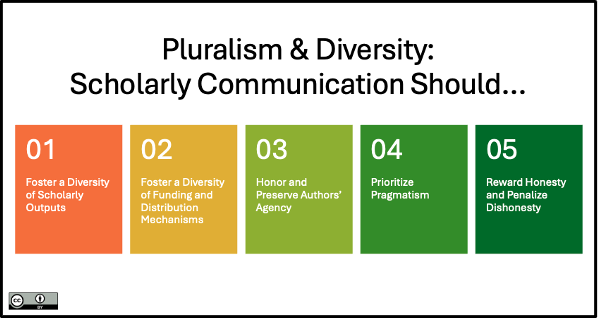
Five Principles for a Pluralistic and Diverse Scholarly Communication Ecosystem
With all of the above in mind, I invite all of us, as both members of and contributors to the scholarly communication ecosystem, to work towards a pluralistic system that will:
- Foster a diversity of publishing outputs. Recognizing that every manifestation of scholarly output (articles, books, data sets, white papers, etc.) performs some scholarly functions well and some less well, a healthy scholarly communication ecosystem will foster a diversity of publishing output types.
- Foster a diversity of funding/distribution models. Recognizing that every model of publishing involves a mix of costs and benefits and strengths and weaknesses, a diversity of publishing models – both open and toll-based – should be encouraged to flourish, rather than one model or category of models being artificially imposed on the ecosystem. Instead of trying to force a single model on the system, we should try to mitigate the downsides and magnify the upsides of each model within a complex and diverse system.
- Honor and preserve authors’ agency. Recognizing that different scholars and scientists operate in different disciplinary contexts and with different needs and viewpoints, scholarly authors should retain the ability to decide how and where to publish their work, including the right to negotiate whether and how to transfer rights to publishers or institutions and which (if any) of their exclusive rights to reserve for themselves. Those in a position to exercise power over authors should infringe as little as possible on authors’ agency.
- Prioritize pragmatism. Contributors to the ecosystem of scholarly communication should focus on proposals, projects, and system changes that are likely to create the most good for the most people at the least cost.
- Reward honesty and penalize dishonesty. The scholarly communication ecosystem needs structures and practices that reward reward true and honest reports of research outcomes and that penalize and reject false and dishonest ones, that reward honest publishing practices and penalize deceptive ones, and that reward appropriate transparency without forcing inappropriate transparency.
It’s important to note that none of what I’m proposing here would foreclose continuing to advocate for the adoption of particular models of access, including open models. Within a scholarly communication ecosystem that values pluralism and diversity, voices of advocacy will be welcome across a wide spectrum of viewpoints and options. However, an ecosystem characterized by respect for pluralism and diversity will tend naturally to be skeptical of totalizing proposals that reflect a desire to impose one specific model (or category of models) on everyone else. Of course, in a healthy ecosystem skepticism will be expressed in the form of respectful dialogue.
Now the question is: does a critical mass of stakeholders in the scholarly communication ecosystem share these assumptions and goals? If so, what could we do to advance these principles? Thoughts welcome both in the comments and to the author directly.

Discussion
42 Thoughts on "In Defense of Pluralism and Diversity: A Modest Manifesto for the Future of Scholarly Communication (Part 2 of 2)"

It is rather surprising that Mr. Anderson’s manifesto for the future of scholarly publishing turns out to be little more than a defence of the status quo. The manifesto fails to persuade in suggesting that there is no moral difference between genuine open access publishing (by which I mean no APC and no subscriptions – which I termed the “platinum model” some years ago) and commercial scholarly publishing.
The moral gap is, in fact, enormously wide: the scholarly publishers are businesses, their fundamental objective is the achievement of profit, and the extent to which journal subscription costs have exceeded the cost of living index demonstrates that this imperative takes precedence over any obligation to treat scholarly research as a public good.
OA publishing on the platinum model ensures equitable access to research, ensuring that it is a public good available to the widest audience, regardless of the economic conditions of the information seeker. The model also removes barriers to access for researchers and others in the “Third World” – the less economically secure parts of the world. It is not surprising that, in many of these countries, OA journals reporting local research are proliferating.
Most academic research is publicly funded and there is a strong moral claim that when a tax-payer has helped to fund research, he or she should be able, freely, to access the results. In fact the taxpayer is not only funding government-funded research, but also the salaries of publicly-funded researchers, the costs of academic library subscriptions, and the subscription deals done by universities to enable a kind of open access.
On the basis of utilitarian ethics, the present model of scholarly publishing may benefit the commercial organization and its shareholders, but it does not satisfy the greater good.

Most academic research is publicly funded
Can you provide a source showing this data? I was surprised recently to read that in the US at least, government funding had fallen from 58% of basic research in 2000 to now less than half (42%) as of 2022 (https://datasciencemilan.org/how-much-money-does-the-government-spend-on.html). The same article suggests around 40% of research in the UK is government funded. Here it notes that 75% of clinical trials are funded by private companies (https://undsci.berkeley.edu/who-pays-for-science/).
I suspect that globally, China may be swaying things with their government’s increased research funding, but I would love to see better data if you have it.

As a note: the more relevant discussion here would be the precentage of publications in the scholarly ecosystem produced on the basis of publically-funded vs. non-publically-funded research. For instance, Google invests in basic research, but doesn’t necessarily translate into publications at the same rate as the per-dollar (or per-euro, per-yuan) investment by a public body.
Good point! Also there are some fields that are more industry-dominated than others. Many fields are largely unfunded (and often, research is done as part of a salaried position at a university, paid for by tuition revenue). Do the “morals” change for those fields as opposed to those that are heavily publicly-funded?

Thanks for the response, T.D. You and I obviously disagree on some issues of right and wrong, and there’s not much point in arguing over those here. On a couple of points of fact, though:
First, it’s very important to bear in mind that the scholarly publishing world is not conveniently divided between for-profit toll-access publishers and non-profit open-access publishers. It is a much messier array of for-profit and non-profit publishers that publish a mix of toll- and open-access content, as well as fully non-profit toll-access publishers and purely commercial (and sometimes highly profitable) OA publishers.
Second, your point about the demand-side benefits of platinum OA is well taken. But it elides another important point about the costs of platinum OA, which are significant: when an institution of any kind takes on open publishing as a cost center, it diverts resources away from other important and worthy projects. Does that diversion represent a net benefit to the world? It may or it may not. Simply pointing to the benefit of access doesn’t come close to creating a rigorous justification for the diversion.

I’m not sure the financial example of the Public Library of Science supports your assertations about publishers and profits/excess revenues. PLOS has lost money in 4 of the last 9 years according to their Form 990. They are a not-for-profit dedicated to open access publishing that carries out limited non-publishing activities, charges APCs between ≃$3000-6800, and recently accepted a major infusion of grant money to realign future activities and practices.
We can discuss the ethics of commercial entities, but I don’t hear the same conversations about other purveyors of scientific support or supply, such as Battelle or Thermo Fisher Scientific.
The first step to creating a sustainable open science system is to accept that there are very real, serious costs associated with a scholarly communication system, AFTER the grant funded research has concluded.
Carl, can you clarify whom you’re responding to? I think you’re the first person in this conversation who has mentioned PLOS.
The original comment. PLOS is anecdotal, but very apt example of the real-world challenges and costs of bringing open access publication models to fruition.

I think, many believe a not-for-profit means the organization is not beholding to a year-end profit and loss statement. Profit is called excess revenue, and money goes into the bank, while loss means we need another handout!

To reply to the top comment here: I think this fundamentally misses the point (I’m afraid). The paid subscription model does not *necessarily* mean a for-shareholder-profit extractive model. That’s just one way of doing it. There are plenty of non-profit publishers offering paid subscriptions to their journals at prices that essentially just cover their costs and overheads, and any surplus is put back into their scholarly operations. Not all scholarly publishers are commercial publishers.
And Rick is absolutely right, the paid subscription model is a completely legitimate way of publishing. It makes most sense, to my mind, to spread the cost of publishing amongst those who wish to read. And the desire of readers outside the academy to read academic content has been massively over-stated (although it is real, and a problem — society memberships are a way of addressing this). But it’s not the fault of the model itself that it’s been abused by the big commercial publishers.
Has it been abused? Microsoft reported earning $245 billion in 2024 and a profit of $88 billion, resulting in 34.7% GM! Outrageous! It should drop its prices so more can enjoy its products!
Microsoft invests in new products, and so do the major publishers.
Both serve a social good, which is why they are successful.
Neither is abusive!

I agree with all of this. I’ve been thinking about how the power dynamics in the scholarly knowledge production system affect these sort of goals and what we should organize our compromises around.
When I say power dynamics I’m thinking about the drivers of the academic evaluation system, how difficult it is to find resources to support alternative platforms because of how much is already committed to the vendor platforms deeply integrated within academic production, information asymmetries that lead to unequal bargaining power, and unintended consequences no matter what compromises we make.
I wish I had more time to think, but I appreciate the starting point that this article provides.
Thanks, Willa! I’m glad you found the piece useful.
In recent years I’ve been thinking a lot about the contextuality of power and privilege. It’s always interesting to see who has how much (and what kind of) power in what contexts. Scholarly communication is particularly complex in this regard, I think.

thanks rick. Perhaps it is implicit, or contained w/in the pragmatism and honesty principles, or as one principle overriding all 5 priciples, but/and i think it’s worth stating or noting explicitly that the ecosystem should reinforce, advance, and foster science and scholarship (the three goals you stated at first). this makes things like reliable archives for content, data, and code; interoperability (to expand trust and use); some standards and standard practices; etc. priorities.
Rick, great analysis and proposal. It addresses the ecosystem but leaves out the audience. The reader can either go to a library to read a subscription-based article or read it on a platform supplied by the library/business or, in the case of an OA article, go to a platform that carries it. They pay little or nothing to enjoy the benefits of the article.
The author has the option of either going cap in hand for funds to publish – OA -or turn over the work to a publisher who does not charge the author but enjoys restricting the author’s agency in return for its services.
My question over the years is: Why does the reader enjoy a free lunch?
Harvey, I’m not sure what you mean by the reader enjoying a “free lunch.” Under toll-access models, the reader either pays for access or has the cost of access covered for her by a broker, such as a library. There is no “free lunch” under any scholarly publishing model — the question is just who will pay for the lunch (and how).
I see your point. However, what I am trying to convey is the following: In the toll-access model, the institution pays for access, and the reader gets free access; in the OA model, either the author or someone else pays for the publication. But, in both models, the reader reads it for free.
In the toll-access model, it’s actually at least as common for readers to pay for access themselves (either directly as subscribers or indirectly as tuition-payers or payers of library fees). Of course, under publicly-funded OA readers are paying indirectly as well, as taxpayers.
The fiscal dynamics are not simple, and weren’t simple even before they became vastly more complicated with the advent of the OA movement. (Not that complexity itself is necessarily a bad thing.)
Rick: I was in NYC on a business trip and walked into the NYC Public Library, and while there, I looked at some journals. Cost me nothing.
But, I see your point. The caveat being the word indirectly. One pays indirectly for many things whether they want to or not, and in most instances, that is a good thing.

This is an interesting comment given the fact that most libraries at research-intensive institutions no longer subscribe to print journals (if print is even offered by the publisher) that a visitor could walk in and peruse. The vast majority of research libraries’ serials holdings are now licensed digital content, and providing access to this content to walk-in campus visitors or anyone not affiliated with the university is prohibitively expensive.
In addition, how many libraries in developing nations subscribe to substantial numbers of toll-access serials, either print or digital? I really doubt that I could find a library in Haiti or Kenya that would have many toll-access journals I could walk in and read.
In short, toll access is exactly that for most of the world: if the reader wants access, the reader pays. No matter where you live in the world, only a privileged few can access this content via libraries.

Readers might find the recent “Frybourg Declaration” on the For Better Science blog highly pertinent to this discussion. After considering numerous possibilities, including the UK Wellcome Foundation’s disappointing attempt to start its own publishing system, it is concluded:
“Needless to say, any reform along the suggested lines will be difficult, because the publication industry, which is deeply entangled with the current academic system, controls much of the public discourse and is very good at self-preservation. Also, the current granting agencies are typically led by academic scientists who are also embedded in the current, dysfunctional scientific and publication ecosystem. So they must go as well. The management of the granting bodies should be replaced with a new crop of government administrators and reform-minded scientists whose sole interests are quality, reproducibility, validation, and the eventual translation of the findings for public benefit.”
Interesting comment, but in light of current affairs, personally, I don’t want government officials involved in anything that they consider the public good!

Hi Rick,
Good pieces. But qualify the opening — not everyone assumes the transition from toll access to OA is inevitable. Sure, OA has dominated the Scholarly Kitchen topics and its discussions. Yet, the reality all along has been that most major publishers and their leadership have long treated OA simply as an alternative business model and revenue channel — and have held those views for a long time. Derk Haank, Elsevier Science CEO 1998-2004; Springer Science 2004-2017 (pushing Springer into OA, buying BMC in 2008), offered as much back in 2011. https://www.infotoday.com/IT/jan11/Interview-with-Derk-Haank.shtml..
I know you’re writing for the SK, which is often its own scholarly bubble (or culinary club), so will hope that you are writing with some hyperbole! OA will march on, but let’s be candid about its history.and its audience’s assumptions!
Very good pieces — good data.
with thanks,
-A
Hi, A.B. —
With respect, I don’t believe there’s any hyperbole in my piece. It’s based not primarily on my experiences writing in (or reading) the Scholarly Kitchen, but on 25 years of involvement in the larger conversation around open access in the library and publishing world. I think it’s safe to say that the inevitability of a global transition to OA is a fundamental and generally-held article of faith within the OA movement. (Of course, not everyone in scholcomm is part of the OA movement.)
A quick search for “open access is inevitable”:
https://www.timeshighereducation.com/campus/open-access-inevitable-only-how-remains-discussion
https://crl.acrl.org/index.php/crl/article/download/16255/17701
https://archive.blogs.harvard.edu/pamphlet/2012/06/28/the-inevitability-of-open-access/
https://www.crimrxiv.com/pub/9bhzvcca/release/1
https://www.nejm.org/doi/full/10.1056/NEJMp1211410
etc.
Hang on — you did write in your opening, “For many years now, the dominant discourse around the future of scholarly communication has centered on two assumptions..” which does imply the broad scholarly community, not just those “..within the OA movment.” i.e. you were referencing the basic assumptions held by the scholarly community. Popular and trending assumptions, certainly, but not held by all, nor necessarily held by the majority (at least outside of the SK). Just a bit of post publicaton open peer review, so-to-speak. You wrote some good pieces. Keep it up. Good Autumn to you.
You’re right, I did say that — and I stand by it. “Dominant discourse” doesn’t mean “the stated position of every individual.”
Thanks for the kind words and for the engagement!
Good Morning Rick, Hi David,
Well, what I thought was a minor comment took on a life of its own. In a nutshell, I agree and I rather like what Rick wrote in his 2 posts. My earlier side-point about ‘post publication peer review’ rings clear this morning. It is this paragraph which doesn’t ring soundly,
“ For many years now, the dominant discourse around the future of scholarly communication has centered on two assumptions:
First, that charging people for access to scholarly products is morally unacceptable, and must be eradicated by means of a global transition to open access (OA).
Second, that this global transition from toll access to OA is inevitable (if not happening as quickly as it should be)”
That’s an oversimplification. The OA movement is built on 3 pillars: scientific, economic, and moral. While the scientific and economic reasons may not be as trendy now, they’re still at the heart of the debate, and have been from the onset:
1. Scientific: OA speeds up discovery, collaboration + reproducibility
2. Economic: sustainable publishing and maximizing research value
3. Moral: It’s about fair, global access to knowledge. i.e. because everyone deserves a chance to benefit from science.
Hi, A.B. —
I think you’re conflating two different issues here. The “dominant discourse around the future of scholarly communication” is one thing; I stand by my assertion that it has been built on the two assumptions I identified.
The fundamental assumptions on which the OA movement is built (or what you’re calling its “3 pillars”) is a different issue. Those assumptions have certainly helped to shape the dominant scholcomm discourse over the past couple of decades (for example, the assumption that OA speeds up discovery has encouraged a discourse strategy that equates resistance to OA hegemony with resistance to scientific progress), but the fact that they’re connected doesn’t mean that they’re the same thing.
Also, it would be interesting to see to what degree OA’s various advocates and advocacy groups would frame those assumptions in the same way you have. I’m sure there would be broad agreement, and I’m also sure it would not be universal. The wide variety of strategic priorities, and even of OA definitions, within the OA movement is one of the many dimensions of diversity that currently defines the scholcomm landscape.
Alright, let’s tie this off. Stand by your assertion. I will stand by mine ( that the “dominant discourse around the future of scholarly communication” has been, and continues to be based on the scientific, economic, and moral assumptions. These are the heart of the ongoing debate).
Open Peer Commentary would be a cool thing to pilot here on SK. a la Current Anthropology or Behavioral and Brain Sciences (founded by OA evangelist Stevan Harnad, BTW)
Cue; Tammy Wynette’s ‘Stand by Your Man’.
Well, we do have comments for peer commentary, and we always welcome counterpoint response articles and have published many over the years.
It’s interesting to think about the ongoing validity of these assumptions, now that we’re 20-plus years into the modern OA movement. Number 3 is a qualitative opinion, hard to prove one way or the other and based on the individual’s perspective. Number 2 has at least so far been a failure. OA seems to have led to market consolidation, increased costs, lower quality/increased fraud, and higher profits for commercial publishers. The jury is still out on assumption number 1. I have not seen any actual analysis showing that OA speeds discovery collaboration, or reproducibility. Are there any supporting studies for this? Surely 20-plus years in these benefits should have become clear, no?
David, you raise some good points. Taking the latter first: without investing in some collation and writing time, I am putting aside any analysis that shows OA speeds discovery, collaboration, or reproducibility. With that in mind, I think many of us have read similar analyses on OA increasing citations, discoverability, etc. And ditto but for those that have shared anecdotal points about collaboration. Reproducibility seems more thorny. Perhaps transparency would be a better word. As I wrote, these are tackle points for another scrimmage day, so-to-speak.
With regard to the SK post here: yes, the posts here are both random and not especially curated. In Open Peer Commentary (OPC), commentaries from reviewers are solicited on published author accepted manuscripts (AAM): often called the ‘target’ articles. The journal editors review the potential commentators/reviewers and their respective commentary pitch (each submits a short abstract about what they will write on), and then select and invite a list of 5-20 (usually subject dependent). Once commentaries are submitted, the authors are invited to respond to each.
Once these steps are completed, the final versions of record: target paper, commentaries, and target paper author responses are published and connected.
OPC is particularly useful for subjective and/or significant and controversial topics. It offers a dynamic, curated, and citable forum for the communication, criticism, and potential unification of critical thought, benefiting the greater audience.
Go look at Behavioral and Brain Sciences: https://www.cambridge.org/core/journals/behavioral-and-brain-sciences
My understanding of the citation advantage studies is that the randomized controlled trials done show that this is illusory, and even if discoverability is improved (one assumes search engines and now AI prefer stuff that’s free), it remains worrisome to me that there are no definitive studies supporting this most basic assumption of the OA movement. Whether it’s inevitable (per Rick) or a route to everyone benefiting from science (per you), where is the proof that this is a real thing and not just wishful thinking? It concerns me that after more than 20 years we’re still relying on assumptions rather than proven facts.
As for the whole peer review thing, I would probably answer that we are not a peer reviewed publication, rather an informal opinion blog. Our goal is to be inclusive and reflect the SSP (and larger scholarly communication) community, offering a rapid route to public conversation and presentation of ideas, rather than curating a unified set of critical thought.
Sage observation. Perhaps there is no hard data because there is none!

Great piece. Yesterday’s, too, in this two-part write-up. Thank you so much, Rick. These are breaths of fresh air.

I am a senior researcher of mathematics and the Editor in Chief of a Diamond Open Access journal. I have been following your interesting discussions on the OA publishing model for some time now. As you have correctly pointed out,there are issues with the current publishing models, and the OA requirements have made things more complicated and in some sense worse.
The ethical argument that a tax payer should have free access to read articles which they paid for was easy to sell, so many bureaucrats jumped on this fast moving train that seemed to head in the right direction. It does indeed make sense, but unfortunately there are some unwanted side-effects that are not so often discussed so I take the liberty to point some out.
1. The OA model gave rise to a flood of new publishers and many-many more new journals, mostly OA journals with APC and unfortunately of predominantly low scientific quality, including lots of predatory journals. Why did this happen? Probably because it is generally much easier to get money from APCs paid authors than it is to get subscribers, especially when one knows what the authors want or need (keep in mind that there exists a sizable group of scientifically weak or even fraudulent authors out there who need to publsh). The negative consequences of this large number of non-serious journals to science are plenty and rather obvious. Unfortunately there seems to be no end in sight to this flood of new journals, especially in the mathematical and engineering sciences.
2. One of the arguments for free access has been the concern that commercial publishers have too much control over scientific results and that they make too much money with their paywalls. That is true, but from what I read, I conclude that some large publishers have become more powerful and that they are making more money now than before the OA movement. The control is still there, only now they control the authors directly by preventing those without the necessary cash to publish, which is even worse! Also, take for example the hybrid publishiing model which was born directly from the OA requirement. These hybrid journals are still sold to the subscribers, no matter how many articles are open and have been paid for already. Today, most mathematics journals in fact use this publishing model.
3. Many publishers try to fulfill the need for OA by launching new OA journals, flipping some traditional journals to OA, or purchasing existing journal from other small publishers. This in itself is not necessarily a bad thing, but there is a problem. These OA journals must be filled with articles, lots of articles, because the income of the journal is now determined by the number of articles it publishes rather than the number of subscribers. So marketing the journals to readers is no longer relevant. Instead the marketing now focuses on authors to submit their articles. So the journals put pressure on the editors, in particular the chief editor, to publish a certain quantity of articles which inevitably affects the reviewing process and hence the scientific quality (I have person experience with this because I was the Editor-in-Chief of a journal that was bought by a large commercial publisher and flipped to OA. I resigned from this journal and most of the board members did too). As an active researcher I am getting at least one invitation per day by some editor to publish my next article in their OA journal (often for a discount). On the other hand I am not getting any marketing information or invitation from OA journals to read their papers. As you probably know, the best way for a journal to attract authors is with a good scientific reputation and a high journal Impact Factor, where the Impact Factor is the most important player. And that is exactly where the problem lies. How does a journal get a high Impact Factor? That’s easy to answer: the journal should publish articles that get lots of citations. Of course high quality articles often get lots of citations, so one would think that a high Impact Factor would indicate a high quality journal, right? True, but not necessarily. The problem is that citations can be manufactured so that a fraudulent or predatory journal can also arrange a high Impact Factor for itself, and many do so successfully! (there are all kinds of tricks that some editors apply which I prefer not to spell out publicly here for obvious reasons). Since evaluation for research grants and academic promotions are partially based on the journal Impact Factors, this manipulation can have dangerous consequences for the future of science. The mentioned Impact Factor problem is of course not directly a consequence of the OA publishing model but it is further fueled by the need of OA journals to publish as many articles as possible in order to maximize the publisher’s income.
To sum up:
In my opinion we should abandon the journal Impact Factor and find a better way to evaluate the scientific quality of a journal. Moreover, the science foundations and other research sponsors should directly sponsor qualify Diamond Open Access journals instead of individually paying for the APCs for some authors.

This is a solid piece and I appreciate the pragmatism in the five principles. I did get stuck on this opening statement: “…one fundamental problem with the OA movement is that it’s built on a false premise: the idea that it is unacceptable for anyone to have to pay for access to the published products of scholarly and scientific work.” I’ve heard and read this sentiment bandied about for several years now but I never seem to see it play out in reality. Who is saying this? I’d wager that those of us working in library spaces know full well that someone has to pay for publishing. True, scholarly publishing is a truly unique model by which researchers conduct years of intensive research and craft resulting articles which publishers then obtain for free through submissions. Publishers then provide various editorial services, while benefiting from unpaid peer review labor, and then sell these articles back to the very researchers who provided the content in the first place, often at tens of thousands of dollars a pop. Yes, it’s unique and makes non-academics sweat with confusion, but library folk seem well aware of how it works and that someone has to pay to access at some point. I’d say the ire comes from the tremendous disparities in what we pay for the same products or services across the sector.
Hi, Erin —
My argument isn’t that librarians (or even OA advocates more generally) don’t understand that publishing costs money. With rare exceptions, I agree that they do understand that, and that they don’t generally object to the idea of those costs being recovered in some way. My argument is that the OA movement is built on the idea (false, in my view) that charging for access is a fundamentally unacceptable model for recovering those costs. That idea is essential to the very concept of open access; open access and toll access (to content) are mutually exclusive ideas.
Yes, more worthy points. Electronic distribution of research content immmensely helpful. e.g.: performing a meta-analysis. OA certainly faciliates. Altogether: a better search world than what existed in 1993. A given which is oft overlooked.
Yup, and understand the SK culture. That’s why I suggested that Open Peer Commentary would be a cool thing to pilot, There’re lots of good editorials chock full of data that might be refined a bit for broader appeal. Just a passing thought.
Anyhow, see you, Rick and all around the next campfire.

Thank you for this contribution across the two pieces, Rick. You make valuable empirical and philosophical points. Most importantly, you strengthen awareness that without an understanding of the economics of publishing, assertions that knowledge should be made freely available don’t take us very far.

While I disagree that the premise would be false that scholarship needs to be open to all (you call it a “false premise” in the beginning, but later a “in my view, mistaken premise” – I agree with the latter that this is your view) just as much as I disagree with the statement that there is no publishing model that is inherently morally inferior to another (I remain convinced that a publishing model which extracts money out of the research system or which monetizes user data while infringing privacy is inferior), I agree with the suggestion to foster a diversity of funding models. Which is why we need to disinvest in contracts which threaten to hoover up all available budget and/or continue a pay-to-publish logic. If we would spend at least the same amount on collective funding as we do on paywalls, APCs or read-&publish deals, we would foster the diversity of funding models which you recommend.