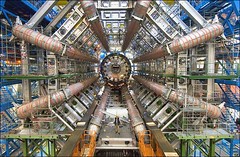
- The Large Hadron Collider at CERN
Collaboration is common in most scientific fields. It brings together individuals with specific skills to build apparatus and conduct experiments that would be nearly impossible for a single individual. Most collaborators, however, like to be acknowledged for their work. As a result, author lists have been getting long — very long in some fields like High Energy Physics.
The bibliographic information for the article, “The ATLAS Experiment at the CERN Large Hadron Collider,” published this past summer in the Journal of Instrumentation, is the length of most undergraduate term papers. It boasts 2,926 authors emanating from 169 research institutions. The article was written even before the collider became operational, which is scheduled for spring 2009.
Getting nearly 3,000 contributors to decide on author order would seem even more difficult than discovering the Higgs Boson, but physicists have worked out the rules with grade school simplicity: authors are listed alphabetically. Authorship on this paper begins with G. Aad and ends with M. M. Zoeller.
Unlike the biomedical field where materials and apparatus are typically purchased from industry, these scientists and engineers are usually responsible for designing and building their own experiments. And constructing a nearly 27-mile long underground accelerator is not something that can be done by a professor and some graduate students in a weekend. The design, construction, and commissioning can take more than a decade. Welcome to Big Science and long author lists.
But as individuals are automatically listed as authors based on their membership in the collaboration, authorship starts to lose its meaning. It becomes impossible for people outside of these collaborations to identify who has contributed what. Even those on the inside may find it difficult to locate individuals with specific knowledge. When credit becomes so diffuse, so does responsibility.
Publication lists may raise eyebrows for potential employers who question the role of an applicant who is listed on 250 papers but whose name appears somewhere in the middle of all of them. It’s the same for junior academics going through promotion and tenure. Returning authorship to a level where the contributions of individuals can be easily discerned is a goal for this community. But recognizing everyone who had contributed is also a matter of fairness in relatively small and tightly coupled community.
Either the definition of authorship in high energy physics will need to change, or other methods for evaluating individuals will take dominance over publications. Collectively, this community will help draft new rules.
Remember, this isn’t rocket science.
![Reblog this post [with Zemanta]](http://img.zemanta.com/reblog_e.png?x-id=ac175dfa-1908-42ef-8403-0b37d2cba772)

Discussion
5 Thoughts on "An Authorship Accelerator"

Here’s a paper that examines the trend in authorship. The publication mentioned above is hardly typical, but the trend *is* up.
McDonald RJ, Neff KL, Rethlefsen ML, Kallmes DL. Effects of Contribution Disclosures and Numeric Limitations on Authorship Trends. Mayo Clin Proc, (2010) 85; 920-927.