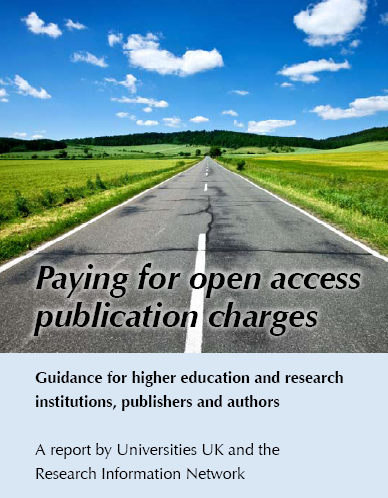
The road is straight, the weather is good. The drive should be simple. The cover of the latest report, “Paying for open access publication charges,” lays out the details for establishing and managing institutional publication funds.
The report and its companion two-page summary paper are both available from the Research Information Network (RIN).
The rationale for creating this report is clear: The response of granting foundations, universities, and publishers to open access journals has been “haphazard.” The purpose of this report is to establish guidelines and recommendations for these groups.
The report first covers why central funds are necessary for funding publication fees. The authors argue that such a funding model avoids most potholes when publication costs are seen as indirect costs to a university (such as the library) and not direct costs (such as funding publication directly from grants). The central fund model is able to support authors without grants, as well as authors whose grants have dried up.
Nicely stated, but the devil is always in the details, and I was particularly interested to see how the report would approach governance of these central posts of publication money, among them:
- Who gets to make the funding decisions?
- How does one determine financial support when articles include authors from other institutions?
- How does one establish priority for funding competing requests if funds become limited? And most importantly,
- How does one deal with appeals when funding requests are denied?
The report provides no answers to these questions except that each institution needs to address them. Questions #1 and #2 are the easiest of the bunch. Beware of #3 and #4.
The function of publication is not merely to disseminate research results — publication also serves as a way to evaluate faculty for promotion and tenure. Those who deny a publication fund request must understand the implications of their decision on the career path of the authors. The time during which a new faculty member must establish a track record in the literature is terrifyingly short. A denied publication can impact the tenure decision of a junior faculty member. Even the delay incurred over an appeal should not be taken lightly.
Unfortunately, I have read no open access publication policy that addresses these important issues:
- The Berkeley Research Impact Initiative (BRII) specifies that it will pay up to $3,000 for articles published in OA journals, but caps expenses at $1,500 for articles published in hybrid journals. No rationale is given for these figures, but one could imagine that the sponsors considered the fees charged by many commercial publishers and set limits accordingly.
- The University of Wisconsin-Madison Open Access Publishing Support Fund will cover 50% of author fees for articles published in OA journals and 30% for hybrid journal and limits one award per year per author. One has to infer whether cost-sharing is the result of wanting to keep the authors sensitized to the fact that publishing costs money, or simply a way to reduce requests (even 50% of $3,000 is unaffordable for a graduate student).
- The UNC-Chapel Hill Open Access Authors’ Fund provides almost no detail, only that they will award up to $1,000 per article.
- The University of Calgary Open Access Authors Fund will fund publishers like Bentham Science (noted for their academic spam campaign), but will only provide funds for hybrid journals when they promise to reduce subscription costs as a result of author-side payments.
- The University of Nottingham in the UK provides only a contact email for more information.
Policies to monitor and govern institutional publishing funds are only necessary if demand exceeds supply. If few researchers request these funds, little mediation is necessary. Just submit the bill.
But many library administrators are pushing for these author funds, and in many cases, the monies are simply being skimmed off existing library collection funds or were provided as a one-time gift from a Vice Chancellor before the economy took a nosedive. As the RIN report states on page 23, there is clearly not enough money to support both author-pays and subscription-pays models.
If use of these author funds takes off, prepare for some road rage.
![Reblog this post [with Zemanta]](http://img.zemanta.com/reblog_e.png?x-id=253491ea-a934-4966-9fef-e07138f9f3e6)

Discussion
11 Thoughts on "Paying for Open Access Publication Charges"

I follow the argument about paying author publication charges through indirect costs. What I don’t understand is how this is going to solve the library funding problem.
In hard economic times, the library can cancel journals without infringing on their faculty’s ability to publish and express themselves. We call this “academic freedom.”
In the indirect author publication charges model, it is impossible to engage in fiscal restraint without impacting faculty’s academic freedom. If the library/institution is unwilling to deny any publication charges because it fears the impact it will have on academic freedom, then it will be left in a worse economic position than in the subscription model.
Hasn’t anyone worked out this logic?

Thank you Richard,
This argument assumes that the model of publication flips entirely from a subscription model to a author-processing-charge (APC) model and ignores a future of both models existing simultaneously. The RIN report notes:
To date, only a small number of researchers [at the University of Nottingham] have applied and have received open access funds for their work, but demand is expected to grow significantly over the next few years when those affected by the funders’ current policies finish their research. (p.24)
But a hybrid future is not feasible. Imagine that you were an author with a choice: You can publish for free in subscription-access journal, or you could ask your institution to pay $3,000 to make your article freely available in that same journal. Wouldn’t you ask for the money?
The APC model may be a thin wedge into a system where the future is a full author-pays model. Somewhere along the way it will slam right into the academic freedom issue. When it does, the accident will not be pretty.

As the chair of the working group that produced the report, I am very much aware that it was written from a UK perspective, and it’s been interesting to see the amount of attention it has attracted from outside the UK.
The UK perspective explains what we say about direct and indirect costs, since there is a particular funding regime in place in the UK for the funding of research, and that will vary in other countries; so you will have to do some translation into your particular funding context, which you will know more about than me.
I’m also very much aware that the report does not provide answers to all the questions and issues that arise in relation to the policies that individual institutions will need to put in place. That’s because there has been next to no thinking on these issues in the UK. So our initial job has been to put what we see as some of the key issues on the table, so that senior managers in universities and elsewhere start to think about them. There’s clearly some follow-up work to do.