Editor’s Note: Today’s post is by Scholarly Kitchen Chef Ashutosh Ghildiyal, Ning Zhang, Gareth Dyke, and Yanli Wang. Ning is the founder and CEO of TopEdit Author Services. Gareth is a Consultant specialising in scholarly markets and researcher networks in China and Central Asia, and is a co-founder of Sci-Train. Yanli is the Publishing Service Director at TopEdit. Part 2 is available here.
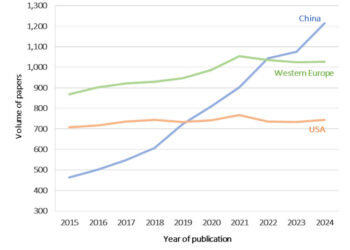
China is no longer simply a major contributor to global research output; it is increasingly becoming a key force shaping the future of scholarly publishing. With extraordinary scale in article production, rapidly improving quality metrics, and extensive collaboration networks, China is moving from being primarily a submissions market to a potential center of gravity for global science.
Its domestic journal publishing ecosystem is evolving at a similar pace. Chinese journals are investing in editorial infrastructure, publishing technology, international visibility, and peer review quality. What was once a largely local publishing environment is now positioning itself to compete globally, not only on volume but also on prestige, citations, and disciplinary influence.
More recently, this evolution has extended beyond journals themselves into the underlying rules of the system: policy, funding, and evaluation. China is no longer only building publishing capacity; it is beginning to shape how research is directed, funded, assessed, and validated. Understanding what is actually happening, and why, is the necessary first step before considering how publishers should respond.
The Excellence Action Plan Moves from Signal to Execution
In 2019, China launched the Science and Technology Journal Excellence Action Plan, aimed at elevating the quality and global standing of Chinese scientific journals. From the beginning, international observers interpreted it as more than an academic modernization program; it was also a strategic move to reduce dependence on Western publishing platforms and reshape the global flow of Chinese research.
In November 2024, the China Association for Science and Technology (CAST) announced the 2024 Special Project under the Excellence Action Plan, effectively marking the launch of its second major phase, widely understood as spanning 2024 to 2028.
Phase I largely focused on identifying and supporting China’s most promising journals. Phase II expands the emphasis toward cultivation: building and developing journals over time rather than simply rewarding established leaders. With a total commitment of 1.2 billion RMB over five years (2024 to 2028), this sustained government investment underscores that China views scholarly publishing as strategic infrastructure rather than a service industry.
Perhaps most strategically significant is the continued focus on digital publishing platforms and journal clusters. Thirteen clusters with a strong foundation were funded in Phase II. Individual journal quality alone does not challenge the market power of major international publishers; infrastructure does. Journal clusters enable shared technology, shared workflows, integrated marketing, unified standards, and economies of scale, precisely the structural advantages that global publishers have historically held.
What deserves particular attention is the role of platform control as a strategic lever. Journal clusters and digital publishing platforms are not simply operational efficiencies; they are coordination mechanisms that shape submission flows, peer review pathways, data capture, and downstream analytics. Over time, platform ownership enables the integration of author services, reviewer networks, research integrity checks, and metrics into a unified environment, creating switching costs and ecosystem stickiness that extend well beyond individual journals. The current focus on platforms is not an implementation detail; it is a long-term play for structural influence over the research life cycle itself. Phase II is not simply funding-driven; it is execution-driven.
Phase II in Action: Building New Journals at Scale
The clearest evidence that Phase II is not symbolic lies in the pace of new journal creation. In November 2024, CAST announced funding for 50 new “High-Starting-Point” journal projects. In 2025, a further 70 were selected, bringing the total to 120 new journals funded under Phase II. The Excellence Action Plan has moved decisively beyond upgrading existing journals; it is now actively creating a new generation of titles designed to launch at scale. The majority are reportedly English-language journals, reinforcing China’s ambition to compete for global authorship, readership, and citations. Many are expected to begin publishing in 2026.
Research universities, medical institutions, and specialized research institutes across China are all represented in the selections, suggesting that journal ownership and editorial leadership have become recognized pathways to building disciplinary influence.
Research Funding as a Strategic Lever
Recent analysis suggests that China is on track to become the world’s largest public funder of scientific research within the next few years. By 2023, government R&D spending in China had grown by approximately 90 percent over the preceding decade, reaching an estimated $133 billion, while growth in the United States and the European Union had remained comparatively modest. Projections indicate that China could surpass the United States in public research funding as early as 2027 to 2029.
If a growing share of global research is funded by Chinese institutions, the natural gravitational pull will shift toward Chinese journals, platforms, and evaluation systems. Policy mechanisms such as domestic publishing mandates and APC funding restrictions are not distortions of the system; they are accelerants acting upon an already shifting foundation.
Historically, leadership in research funding has translated into leadership in scientific influence. The United States has held that position since World War II. A transition in funding leadership would represent not just a numerical milestone but a meaningful reconfiguration of the global knowledge order. The rise of Chinese journals, in this light, is not merely about editorial quality or platform capability; it is about alignment with the fastest-growing source of research investment in the world.
This is, at its core, a question of incentive design. Researchers do not choose journals in isolation; they respond to systems of rewards, recognition, and career progression. As funding, evaluation, and policy become more tightly aligned within the Chinese ecosystem, publishing behavior becomes less a matter of individual preference and more a rational response to a coherent incentive structure. Competing at the journal level without engaging at the level of incentives risks addressing symptoms rather than causes.
Redirecting the Flow of Research
Policy discussions in China now indicate that 20 to 50 percent of nationally funded research output should be published in Chinese-owned journals. If implemented at scale, this would not simply represent an editorial preference; it would constitute a market-shaping intervention, creating a guaranteed domestic supply pipeline reinforced by institutional incentives and national funding flows.
This shift is being reinforced through direct funding behavior. The Chinese Academy of Sciences (CAS), the world’s largest research institution, has signaled that it plans to stop covering APCs for 30 high-cost international journals, including Nature Communications, Cell Reports, and Science Advances. This represents a direct challenge to the open access revenue model on which many international publishers have come to rely. Notably, this development received prominent coverage on national television, a relatively rare occurrence that signals the broader direction of government policy: to redirect research spending toward domestic publishing infrastructure and to strengthen China’s own academic publishing influence.
These policies are also likely to drive a gradual behavioral shift among researchers. As domestic journals gain visibility, improve editorial standards, and become more closely aligned with funding and evaluation systems, the perceived trade-off between international prestige and domestic alignment will begin to narrow. What begins as a policy-driven redirection of submissions may ultimately evolve into a genuine preference shift, particularly among early-career researchers whose incentives are most tightly coupled to national evaluation systems.
Emerging Metrics Frameworks: The Dongbi Index and Beyond
Launched in 2026 and developed by Dongbi Data, the Dongbi Index covers 12,710 journals across 10 disciplines, extending well beyond the medical and life sciences. Journals are ranked into tiered categories (A, B, C, and D) using citation quality and network analysis rather than raw citation volume, based on the premise that high-quality research cites high-quality research.
The Dongbi Index is not a government initiative, and its uptake within China’s research community continues to develop. Of note, the Xinrui Journal Ranking, released earlier in 2026, has reportedly attracted considerable attention within China’s scholarly publishing community and may prove equally significant as an alternative evaluation framework.
The Journal Impact Factor, administered by Clarivate, has long served as a global gatekeeper of prestige and a core driver of submission behavior. The emergence of China-developed alternatives represents an effort to build evaluation frameworks that are not dependent on Western-controlled systems. Considered alongside the domestic publishing mandate and the APC policy shift, these metrics initiatives contribute to an increasingly integrated domestic publishing logic: fund locally, publish locally, evaluate locally, and gain prestige locally.
The deeper question is whether the field moves from a single dominant hierarchy toward multiple coexisting legitimacy regimes, requiring publishers and researchers alike to navigate overlapping systems of evaluation rather than relying on a single global standard.
Editorial Influence and Network Effects
Influence in scholarly publishing is often exerted less through ownership than through control of gatekeeping networks, including peer review pathways, editorial decision-making, and the shaping of disciplinary norms.
Once a critical mass of influential researchers in a given field begins serving as editors for Chinese journals, those journals gain not only credibility, but also privileged access to submission flows, reviewer networks, and emerging research trends. With stronger domestic rankings, more policy-directed submissions, and expanding institutional investment, the conditions for accelerating that shift are increasingly in place.
Research Integrity at Scale
Papers with Chinese institutional affiliations account for more than half of retractions across major publishers, despite representing a significantly smaller share of global research output. Retractions reflect not only misconduct but also differences in detection intensity, editorial practices, and scrutiny levels. A significant proportion of cases has been linked to compromised peer review and paper mill activity operating at scale. Variation in how publishers investigate and report retractions, alongside possible geographic differences in scrutiny, further complicates direct comparisons.
Taken together, these patterns reinforce a broader point: research integrity challenges are systemic, shaped by incentives, oversight, and scale, and become more visible as research systems grow. They are not unique to China, but they become proportionally more significant, and more consequential for the global system, as China’s research output expands.
There are also signs that Chinese policymakers are taking this issue seriously. In February 2026, MOST announced that it would penalize universities that fail to investigate or sanction serious cases of research misconduct, particularly where papers have been retracted in international journals. It also established a national database of serious misconduct cases to inform funding and talent program eligibility.
From Journal Development to System Building
China is treating scholarly publishing as strategic infrastructure: an extension of scientific capacity and global influence. The emphasis on platforms, clusters, operational execution, and metrics independence signals a maturing approach whose objective is no longer simply journal excellence, but publishing system competitiveness across every layer.
The approach mirrors China’s broader development strategy: strengthen domestic circulation while building global competitiveness. The combined effect of domestic mandates, new journals at scale, editorial network expansion, infrastructure investment, and evolving metric frameworks is creating the conditions for a parallel, self-reinforcing scholarly publishing ecosystem with its own inputs, validation systems, and prestige hierarchy.
It is increasingly useful to view this not as competition between journals, but as competition between systems, each comprising funding flows, publication venues, evaluation metrics, editorial networks, and policy frameworks that reinforce one another. Strategic advantage will accrue not to the strongest individual component, but to the system that is most internally coherent. In that sense, China’s current trajectory reflects a shift from participating in the global publishing system to actively reshaping it.
This is not a distant prospect or a worst-case scenario. It is a trajectory already visible in the data, policy direction, and institutional behavior described above. Part 2 turns to what this means in practice for international publishers, and what a constructive and strategic response might look like.

Discussion
2 Thoughts on "The Rise of China’s Scholarly Publishing System Part 1: China’s Journal Ecosystem Is Accelerating"

It seems that GenAI is coming at just the right time. These dizzying increases in high quality scholarly output is going to make it even more impossible now than ever for researchers to keep on top of important work in their fields by just reading everything, or even tables of contents. I really hope GenAI keeps getting better at providing reliable summaries and syntheses, and will be able to include Chinese-language journals in English-language summaries.

Thanks for this excellent piece, which complements our SSP session last week that included a great talk from Ning Zhang on China’s changing policy landscape.
Ahead of the session, we surveyed society publishers and found surprisingly limited awareness of the Journal Excellence Action Plan. The majority described themselves as only somewhat familiar with it, and about a third said they were either unclear on the implications or not familiar at all.
We also modeled the potential impact of shifting submission flows and found that, for some publisher portfolios, even a moderate reduction in retained China-origin articles could translate into tens of millions of dollars in lost APC revenue over a relatively short period.
Based on our (admittedly limited) sample of 20 organizations, publishers recognize that they must lean into this shift in gravity rather than resist it. Survey respondents most often pointed to increased outreach, stronger partnerships, and deeper engagement in China as likely responses to this policy. Publishers should be building that understanding and engagement now rather than waiting for submission patterns to change.