Editor’s note: Today’s post is by Hannha Purtymun, Discovery Librarian at Drexel University Libraries, who works as the project lead for the institutional repository, Drexel Research Discovery, and for DUL’s open access initiatives. She holds a MLIS (University of Iowa) and a MSc in Medieval History (University of Edinburgh).
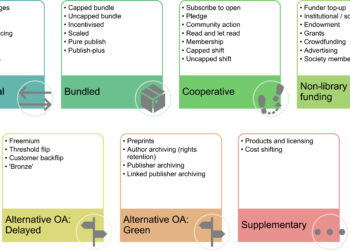
In January of 2024, Drexel University Libraries (DUL) began an open access initiative to increase the participation of Drexel-affiliated researchers in the open access (OA) publishing landscape. This initiative took the form of several transformative agreements with publishers. Transformative agreements are agreements in which access to subscription-based materials is bundled with payment of OA charges for affiliated authors.
Before DUL’s transformative agreements, we largely licensed content in traditional subscription formats either directly with publishers, content providers, or through deals negotiated by our consortia. Before our OA agreements, DUL researchers had the option to publish OA either through departmental, grant, or personal funding. The last 22 months of our transformative agreements have proven to be a success in both saving researchers money and in increasing the percentage of open access articles published by DUL researchers and students.
By publishing their work open access, researchers are making their work more visible, allowing anyone, anywhere to read their work and even expand on their research. Not only does this potentially increase downloads and citation counts of their work, but it allows for progress when it comes to innovation, education, and knowledge transfer.

Background on OA Agreements with Libraries
Although the specifics of much OA terminology remain a subject of debate, here we note that there are two main open access publishing models defined as such:
- Gold Open Access is open access research outputs that are facilitated by a publisher. The published version of a publication is immediately, permanently, and freely available for anyone with internet access to read or download from the publisher site at the point of publication. This type of open access can be publisher or author funded. If it is publisher funded, the work is made open access at no charge to the author or institution. However, if it is author funded, the author or institution will be required to pay an article processing charge for the article to be published open access.
- Green Open Access is a type of open access where a version of a publication is freely available via an institutional or subject repository, or other web-accessible digital archive. There is no cost associated with this option, but it is frequently not the final form of the work that can be submitted to a repository; it is often a preprint or accepted manuscript version.
In addition, journals offering Gold OA come in two different forms, those that are “Fully OA” (all articles in the journal are published OA) and “Hybrid OA”, where OA is optional and some articles remain available only through subscription access. In this model, individual researchers can decide whether to pay article processing charges (APCs) to make their article open.
Transformative agreements at DUL cover publishing in Hybrid OA journals in most cases, with a few exceptions that include Fully OA journals.
OA Agreements with DUL
Originally, DUL negotiated six open access agreements that began in January of 2024. All of these initial agreements included full APC waivers for articles published in qualifying hybrid journals, along with one other agreement that began in April. In November another agreement was signed that allowed open access publications in all journals (Fully OA and Hybrid) with a discount on article processing charges, not a full waiver.
Participation in the agreements was initially slow as outreach to different departments on campus was necessary to promote the opportunity, including letting researchers know that in order to take advantage of the agreements they had to be the corresponding author on the article. However, by the end of the year, over 200 articles were published OA by Drexel-affiliated authors under the terms of the agreements. The month with the most participation in the agreement was December 2024, when 34 articles were accepted under the terms of one of the DUL agreements.

When considering the cost of the agreements on the library budget versus the amount saved for the authors on APCs, we can see that Drexel University, as a whole, benefited by a savings of more than $700,000 (assuming an average APC of $3,000). This is a substantial savings for Drexel-affiliated researchers, especially with the recent shift of federal grant requirements to make connected articles publicly available immediately after publication. Another important note is that of these 200-plus articles, a significant percentage include co-authors who are Drexel students. By having the opportunity to publish OA early in their careers, students are able to demonstrate their ability to conduct research, publish, and collaborate with other researchers.
After the first year of the initiative, DUL evaluated the effectiveness and participation in the agreements. Participation was relatively high, and our cost savings were higher than we expected and higher than most other universities have reported. However, for the following year we decided to emphasize outreach and expand the agreements to include publishers that have a focus on the humanities and social sciences, as most of the participation in the first year was from STEM departments. Since this expansion and push for outreach, in the second year of the initiative, there has already been a larger level of participation in the agreements and greater savings for the university.

Transformative agreements are one of the best ways that academic libraries can support researchers and the public dissemination of knowledge, while also benefiting the university through cost-saving measures. DUL hopes to continue these efforts on our campus and expand the accessibility of open access publishing for all researchers.
Conclusion
As we look ahead to year three of these agreements, DUL is planning to expand our agreements, if possible, based on the library budget, while also expanding our relationships with other departments on campus to leverage potential cost-sharing for these transformative agreements. Based on our experiences, we would recommend providing outreach early and often about any current or future agreements, utilizing consortial agreements in order to get better deals with publishers, and to work directly with your university’s researchers to know where they publish the most and what agreements would be the best fit.

Discussion
2 Thoughts on "Guest Post – The First Year of an Open Access Initiative in Review"

Thank you so much for sharing this analysis of the impact of your transformative agreements. These kinds of evidence-based assessments are so useful for understanding the impact of these agreements and not just the cost.

Back in the day, 40-50 yrs ago, authors received off-prints from publishers for free distribution to requests on post cards. Today, free access is pre-paid by authors for open access. Paywalled articles require exorbitant fees. Some authors can forward free downloads, but most just refer to the publishers’ websites. We live in an age of monetizing. The days of serendipity in the stacks are over; now searches are focussed and limited. These circumstances contain pros and cons for readers that may now increase with the use of AI searches. Be aware of your environment and your online friends.