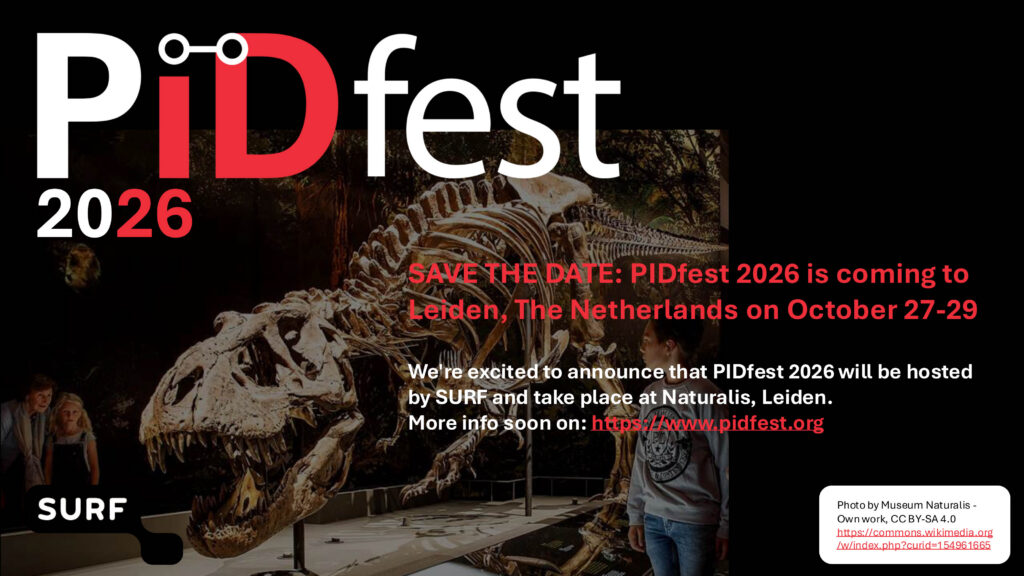
For all you persistent identifier and metadata enthusiasts out there – PIDfest is back, and you’re invited! Following a successful PIDfest 2024 in Prague, Czech Republic, this year’s edition will be hosted by SURF, and will take place in Leiden, The Netherlands, on October 27-29. The theme is Keeping Knowledge Connected – across people, systems, disciplines, borders, and time – and the Call for Proposals is open now through March 22. (Note, I am chairing the Communications and Outreach Committee.)
As many of you know, I am a big research infrastructure enthusiast. Persistent identifiers and their associated metadata continue to play a critical role in this infrastructure, by quietly underpinning modern research, linking people, data, publications, organizations, grants, and infrastructure. I’m especially happy that, in the past couple of years, there’s been increasing recognition of how, by enabling transparency – for example, in terms of provenance – open PIDs, in particular, could help address the research integrity challenges our community is facing, and ultimately improve trust in science and scholarship.
ORCID’s Trust Markers are a great example of how this transparency can help humans and machines alike evaluate the trustworthiness of the information in an ORCID record. In fact, STM’s 2025 report on Trusted Identity in Academic Publishing Part Two includes these two recommendations for pushing trust markers into ORCID:
- We recommend that publishers, funders and research institutes should proactively populate ORCID with verified attributes that they and other systems can trust.
- We recommend that ORCID members who have contributed trust markers should be able to demonstrate this, for example by showing publicly the percentage of articles that have been linked to the profile of the authors.
Crossref’s Participation Reports are another nice example of transparency in practice, again enabling both people and machines to easily see what metadata an individual publisher is contributing, based on 11 key metadata elements.
Of course, there are many other benefits to using PIDs and their metadata, from identification and attribution to discovery and interoperability – and more. Importantly, because they’re used by individuals and organizations across the entire search ecosystem — funders, institutions, libraries, publishers, service providers, and researchers themselves – PIDs are truly a community effort. This is reflected in one of PIDfest 2026’s three themes, Strengthening Community – energizing the global PID community that’s collaborating across disciplines, sectors, and regions. The other themes are Addressing Challenges: confronting barriers to PID adoption and sustainability; and Demonstrating Value: showcasing tangible and potential benefits of PIDs for all stakeholders.
Our overall goal is for PIDfest to help grow a broader, more diverse, more global PID community, involving everyone from first-timers who are just starting out to experienced infrastructure leaders. We want to bring together people from the communities who build, use, fund, govern, and depend on PIDs to share what’s working, what isn’t, and what we can learn together.
So we welcome proposals from all PID enthusiasts, wherever you are on your PID journey – and in a range of session formats, including short talks, panels, workshops, “birds of a feather” sessions, interactive presentations, lightning talks, and posters. We’re looking for proposals that focus on the practical as well as the theoretical applications of PIDs (real implementations, real lessons), that are community-focused (local, national, or regional; across different organization types, disciplines, and functions), and that reflect a mix of different voices and experiences. We especially welcome proposals from those whose views are often underrepresented at conferences like this.
More information about PIDfest will be available soon and I hope that, whether or not you submit a proposal, you’ll consider attending either in person or virtually. Because, while PIDs connect people, places, and things, PIDfest is where you can make your own PID connections
With thanks to Suze Kundu for some of the inspiration for this post.