Since the 1950s, there has been an obsession with space, coinciding with roughly the time that actually reaching space became a possibility. “The final frontier” has been tied to the glorious future of technology and wondrous opportunities just over the horizon. It has long provided a literary and cultural vehicle to create separate worlds to explore in new ways the problems we face at home. Space travel has also been a source of danger, of risk or conflict. Now that humans have returned to the moon’s vicinity for the first time in more than 50 years, it is an apt allegory for the state of scholarly publishing at our current moment. Using this framing, the new STM Trends 2030 was released yesterday at the STM US Annual Conference and it symbolizes a world both full of opportunities and hope, but also with dangers lying just below the surface.
These possibilities are the underpinnings of this year’s STM Trends, covering the next five years, through the end of 2030. Each year STM gathers representatives from across the community in London to discuss trends and technologies impacting scholarly publishing. Using a version of the Delphi method for soliciting ideas, the group captures ideas and then discusses their possible impacts. These ideas are then captured and synthesized into a visual representation.
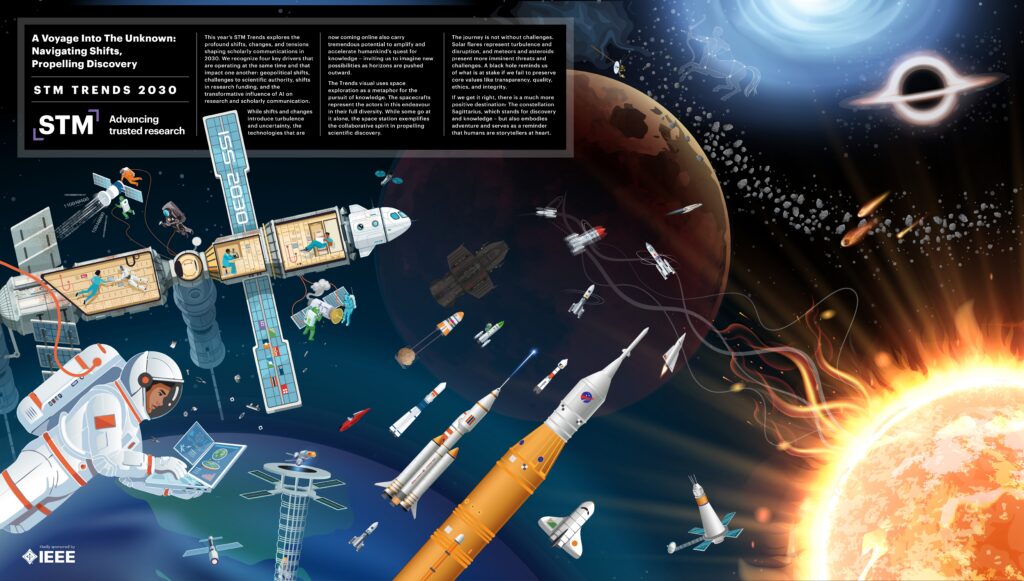
The theme of this year’s visual encapsulation of the trends is the rapid rush to space. In keeping with the excitement of the Artemis II launch to the moon earlier this month, the focus on human’s travel away from the planet very much captures “the moment” for the second half of the 2020s. As we move again outside the relative safe environs of our very confined space in the universe, there is a mix of possibility, energy and opportunity, but also risk, danger and the peril of unintended consequences.
The triumph of science and engineering is in full force, as captured in the visual, much as it was in reality earlier this month. Few things epitomize the glory of science in as much majesty as the world’s space programs. There was an explosion in science and education funding in the United States and other western democracies – and not coincidentally an explosion in scientific publishing – following the launch of Sputnik in the 1950s. Government investments in basic research spiked and propelled rapid advances in engineering, computer science, communications technology, and biomedicine.
Many of the technological tools we rely on in our daily lives were connected to these space programs, including geolocation, satellite communication, weather monitoring, and so many other modern wonders. Space science also connects to so much fundamental research that scholarly publishers communicate, not only the likes of AIP, SPIE, APS, or AGU, but so many more domains from agriculture, medicine, chemistry, and demography. It is a concrete embodiment of possibilities of science and the returns on the basic and applied research.
The momentum of the visualization is certainly “up and to the right” and it matches the optimism of the moment regarding communications and the new breed of artificial intelligence tools. One might read into the rush of spacecraft as representing the enthusiastic barreling into the ether of the plethora of tools and startups seeking to transform science and bring it into glorious fruition. This rush includes sizable, powerful organizations, as well as small and nimbler startups, all of creative shapes and approaches.
Yet, this thrill and opportunity are also tinged with threats and challenges.The International Space Station is featured prominently on the image and is emblazoned with the target year of the visualization is supposed to represent. This is also a poignant reminder that 2030 is the year that the ISS is scheduled to be decommissioned. The flags representing the scientific community that are involved in the ISS and research more broadly can also be read as an upcoming challenge for our community. The international collaboration of 15 countries and 5 space agencies that made the ISS possible for several decades has been a symbol of possibility and peaceful coexistence. Unfortunately, like the ISS itself today the international collaborations across many domains of science seem to be fracturing and at risk of crashing back violently to the ground. In this way, the ISS symbolizes the geopolitical uncertainty that adds to the challenges facing the research community and the scholarly publishing industry. Perhaps the symbolism of the success of the mission and the continued goals of space exploration as one race of humanity can be a positive guide moving into this future.
Unfortunately, the investments that have made these research programs a success are being cut back. Even the long-standing science and political partnerships that have made collaborative efforts like the ISS possible are being questioned and threatened. International collaborations are being challenged by increasing geopolitical tensions and diminishing levels of international trust. While everything has an eventual end, hopefully the research collaborations that are symbolized by the ISS will be replaced and reinvigorated. We can’t escape the fact that both the funding and the geopolitical landscapes are both rapidly changing in ways that will radically alter the scientific enterprise. Realistically, a significant shift will need to be made to change the direction of travel.
One could view the image as representing an exodus in search of more hospitable environments. Of course, to our present knowledge, that Eden only exists in one place we know of: the Earth, where presumably these ships are departing from. The seeming goal of the journeys is toward Sagittarius, the celestial archer shown in the top right of the image. Historically, this figure has symbolized the intellectual quest, targeting new technologies, and aiming high, acting as a bridge between instinct and higher intellect. The sign has embodied an insatiable curiosity that drives exploration and innovation and adds a sign of optimism to the image.
Into the void, there are myriad risks, from the incoming flaming asteroids, to the whisps of solar winds (or gravity), that is drawing some of the ships off course. One might view the red roadster being hurtled out into space among the ships as a subtle nod to the commercialization of the rush toward space and research more broadly. This is also signaled by the apparent space mining noted by one ship towing an asteroid, as if this were The Expanse. There is room in science for both nonprofit, government-supported, and commercial approaches. Finding the right balance between these three has never been easy and it seems these challenges are bound to become harder rather than easier between now and 2030.
Certainly, everything about this vision for the future need not be viewed through darkly-tinted glasses. Throughout the image we see researchers and engineers working together, or working with robots of all sorts. There are even robots working independently. The connection to AI systems is obvious and its implications about the seamlessness of the interactions are profound. There is every expectation that AI tools and the robotic agents that they represent will radically transform research and scholarly communications. We are advancing toward this future together, hopefully in harmony. All the people and humanoids are connected, tethered to each other as they move out into this new frontier together. There is even a nod to the outreach of Adam and the Hand of God between the robot and the human in the ISS cutaway. I’ll leave the question of who is whom in this metaphor for you all to ponder.

Discussion
4 Thoughts on "The Opportunities and Perils of Discovery: STM Releases its Trends 2030"

Thanks for writing this up Todd, my favorite STM session – thinking in visual metaphors – I am drawn to your section – One could view the image as representing an exodus in search of more hospitable environments. Of course, to our present knowledge, that Eden only exists in one place we know of: the Earth, where presumably these ships are departing from. The seeming goal of the journeys is toward Sagittarius, the celestial archer shown in the top right of the image. Historically, this figure has symbolized the intellectual quest, targeting new technologies, and aiming high, acting as a bridge between instinct and higher intellect. The sign has embodied an insatiable curiosity that drives exploration and innovation and adds a sign of optimism to the image.

Thanks Todd for writing this—very well framed. The analogy between space exploration and the scientific endeavour behind it is both stirring and highly relevant for scholarly publishing.
“Into the void, there are myriad risks—from incoming flaming asteroids to the wisps of solar winds (or gravity) that can draw ships off course.”
And yet, it is precisely in that void where new discoveries and learnings take shape. One hopes that through discussions like these, we gain the wisdom and courage to be like those explorers of the unknown—because it is only in venturing into that uncertainty that the possibility of touching new frontiers truly emerges.

This is very silly. We knew how to go to the Moon more than 50 years ago. This last exercise was not a voyage of discovery. It was a signal to the Chinese that we were not prepared to leave the Moon up to them. In my youth this type of thing was called the Dog in the Manger syndrome. It had nothing to do with the human need for discovery.

Thanks for writing this up, Todd. I look forward to seeing the STM Trends forecast and imagery every year! Always such a helpful way of conceptualizing this huge publishing ecosystem and placing it in the real world. Though I’m not super knowledgeable about it, I love space and what we can learn from exploring it, and also so much great space sci-fi! So I really LOVE this one. It does feel like there are many parallels right now: a time of opportunity but also of risk, as you said. Your comments about how the previous space craze increased investment and excitement around research in general was encouraging. I hope we see the same thing happening sooner than later. And I hope too that we can find ways to rebuild the declining trust between nations and organizations and people — we will need that if we are going to make progress that benefits everyone to address the many challenges the world faces now.