Editors’ note: Today’s guest post is by Shaun Khoo and Mahesh Miikael Karnani. Shaun is a neuroscientist and project manager at UNSW Sydney, and Mahesh is a neuroscientist and group leader at the University of Edinburgh. Reviewer credits to Chef Rick Anderson.
In mid-April, Jonny Coates argued that “the preprint movement sits on a precipice” and, while it “has not failed yet, it is definitely unhealthy.” A key risk, according to Coates (and Richard Poynder before him), is that preprints have been co-opted by commercial legacy publishers. While you might expect us, as two volunteer board members at a non-profit preprint review platform (Peer Community In Neuroscience), to agree wholeheartedly with Coates, we suggest that the involvement of commercial publishers is not unequivocally bad and that preprints provide some room for optimism about open access as a whole.

Not-All-For Profit
Preprints started in the non-profit space and, as Coates notes, some of the most well-known preprint servers are non-profit (Figure 1). But does the growth of commercial publishers into the preprint space really threaten the preprint movement, and if so, how much? Even though Elsevier bought SSRN back in 2016, it remains free to post a preprint and free to read. So even though SSRN is now operated by what is perhaps the most demonized of commercial publishers, it still fulfills the essential function of a preprint repository and hosts over 1.8 million preprints without any author or reader fees.
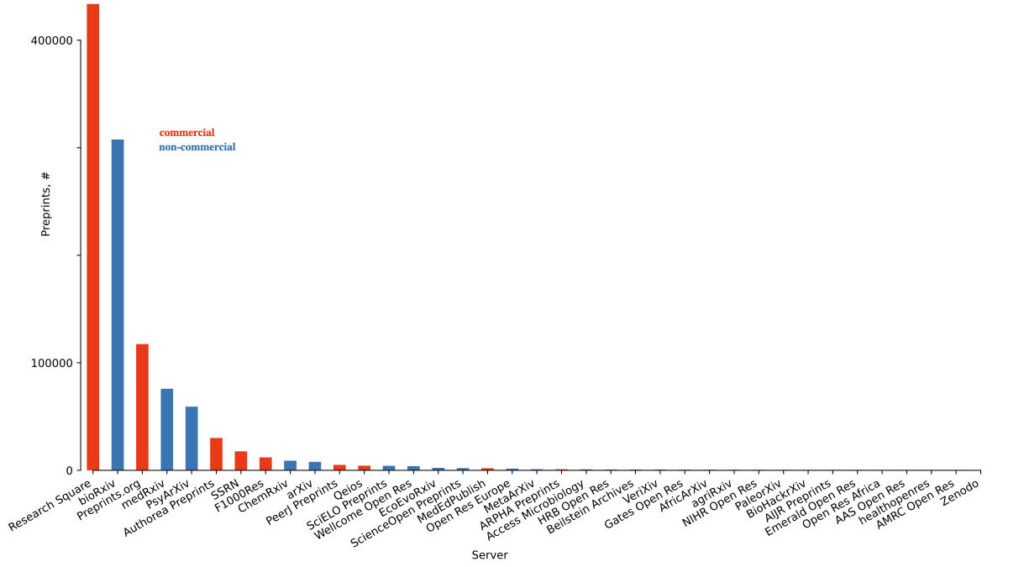
Dataset PreprintAbstractsXML_202604.zip 2026-04-26 18:51 containing all ~1.1M preprints indexed on EuropePMC from 2012, was downloaded from https://europepmc.org/pub/databases/pmc/preprint_abstracts/.
If the entrance of commercial publishers was significantly harming non-profit preprint servers, we might also expect them to attract fewer preprints. However, this does not appear to be the case. If we look at some of the most well-known preprint servers, like arXiv, bioRxiv, and OSF Preprints, we see that only OSF Preprints has experienced a noticeable decline from a peak of 21,844 to 7,353 preprints in 2025. In contrast, arXiv has experienced uninterrupted growth from 2017 to 2025, averaging 13% p.a., while bioRxiv has averaged 23% growth, from 11,347 preprints in 2017 to nearly 50,000 preprints in 2025 (data source: Dimensions). This suggests that rather than damaging preprints, the entrance of commercial publishers may have simply widened or accelerated their adoption.
Intrinsic Interoperability
A key reason why involving commercial publishers is not as major a problem for preprints as it might be for journal publishing is that preprints are intrinsically interoperable. In journal publishing, part of the publisher’s pricing power is because papers in a subscription journal cannot easily be read elsewhere and derive their career benefits (funding, promotions) from their association with that journal (whether toll or open access). However, for preprints, this is less true since where a researcher preprints is not explicitly associated with any career incentives.
This has not stopped publishers apparently trying, of course. Research Square, for example, shows where a preprint is currently under review. For some, this may attract prestige value as they can verifiably claim that their paper is under review by a journal of a particular reputation. This is not surprising, given what we already know about academic publications as Veblen goods. However, posting to a non-profit server like bioRxiv, the largest preprint server in life sciences, is also motivated by impact and credit or staking a claim. The value of prestige and impact also varies between disciplines since, in physics, the community has been the driving force behind preprinting.
Preprint servers can also vary in the degree of ease with which they connect to others. A commercial publisher’s preprint server might offer seamless submission to their own journals, or perhaps preprinting a submitted paper is as simple as checking a box during journal submission. An easy submission process might support a publisher’s pipeline, but it does not prevent the authors from submitting their preprint for peer review and publication elsewhere. Authors may have to fill in some more forms, but they retain the right to do so, and importantly, readers can always download the preprint no matter where it is published.
Safeguarding interoperability is critical. While mandates on researchers’ preprinting behavior may not be necessary or effective, funders, institutions and advocates should carefully monitor preprint services for signs of weakening interoperability. Any review service or journal should have equal opportunity to integrate with any preprint server to ensure preprints are serving their fundamental purpose.
Preprints Help Point the Way Forward
The preprint movement, as with open access, was never and will never be perfect, and Coates is right to call out problems like decreased breadth of advocacy, poor governance, or missed opportunities to build in equity. Like many social or cultural movements and new initiatives, the preprint movement can be dominated by ideological radicals who may not understand the various economic factors, incentives, and experiences of other people. It is also encountering new challenges, like the rise of AI slop that undermines the credibility of preprint servers and wastes the time of moderators. How well these challenges are addressed by each discipline’s preprint servers of choice will influence the evolution of preprinting culture.
However, this becomes another point where the diversity of non-profit groups and involvement of commercial publishers actually supports, rather than undermines, preprints and the open access principles they uphold. If one preprint service begins to fail, loses funding, or is torn apart by ideological in-fighting, there are multiple other services — both non-profit and for-profit — that authors can use as substitutes. As a whole, this makes the preprinting ecosystem more resilient, not less, and ensures that researchers will continue to be able to make their work openly accessible before inclusion in a journal.
The success of preprints shows that open access principles can survive adoption and co-option by commercial publishers. If an open access practice is sufficiently well-designed, it can support the goals of open access — such as accessibility, affordability, and equity — no matter whether it is operated by a non-profit scholarly community or a global corporation. In the case of preprints, commercial publishers have driven mass adoption, and their entrance has not slowed the non-profits who remain in positions of market leadership. Therefore, preprints show that open access practices do not have to fail. Instead, our systems of scholarly communication are constantly (albeit slowly) changing, and sometimes it is possible to make them better.
Discussion
20 Thoughts on "Guest Post — What Does Commercial Adoption Mean for the Preprint Movement?"

If BioRxiv (CSHL & CSHL Press) and MedRxiv (CSHL & BMJ Group) are non-commercial, why is ChemRxiv (ACS/RSC/GDCh/CCS/CSJ) commercial?

Aren’t the entities behind ChemRxiv also non-profits? Also, anyone can use the word “arxiv”, it’s not like it’s specially reserved for non-commercial purposes.
Also worth noting that bio and medRxiv have both spun out of CSHL Press and are now an independent non-profit, openRxiv.

Apologies if I’ve misclassified it, but see https://www.chemistryviews.org/chemrxiv-joins-wileys-research-exchange-preprints-platform/. Perhaps ChemRxiv is currently moving into more of a commercial setting? If anyone has further insight, please comment.
I believe that’s just an announcement that chemRxiv has chosen Wiley as their vendor providing a hosting platform, not any indication of a change in its non-profit status. For comparison, bio/medRxiv both employ HighWire for hosting, also a commercial, for-profit company.
Thanks for these comments – we’ve now fixed the figure.

Thank you Shaun and Mahesh! A thing to note regarding the sheer volume of preprinting happening via Research Square is that it’s differently motivated compared to other dominant preprint servers. Research Square is built into the submission process of a lot of Springer Nature journals via their In Review program. Currently the lists is about 1,500 journals if updated. In Review prompts authors while submitting to those journals to optionally let the In Review option deposit the non-peer-reviewed manuscript into Research Square on behalf of the authors: https://www.springernature.com/gp/authors/campaigns/in-review
Some proportion of this volume of authors may not be authors who would have else proactively gone out of their way to preprint. They just check a box when they submit to those Springer Nature journal. To me, it’s a differently motivated preprint for some proportion of those Research Square authors, maybe a matter of why-not convenience.
Yes, the convenience and the prestige signals are likely drivers there. On one hand it’s great that this improves adoption of preprinting, but on the other hand this may not be the type of preprinting culture that would be ideal for improving the science. If RS preprints are indeed not posted primarily because of the ‘canonical’ reasons https://www.cos.io/blog/preprints-what-why-how, this mode achieves the rapid sharing aspect but doesn’t fully leverage development by community feedback/commenting. Perhaps moving people who preprint on RS for non-canonical reasons to consider the canonical reasoning (ugh, starting to really dislike the terminology I went with here…) on their next preprint, is where an overarching community strategy could help, linking back to Jonny’s guest post.

“Even though Elsevier bought SSRN back in 2016…” might lead readers to think it was non-commercial before that. Certainly that was the perception of many at the time. Yet, it was a for-profit company all along.

Thanks Lisa, and sorry for any confusion.
A lot of common perceptions around for-profit and non-profits get quite blurry in this space – we have for-profits providing free preprint servers and non-profit societies using journals as a revenue stream. However even though SSRN was always for-profit, I think many people would expect Elsevier to ramp up extraction or value capture, but this doesn’t seem to be the case, at least not directly. Does this mean Elsevier is not an ‘evil corporation’ or that preprinting as a practice is well designed enough to avoid the pitfalls other open access practices have fallen into?

Thanks for this. The fixation some have between commercial (which is deemed “bad”), and non-commercial (which is automagically “good”), does an immense disservice to scientific advancement. Whether an organization pays taxes on its profits is way less important than what it does in the world.
The bigger issues for preprint servers are that they can (have?) become repositories of AI slop and pseudoscience. In the later case, people use preprints to promote flawed theories which will not pass peer review. AI is trained on these servers, further perpetuation the misinformation. But I digress…
Thanks Roy. We have definitely seen our fair share of AI slop submissions at PCI Neuro. It’s a shame that it is increasing moderation and storage costs for preprint servers, wasting time and eroding trust. I don’t have great solutions here but review and curation (via platform or journal) can probably help, at least for academics who know how to evaluate information.

I definitely agree that the for-profit v non-profit is not that productive. For me values matter much more so, particularly when looking at organisations involved in trying to instigate some form of change.
I’d push back on that second statement though. There’s plenty of examples of flawed theories and LLM generated content that has passed peer review – arguably much worse than a preprint with these issues as peer review is used as a stamp of approval.

“I don’t have great solutions here but review and curation (via platform or journal) can probably help, at least for academics who know how to evaluate information.”
Even though I’d applaud the curation model to finally arrive, the argument is not sound: it is precisely academics who know how to evaluate information who do not really need journals or platforms but can read from an archive.
Given the ever-steepening peer review crisis, journals, APC-models, and prestige games are increasingly in trouble in any case. Once hiring committees are onboard, which they tend to somewhat already be, archives are all we need. But as for the curation, it could also be something else than peer review; e.g., a dedicated editor-like team could lift archived manuscript worth reading in particular. There might also be new commercial opportunities with such curation.
I think for me the biggest concern with who owns the server comes down to behaviours and what the bigger aim is. Are we trying to make things open access? Because Sci-hub was more successful at that than anything else has been. Are we trying to promote earlier sharing? Then it doesn’t matter who runs the server, most preprints are posted at the time of submission (or possibly after). Are we trying to change the current system? This is where things really become important. For example, Research Square is great at getting authors to post a preprint – in no small part due to the tick box during submission to Springer-Nature journals. However, RS does not have links to reviews by independent services. It does not include additional tools or accessibility options. In contrast, bioRxiv/medRxiv both provide additional context to help readers, new experiments to add additional functionality and actively advocate for preprints and change to the system, alongside better reform of academic assessment. To me this is enormously important.
In fact, the advocacy is the single most important aspect to changing behaviours. Yes people preprint to RS who may not otherwise but they’re not making a properly informed choice. They’re doing it because it’s an easy step. If we want lasting change, better behaviours and culture then we need that advocacy element
This! These are all positive directions, but advocacy will be more effective if it is coordinated to point in one of them, as you’ve suggested. And perhaps also targeted to authors who are already dipping a toe in culture change.
Yes, this modern invention of peer-review might not be always the best solution given how long it takes and how little tends to change as a result (see, e.g., https://doi.org/10.1371/journal.pbio.3001285), yet it certainly can help. What else is there? Lots of possibilities, e.g., the strong ideas compiled here https://ripplingideas.org/focus-areas/trust-in-research/trust-indicators/
Indeed some good ideas in the post you linked, Mahesh.
But, increasingly, I am advocating for total openness; authors, reviewers, endorsers, editors, and whoever is involved all put their reviews, endorsements, curations, or whatever openly online with traceable ORCID records.
As an anecdote: sometimes I read so good manuscripts from arXiv that I would have no problems putting my ORCID record as a stamp of approval (so, cf., publish this piece without peer review because it is solid already). Of course, today, I have to review also a lot of terrible garbage, including AI slop, but that is largely due to the traditional journal/conference model.
For curation, you could augment such ORCID-backed endorsements with slight editorial reviews or commentary; it would also help with the popularization of science.
I think total openness is great as transparency, if nothing else, allows us to check and hold the system/people to account. However, the system also needs consequences for poor behaviours and appropriate incentives for good ones.
My approach to trust signals (https://katinamagazine.org/content/article/open-knowledge/2026/system-for-measuring-trust-failing-better-way) is an example of trying to design a system that would be a step more in the right direction. I find too many solutions lack a focus on the reader, when what we need is a bunch of different efforts that align for different groups.
The curation idea you suggest is similar to what William Whewell said of review reports – “[reviewer reports may] often [be] more interesting than the memoirs themselves and thus a great source of publicity for science” (https://www.themodernpeer.com/a-potted-history-of-peer-review-part-1/).

Hi
Thanks for this post and the comments. I agree that for-profit versus non profit may not be the best factor to take into account. We know many non profit publishers that have questionable practices such as APCs = increasing function of IFs, and we also know some for profit publishers (eg Copernicus) that have very ethical practices.
You don’t include institutional repositories as possible hosts for preprints. Why is it so? An example is HAL in France (https://hal.science/). It is institutional (CNRS, INRIA, INRAE) and it is the main repo for preprints in France. There are also many repositories managed by university libraries that make a great job worldwide (cf COAR, https://coar-repositories.org/). They can become, and some of them already are, major actors of the preprinting ecosystem, they are at the forefront of interoperability (cf COAR Notify protocol, https://coar-repositories.org/tools-and-resources/notify/) and they benefit from an advantageous sustainability, as soon as large institutional research bodies are sustainable.
Good point – I think institutional repositories can be very important if they are interoperable from both an author (individuals outside the institution can submit) and discourse ecosystem perspective. However, the volumes of preprints on institutional repositories appears low or poorly documented, and potentially overlapping with the repositories discussed above https://asapbio.org/delving-deeper-into-preprints-in-institutional-and-generalist-repositories/. Another practical reason we didn’t include them is that there are several thousand of them, but data wasn’t readily available, e.g. not indexed on EuropePMC, where we got the dataset for Figure 1 from. To give some orientation to the volumes, the ASAPbio post from 2022 listed a mean of ~700 preprints/institutional repository, in a range of ~0-8000, and querying e.g., HAL today returned ~3000 preprints, of which ~1000 are in the life sciences, so would have appeared around the middle of our plot in Figure 1 were it indexed by EuropePMC.