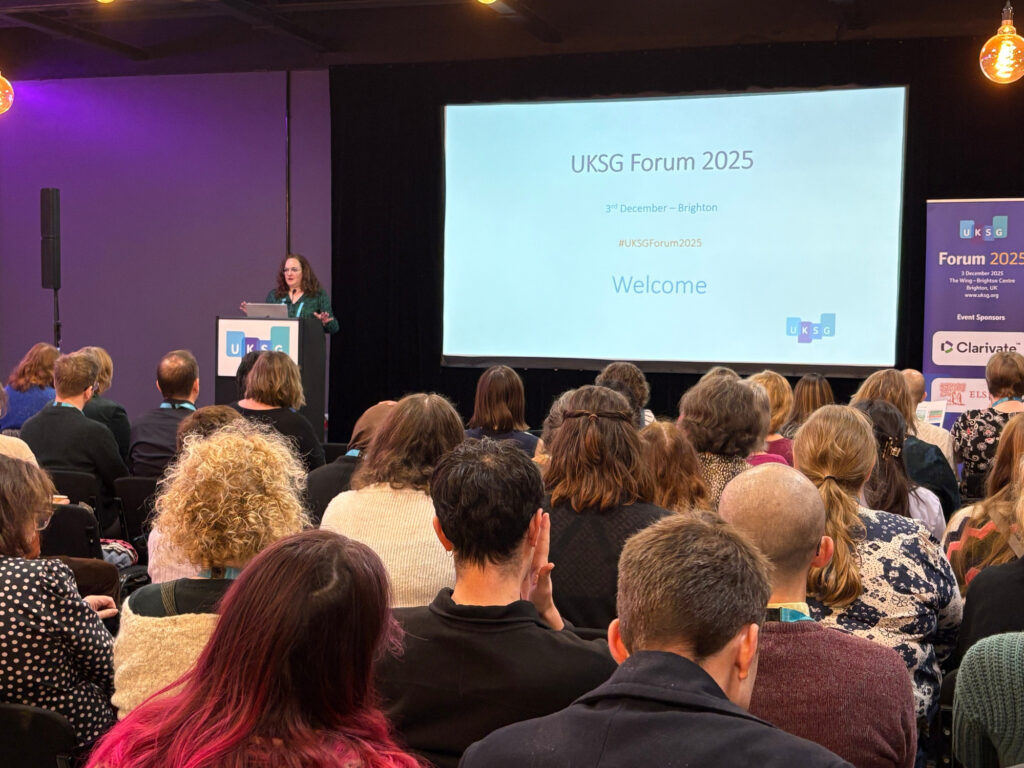
The UKSG Forum is a late Fall in-person event combining a table-top exhibition and a series of 20 minute talks, with a particular focus on first-time speakers and to some extent, a focus more on day-to-day realities than horizon gazing. It is like an entire 2-3 day conference stripped back to bare essentials and completed in just one day. It’s breathtakingly intense but also a very efficient and energizing way to get fresh knowledge and ideas about the latest challenges in our sector. It’s free for people from UKSG member organizations to attend. For all these reasons, it attracts a different, more diverse audience than other events. Here’s a snapshot of the themes emerging from this year’s event, held in Brighton, UK on December 3rd, which I chaired in my capacity as Chair of UKSG.
The Messy Middle
If there’s one phrase that captured the spirit of this year’s UKSG Forum, it was Mark Hughes (Head of Libraries at Cardiff Metropolitan University) positing that “we’re right in the middle of the messy middle.” The messy middle is where librarians such as Steph Gibson at the University of Suffolk feel they are when they have to balance the expectations of users (bottom up) with the rationalizing of university administrators (top down); it’s where Dublin City University’s library was when in the middle of merging four institutional collections, they found a fifth merger taking place and another collection being added to the project; it’s where the team at UWTSD Birmingham sit, bridging the gap between a disadvantaged community and their right to tertiary education; it’s where the Open Research team at Lancaster University Library finds itself, as budgets are reduced and academic workloads are increased; it’s where Liesl Rowe, copyright clearance librarian at Leeds Beckett University is, managing the needs of academics undertaking systematic reviews and requesting 300 articles by ILL (more than the entire university’s annual ILL allowance). But “the messy middle” wasn’t the only unifying theme of a diverse program.
Changing priorities: from global to local?
I wouldn’t have expected this, but “local” was a word that echoed throughout the day. Godwyns Onwuchekwa (Global Tapestry Consulting) talked about the importance of local community involvement in research — whether in terms of co-creating studies, adding context to data, improving engagement to maximize the influence of research.
“Without context, data is superficial, incorrect, even harmful … Data can tell us what is happening; communities tell us why.”
Elsewhere, we saw how local context shapes collections, systems, and services. Marie Hitchcock and Ellen Brown from the University for the Creative Arts described setting up the archive for the renowned designer Zandra Rhodes, and her passion for ensuring the collection should benefit the Medway region where she grew up. They described the impact of this “local community first” thinking, on everything from the branding through the physical experience of visiting the archive, to the website UX “needing to feel like online shopping at Tesco” rather than an academic environment.
Olivia Edmonds and Taran Johal at the University of Wales Trinity St Davids in Birmingham support their local community in getting back into education and employment. Their Institute of Inner-City Learning covers everything from digital literacy (helping someone use a laptop for the first time when they’ve only ever been online via a phone) to AI literacy (it’s “not about making people experts — it’s about making people aware; a little bit of foundation knowledge can be the difference between getting an interview and not, or having a successful interview and not.”)
In recent years, so much of the discourse in scholarly communication, and the direction of our thinking, has been about globalization — whether in terms of improving equity through better recognition of and support for researchers in the global South, or attempts to bring about global consistency in licensing models, funder policies, publishing infrastructure, and so on. On the other hand, hindsight is beginning to show that in the wider world (since the economic crisis of 2008, perhaps), there has been a growing geopolitical, societal shift away from the global, and towards local identity, autonomy and priorities. Whether coincidence or correlation, I think it’s worth noting this theme having been apparent at the UKSG Forum — the event’s focus on grass-roots realities makes it a bellwether for changes that may be become more widespread.
It’s getting harder to keep up and to keep order
Speakers talked a lot about “keeping up” and “keeping order”. There is so much to learn from the deep-dive insights shared at an event like this; it’s one of the things that makes UKSG a particularly useful collective, because for publishers to really understand and meet the needs of libraries, it’s helpful to get a really rounded, visceral feel for the day-to-day reality such as that experienced by Amanda Halpin (Dublin City University Library) and Claire Mason (ex-DCU, now Maynooth University Library) when they were tasked with merging the collections of four institutions (and a fifth added while the project was underway). They needed the mother of all spreadsheets and two enormous dumpster bins to get 3 miles’ worth of collections under control. The two particularly thought-provoking things about that were (a) not one of the library systems they licensed between them were accurate enough, granular enough, or structured in a useful enough way, to support this job — they had to go right back to basics with the old spreadsheet and (b) they had to ‘disguise’ the dumpsters (no library labeling — just the nicknames Brenda and Oscar) for fear of attracting negative attention on social media (they were mindful of negative news stories about dumpsters outside libraries).
They needed the mother of all spreadsheets and two enormous dumpster bins to get 3 miles’ worth of collections under control.
Another perspective on what it takes to keep up / keep order came from Kira Hopkins of Copim Open Book Futures. She asked how we expect users to find their way around all the open resources available to them when she attempted to consolidate multiple information hubs and ended up with a 35+ page scoping document for a “guide to the guides”. Metadata surfaced repeatedly as another foundation that cannot be neglected. Caroline Marwein and Matt Pentlow’s analysis of House of Commons Library collections showed how gaps in metadata translate directly into gaps in representation. Better metadata means better insight, leading to better decisions. It also underpins AI development: as Mark Hughes noted in his closing keynote, “garbage in, garbage out” becomes more acute in AI-enabled systems.
Yet “keeping up” is not only about systems — it is about institutional reality. Steph Gibson of the University of Suffolk reminded us, with humor, that many libraries are operating with shrinking budgets, reduced space, and fewer staff, while facing expanding expectations. Larger institutions are experiencing the “shoestring conditions” smaller institutions have long navigated. The shared sense was not panic but pragmatism.
A matter of trust
Many of the conversations came back to trust — in ourselves, in each other, in our shared values, in the data. I smiled at Steph Gibson describing collection weeding decisions as being based on “usage data and vibes”, but felt compelled to comment in my closing remarks that we underestimate “vibes” at our peril. “Vibes” is short-hand for “professional expertise” and we must value and trust the knowledge we have built up, particularly as we face the AI wave.
We must remember to trust and value our instincts and experience.
Similarly Jenny McHugh of Lancaster University talked about trying to rescue and rebuild engagement with their RDM training program post-COVID; she shared her clear and effective four-step strategy but caveated self-deprecatingly “it wasn’t this systematic at the time”. Well, perhaps not in the sense of having been a clearly documented step-by-step program from the outset, but again, her ‘un-systematic’ program worked because of her experience and expertise. We must remember to trust and value our instincts and experience. Ellen Hartman from OCLC’s point about social interoperability — the practical importance of building trusted relationships with different parts of our institutions — positions trust as infrastructure; the oil within the cogs within the machine.
Nowhere was this more effectively illustrated than when Liesl Rowe from Leeds Beckett University gave her brilliant film noir-themed presentation, They Asked for Everything: The Case of the Systematic Review that Swallowed the Library (Liesl’s slides, along with those of most of the speakers, can be viewed via the Forum website).

Liesl explained that she is seeing the systematic review becoming more prevalent, an interesting observation in and of itself (why is this? why are more researchers doing systematic reviews? Because they can’t get funding to do original research? Because they need to find something to publish? Because they see gaps in the literature? Because there is more literature needing to be synthesized? Because there is a more rigorous approach to doing your background research? or..?). On a practical level for librarians, more systematic reviews means they are being deluged with 200 to 300 ILL requests from a single author — too much for one team, or one budget, to handle — but worse, a use case specifically not allowed by standard ILL copyright rules. Liesl described how she worked with the Copyright Licensing Agency to change the rules. Only when you have trusted relationships can you push through a change of that magnitude as quickly as she did.
Well, of course AI came up
Mark Hughes’ closing keynote had a strong blueprint for what good adoption of AI in higher education looks like (see slides).
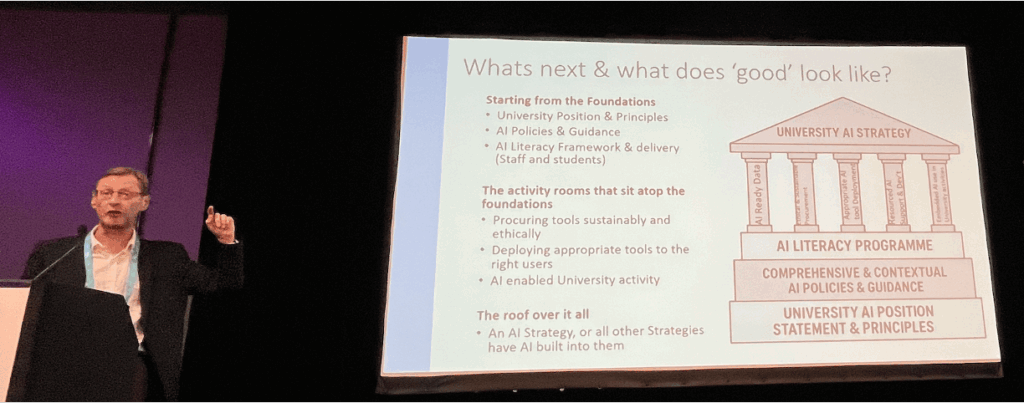
The foundations are:
- Position: a clear, visible and central articulation of your position and principles around AI usage
- Governance: comprehensive and contextual AI policies and guidance — properly promoted, updated and enforced
- Literacy: training people on how to use AI tools safely and well.
The pillars are:
- Clean, AI-ready data
- Ethical and stable AI procurement
- Understanding and meeting the needs of different communities
- Professionalizing the use of AI “from being a toy into something that is an indispensable tool”
- Understanding which processes need to be reshaped — and only embedding AI where it is appropriate and actually provides benefits.
The roof over it all is a strategy — “the how bit”.
“How we apply our institutional and professional values [to AI deployment] sends an important message out to the wider world. Tools do not define our ethics; our ethics must define our tools.”
Being right in the middle of the messy middle is a good thing — it means we are in the right place at the right time to make a difference. We may be bouncing around in the turbulence, trying to work out how to use AI well, right now, and avoid potential harms, but “like the internet, like the combustion engine” we will smooth the rougher edges away until AI is “ambient infrastructure”.
The continued importance of human relationships
The discussions today underline that we cannot navigate the messy middle alone. In a sector where the pace of change is unrelenting, we need to listen to each other, learn from each other, and — crucially — trust each other. The scholarly information ecosystem is a complex web; UKSG is one of the few places where the full ecosystem gathers as equals to make sense of it together. While the landscape will keep shifting, the relationships we build at events like this — local, professional, cross-sector, but most importantly, human — are what will carry us through.

Discussion
4 Thoughts on "In the Messy Middle: Observations from the Front Line at the UKSG Forum"

Great summary of a great event Charlie, thank you. I had the same impression of organisations and individuals struggling to ‘keep up’ and ‘keep order’, but also that relationships, networks and collaborations were what people are relying on to get them through through these challenges.

Thanks, Rob. I enjoyed your write-up of the same event, which I link to as it’s also a good read for anyone interested in seeing a different perspective on the themes that emerged! I loved this point: “Speaker after speaker described shrinking budgets, reduced teams, and constrained spaces. But what emerged wasn’t despair but rather creativity, collaboration, and community.” Absolutely.

Charlie
Many thanks indeed for posting this terrific meeting report – particularly worthwhile as it reflects the experiences of an important part of the western university sector (in the main teaching-led institutions, to use the current UK jargon, without significant STEM research bases) not often articulated on the Kitchen. And the point about ‘local’ and ‘global’ is very well taken: NB that in their origins several of these institutions were prior to 1992 Polytechnics on the old British model, with direct and specific governance links to their immediate localities.
Thanks, Richard! Yes, very good point about the nuances of different types / periods of institution and their differing focus, thanks for emphasising / explaining that.