Research integrity is fundamental to trust in the scholarly record, but the systems that protect it are under growing pressure. Long-standing challenges such as fraud, manipulation, and problematic research practices now intersect with rising submission volumes, evolving incentives, and rapidly advancing artificial intelligence. These pressures affect different parts of the scholarly communications ecosystem in different ways, raising important questions about where risks are emerging, how effectively they can be detected, and whether current policies, practices, and resources are keeping pace.
The September 2026 Pulse Check Poll explored how organizations across the scholarly publishing ecosystem are responding to today’s research integrity challenges. The findings provide a timely snapshot of current priorities, community confidence, and underlying causes.
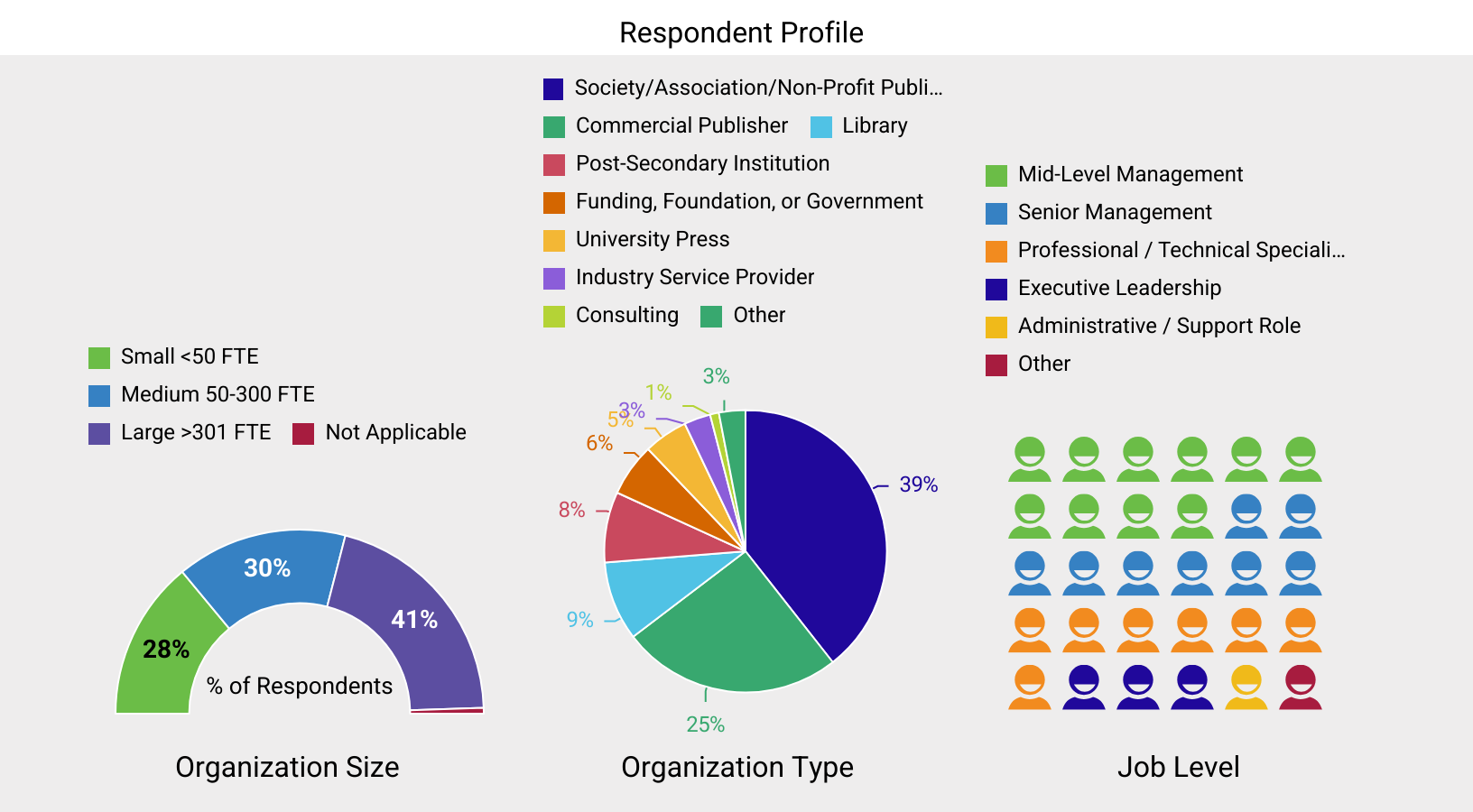
This Pulse Check Poll was distributed to members of the Society for Scholarly Publishing, readers of The Scholarly Kitchen, and other professionals in the scholarly communications community. There were 181 respondents from a variety of organization types, sizes, and job levels.
This post provides high-level aggregate results; the full report, available at no cost on SSP’s website (log-in or account creation required), provides additional detail and the ability to filter the data by organization size, type, and job level of respondents.
Key Takeaways
- AI-generated or manipulated manuscripts are the leading challenge, and concern is outpacing detection confidence. Nearly half are slightly or not at all confident in detecting AI-generated manuscripts.
- Despite 94% implementing at least one integrity measure, 63% have little confidence that the ecosystem is effectively protecting the scholarly record.
- AI is both a challenge and a tool. More than half use AI-assisted screening, yet the community remains divided over whether AI is improving integrity detection and prevention.
- Where organizations sit in the ecosystem shapes what they see. Publishers emphasize publication-workflow threats, while funders, institutions, and libraries place relatively greater emphasis on research practices and systemic challenges.
- Publish-or-perish incentives rank as the leading root cause, with respondents emphasizing how incentives, AI, submission volumes, fraud, and resource constraints reinforce one another.
Challenges of Greatest Concern
Respondents demonstrated a clear concentration of concern around AI and large-scale threats to the integrity of published research. Nearly three-quarters of respondents (73%) identified AI-generated or AI-manipulated manuscripts as one of their top three concerns, making it the dominant issue by a substantial margin. Paper mills (44%) and false references or AI-generated hallucinations (41%) formed a second tier of concern, with each selected by more than four in ten respondents.
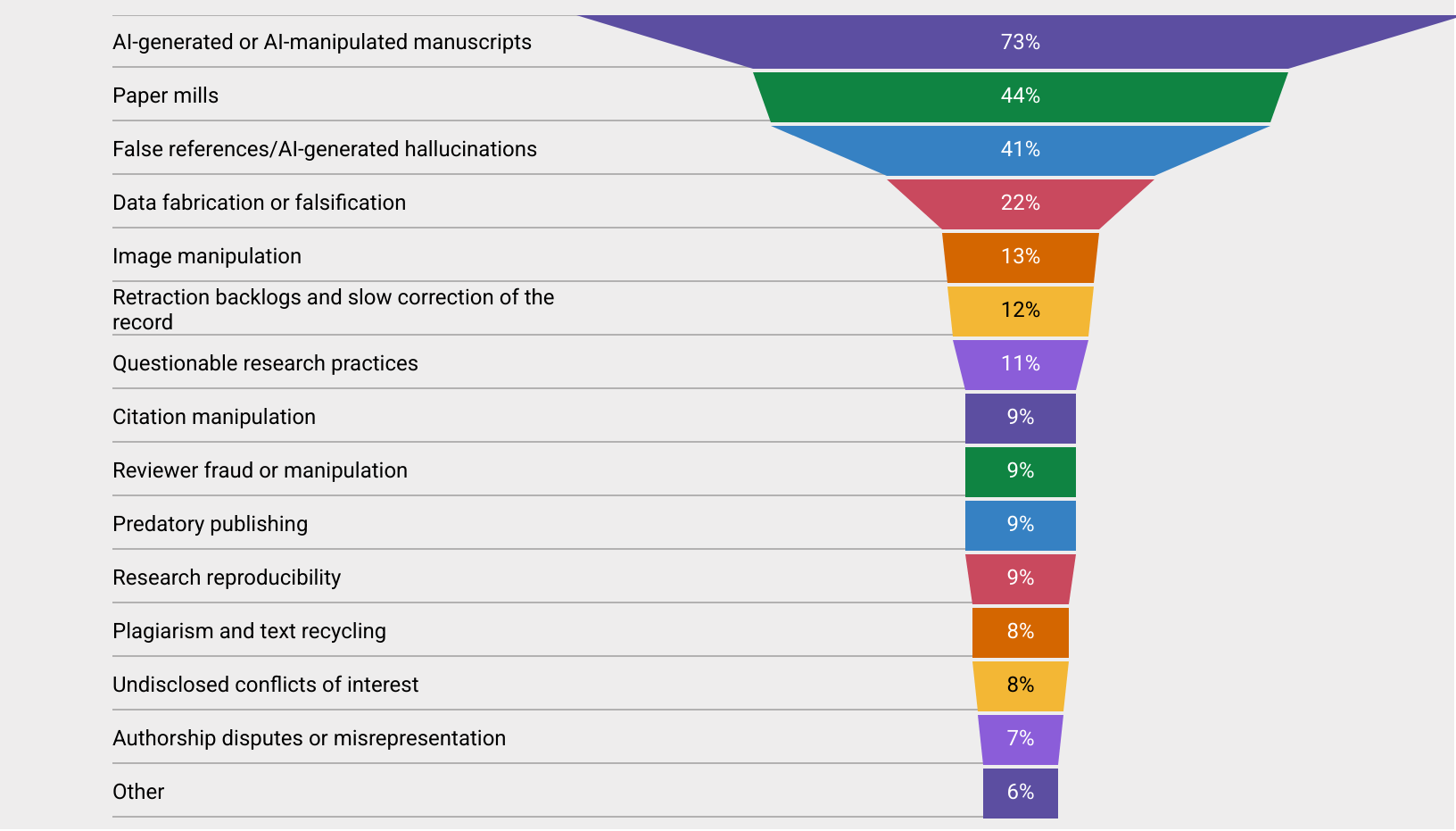
Beyond these leading issues, concern was considerably more dispersed. Data fabrication or falsification (22%) was the only other challenge selected by more than one in five respondents. Image manipulation (13%), retraction backlogs and slow correction of the scholarly record (12%), and questionable research practices (11%) followed, while each remaining issue was selected by fewer than 10% of respondents.
Detection Confidence
The results suggest generally modest confidence in organizations’ ability to detect research integrity problems before publication, with substantial variation depending on the type of issue. Confidence was highest for plagiarism and text recycling, with 59% of respondents very or extremely confident in their organization’s ability to identify these issues.
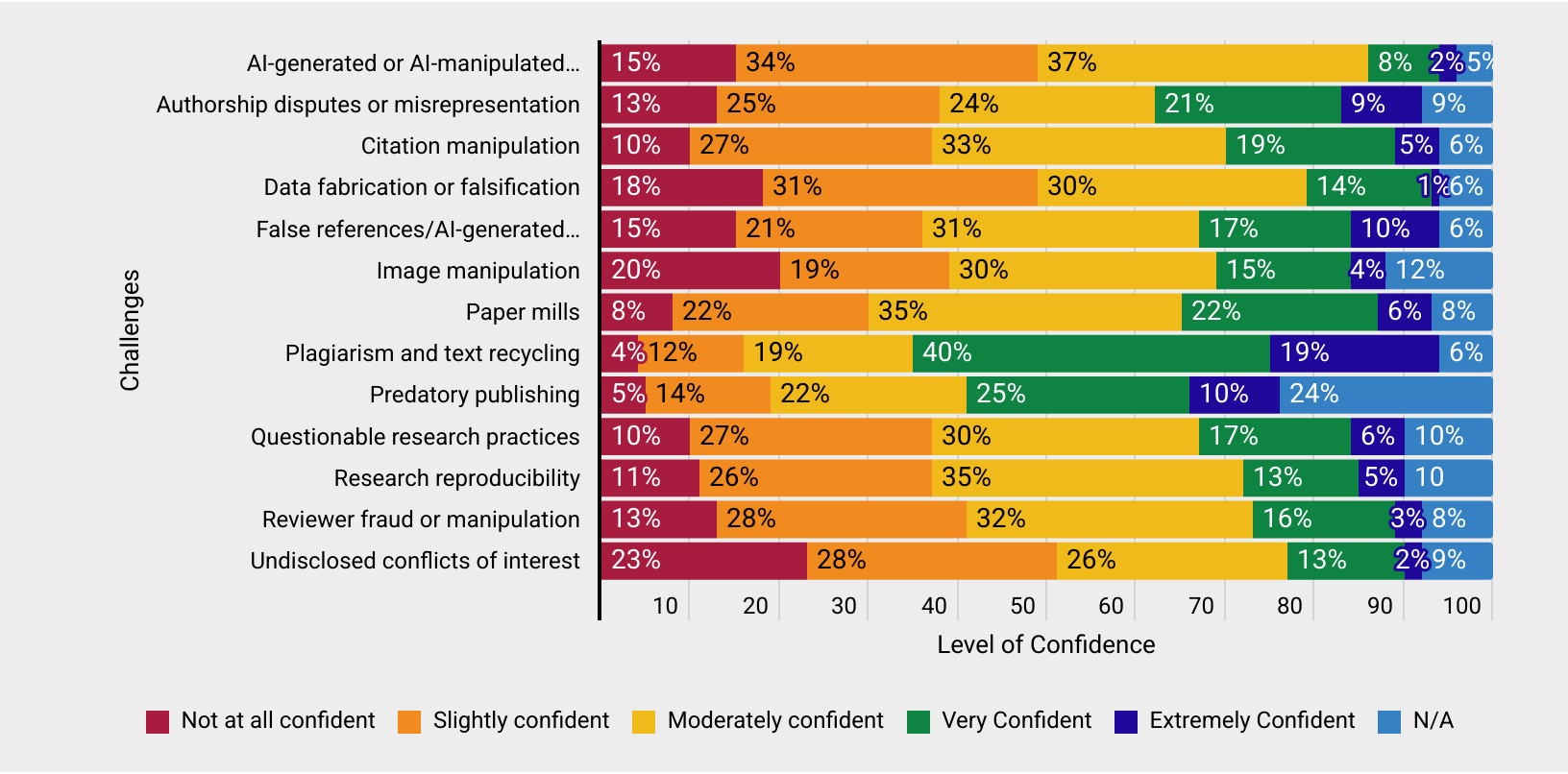
In contrast, roughly half reported being slightly or not at all confident in detecting undisclosed conflicts of interest (51%), data fabrication or falsification (49%), and AI-generated or AI-manipulated manuscripts (49%). AI-generated or manipulated manuscripts were the community’s leading concern (73%), yet only 10% are very or extremely confident in their ability to detect them before publication.
Paper mills showed a more mixed picture, with 28% very or extremely confident and 30% slightly or not at all confident. Confidence was notably lower for several complex or difficult-to-verify integrity problems. Undisclosed conflicts of interest generated the lowest confidence, with 51% slightly or not at all confident and only 15% very or extremely confident. Reviewer fraud or manipulation also presented a challenge, with 41% reporting low confidence and just 19% high confidence.
Impact of AI on Research Integrity
Respondents overwhelmingly see AI as changing the research integrity landscape and creating new risks, while views are considerably more divided about whether AI is also improving the ability to address integrity problems.
AI as a detection and prevention tool
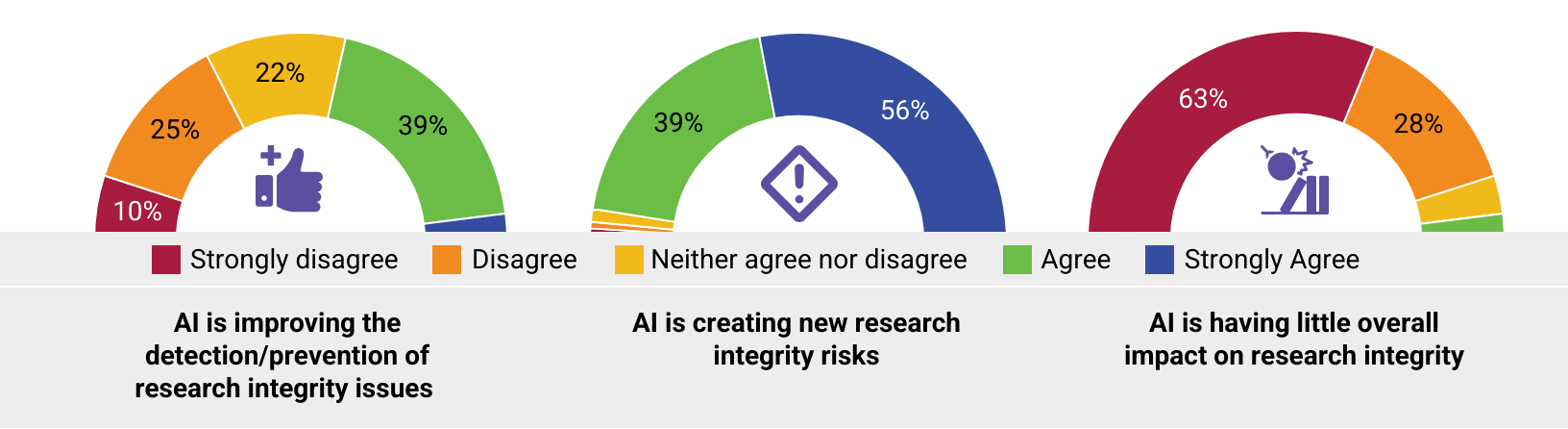
Results lean positive on AI’s potential contribution to detecting or preventing research integrity issues. 43% agree or strongly agree that AI is improving detection and prevention, compared with 35% who disagree or strongly disagree and 22% who are neutral. This suggests some recognition of AI’s value as an integrity tool, but far from a community consensus.
AI as a source of new risks
95% agree or strongly agree that AI is creating new research integrity risks, including 56% who strongly agree. Only 3% disagree. This reinforces the earlier results identifying AI-generated or manipulated manuscripts as the leading research integrity concern.
AI’s overall impact on research integrity
91% disagree or strongly disagree that AI is having little overall impact, including 63% who strongly disagree. Just 4% agree that its overall impact is small. Respondents are not treating AI as an emerging issue; they perceive its effects on research integrity as consequential today.
Strategies Implemented
Organizations are taking a multifaceted approach to strengthening research integrity. Research integrity policies (72%) and plagiarism screening (68%) are the most widely implemented measures.
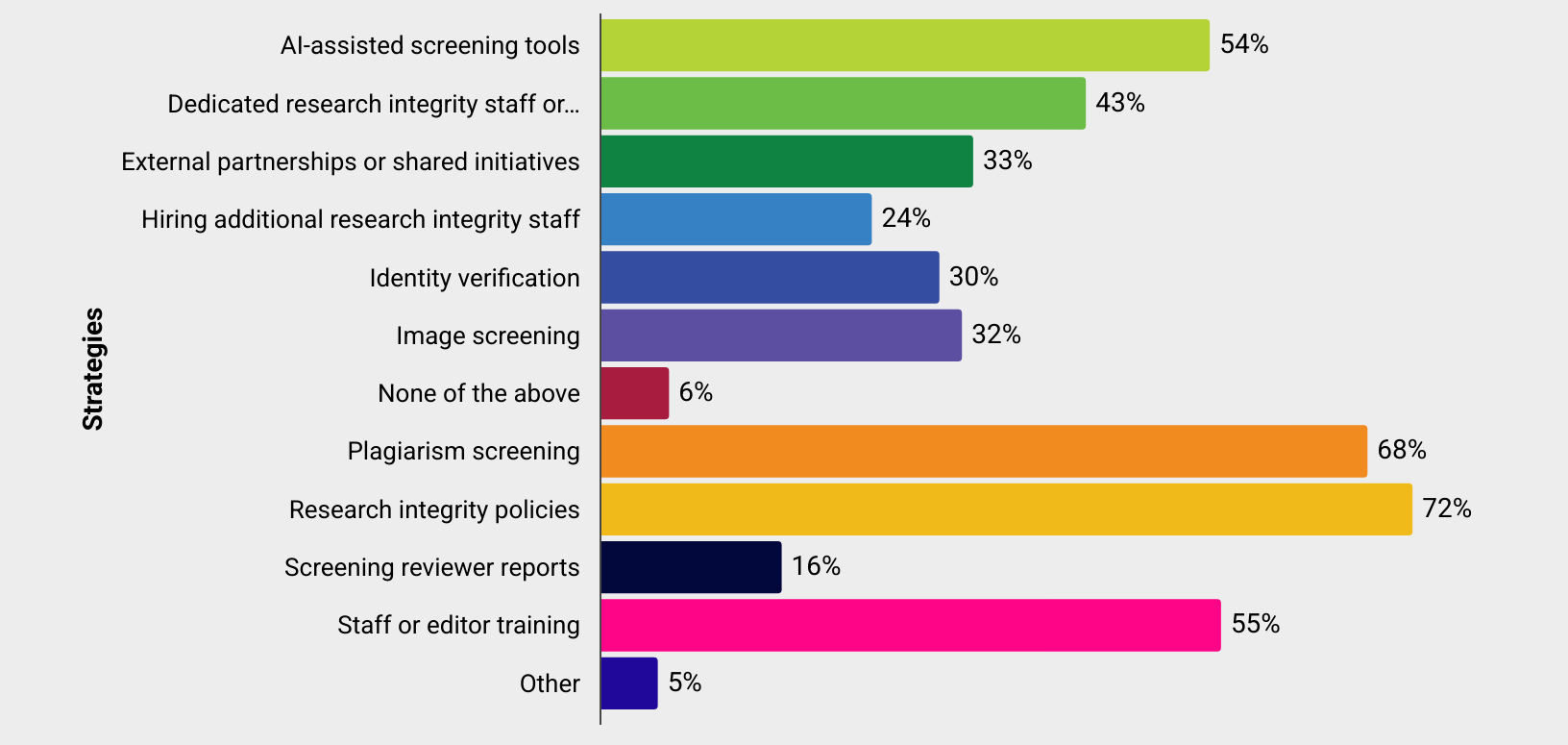
More than half of respondents report staff or editor training (55%) and AI-assisted screening tools (54%) indicating that AI is already playing a substantial role in organizations’ integrity efforts despite the mixed confidence in its effectiveness seen in the previous question.
Dedicated research integrity staff or committees are in place at 43% of organizations, while roughly one-third have implemented external partnerships or shared initiatives, image screening, or identity verification. Only 6% report none of the listed measures, indicating that most responding organizations have taken at least some action to strengthen research integrity.
Industry Confidence
Respondents express substantial concern about the scholarly communications ecosystem’s ability to protect the integrity of the scholarly record. Nearly two-thirds (63%) are slightly or not at all confident that the ecosystem is effectively protecting the record, while 34% are moderately confident. Only 3% report being very confident, and none are extremely confident. The results suggest that concern extends beyond individual integrity threats or organizations’ ability to detect them. Respondents also have limited confidence in the effectiveness of the ecosystem as a whole.
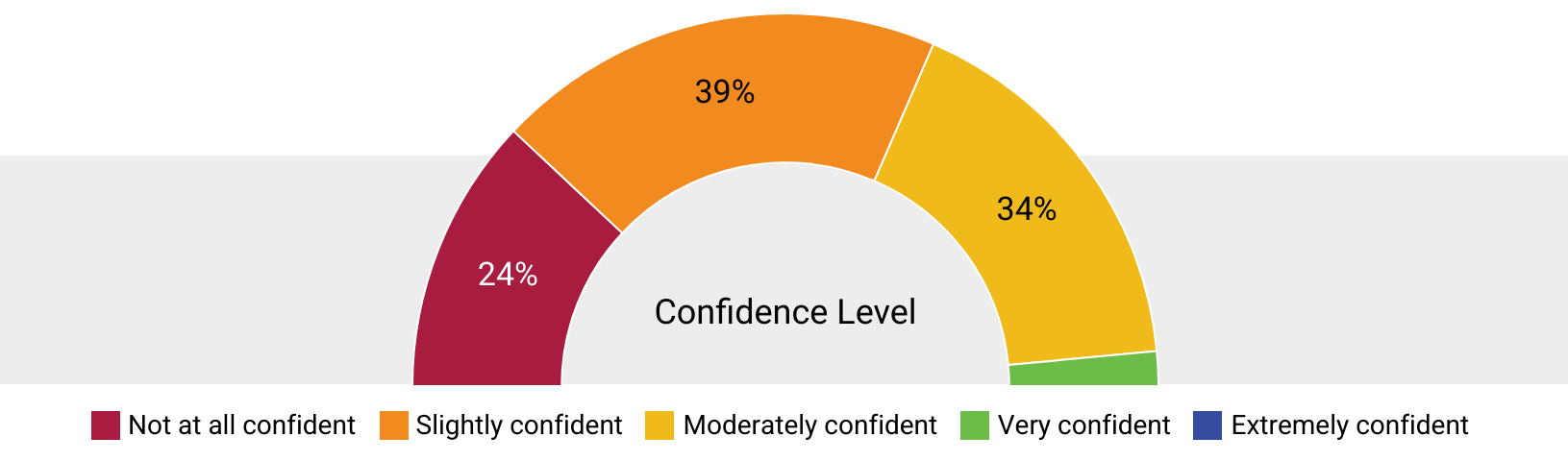
Despite respondents reporting widespread organizational action (94% have implemented at least one of the integrity measures listed previously), confidence in the collective effectiveness of the ecosystem remains quite low.
Root Causes
Publish-or-perish incentive structures rank as the most impactful root cause, with the highest overall score (4.56). Nearly half of respondents (46%) ranked this first, and 60% placed it in their top two. This suggests respondents see research integrity challenges as rooted substantially in the incentives surrounding research production and publication, rather than primarily in particular technologies or business models.
Respondents (in their comments) also broadened the concept of “publish or perish” to include institutional rankings, research assessment, funding incentives, expectations of novelty, and organizational pressures around research productivity.
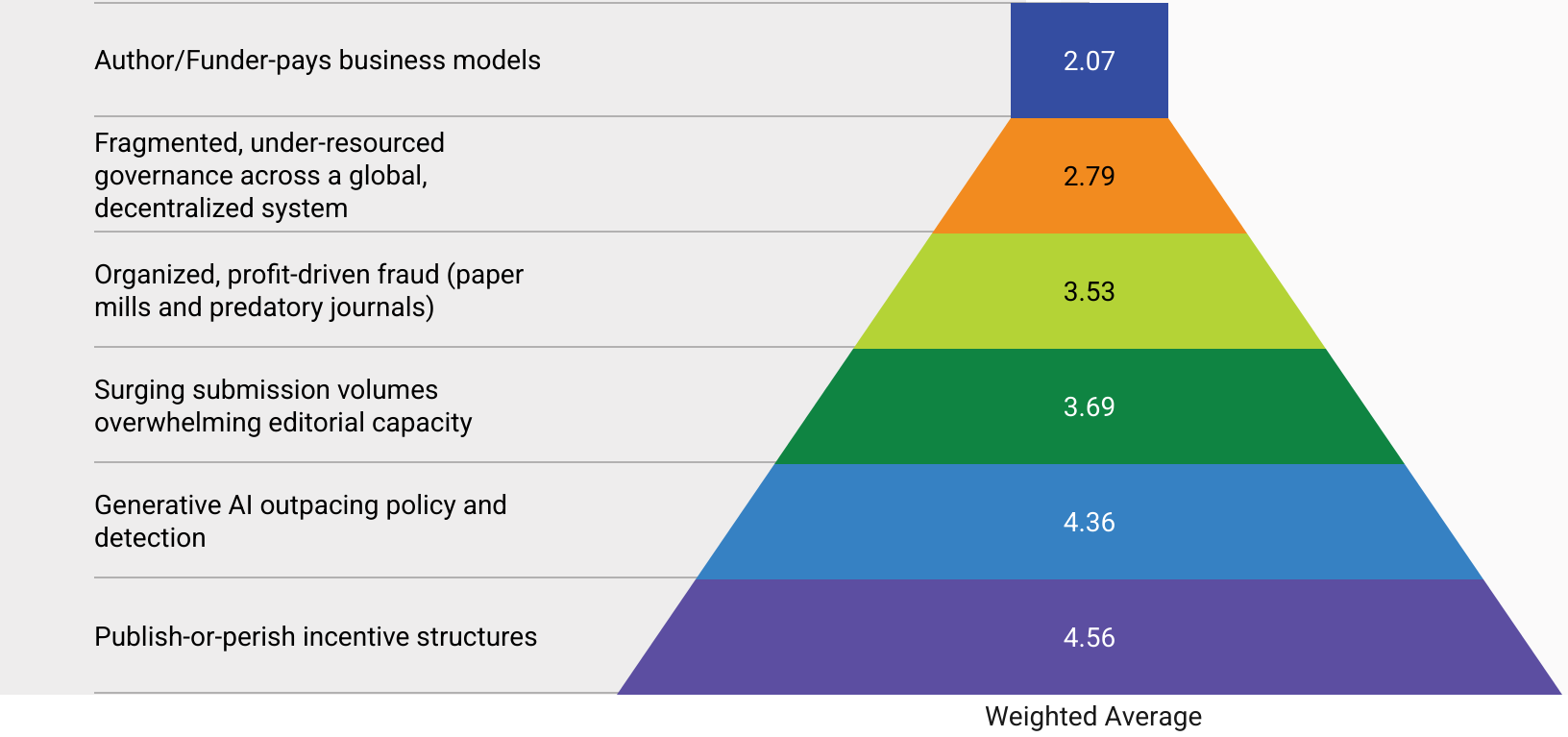
Generative AI outpacing policy and detection ranks a close second, with a score of 4.36. More than half (52%) placed it among their top two root causes, and three-quarters (76%) ranked it in the top three. This reinforces earlier findings that AI is viewed not simply as another integrity challenge, but as a force that is changing the scale and nature of existing challenges faster than policies and detection capabilities can adapt.
Surging submission volumes overwhelming editorial capacity ranks third (3.69). More than half of respondents (57%) place it in their top three. Organized, profit-driven fraud, including paper mills and predatory journals, follows at 3.53, with responses more broadly distributed across the rankings. Together, these findings point to concerns about both the volume of material entering the system and deliberate efforts to exploit it.
Respondents place considerably less weight on fragmented, under-resourced governance across the global decentralized system (2.79), while author/funder-pays business models rank last by a substantial margin (2.07). Nearly half (49%) rank business models as the least impactful of the six root causes, and 72% place them in the bottom two.
Several respondents emphasized that the causes are interconnected rather than independent. One respondent summed up the sentiment with this explanation:
“Because of the unreasonable structure of the publish-or-perish incentive, authors NEED papers, and they will go to paper mills to get them. Paper mills are supercharged by AI, and this creates the tsunami of submissions landing on journals. In an author-pays system, the cost of managing the increase in papers has to be supported by accepting more of them, even while the cost of screening them also increases as more systems are brought into the workflow. Finally, any paper caught in one journal’s (expensive) screening can move over to another journal, and another, and another, until it finds the least-resourced, most gullible, or actually fraudulent outlet.”
Conclusion
The results reveal a scholarly communications community actively responding to research integrity challenges, but with limited confidence that current efforts are sufficient. Most organizations have implemented policies, screening tools, training, staffing, or other safeguards, yet nearly two-thirds of respondents remain slightly or not at all confident that the ecosystem is effectively protecting the scholarly record.
AI has intensified this tension. Respondents overwhelmingly agree that AI is creating new research integrity risks, while confidence in detecting AI-generated or manipulated manuscripts remains low. At the same time, more than half of organizations are already using AI-assisted screening, illustrating AI’s emerging role as both a source of risk and part of the response.
Perhaps most importantly, respondents view today’s challenges as interconnected. Publish-or-perish incentives, rapidly evolving AI, growing submission volumes, organized fraud, and resource and governance constraints can reinforce one another rather than operate in isolation. The findings suggest that protecting the scholarly record will require continued attention not only to individual threats and detection tools, but also to the incentives, capacity, coordination, and shared practices that shape research and scholarly communication across the ecosystem.
The full report, available at no cost on SSP’s website (log-in or account creation required), provides additional detail and the ability to filter the data by organization size, type, and job level of respondents. If you have a suggestion for future Pulse Check Polls, send your ideas to info@sspnet.org.
Author note: Data collection was conducted September 1-15, 2026. AI applications were used to assist in the analysis and summarization of the data in this report.

Discussion
2 Thoughts on "Research Integrity in Scholarly Communications — SSP Pulse Check Report"

Two factors are worth considering alongside this data. 1) the long tail of publishers, small single title operations, can’t afford AI integrity checks and are at risk of becoming a back door for paper mills. 2) these same smaller publishers are not aware that they even have a problem. Awareness and availability of tools to the long tail is essential.

Recommend the AI threat to research integrity and research papers be broken separated two separate areas: a threat to the “ text”, ie abstracts, discussions , experimental designs, results, discussion, and conclusions ; and “ data”, ie the raw and processed data generated by the research, experiment, study, etc.
The threat to data can be prevented by an independent Quality assurance system thru implementation of standard data collection procedures and audits to ensure the data’ s integrity(DI) . The pharmaceutical industry has stressed DI for the last 15 years and has seen marked improvements.
Ensuring integrity of the data will then ensure accuracy of the “ text”- ie you can’t propose, discuss, nor conclude results ( or mar the Academic record ) that is not supported by data, no matter how many hallucinations the AI has.