Generated overviews now answer many reader questions, and they look like something new, but they serve a reader need that scholarly publishing had long met with a genre of its own. Review articles, handbooks, and encyclopedias exist to tell readers what is established, what is contested, and what to read next. Nonetheless, the production method and timing have changed. The overview is assembled when the question is asked rather than in advance, what I call just-in-time synthesis, which I use here to mean any overview generated in response to a question. That matters because it changes who is responsible for what readers are told. Today, I separate the genre from the method and consider what the difference means for publishers and libraries.

The Genre is Not New
Scholarly publishing sorts its outputs into primary research reports and secondary works that gather, compare, and interpret them. The secondary tier includes narrative review articles, systematic reviews and meta-analyses, annual review series, handbooks, encyclopedias, and the textbooks that carry a field’s settled knowledge into classrooms. Each answers the same reader need: to know what is established without reading everything. Editors commissioned these works, experts wrote them, and review, or editorial oversight, vouched for them, so the publisher’s role was to organize expertise into a stable, citable, dated summary.
A synthesis does three things for a reader. It orients, by describing the shape of a field or topic. It judges, by saying which findings are settled, which are contested, and which questions remain open. And it directs, by pointing to the sources a reader should consult next. The volume of scholarship is one reason the genre exists, since the literature in most fields grows faster than anyone can read, even within a specialty.
A more challenging problem arises outside one’s own area. A researcher entering a neighboring field, a member of an interdisciplinary team, or a student exploring a topic for the first time cannot tell from the papers alone which findings matter and which to trust. Those judgments require expertise, and readers without it reasonably rely on experts to say what has been decided, what remains unresolved, and what deserves limited attention. Review articles, handbooks, and encyclopedias provide that judgment, making them more than shorter versions of the papers they cover.
Systematic reviews show this most clearly. They follow a documented, repeatable method for searching for, selecting, and appraising studies, and that method is part of why readers trust the result.
Zero-Click Before AI
The gap between what publishers offer and what readers use is not new. In July 2017, Lettie Conrad wrote that reference works were ripe for innovation, drawing on an Oxford University Press study, Navigating Research, that documented declining use of reference resources as students and researchers began with the open web, Wikipedia, and Google.
That November, I spoke at the Charleston Library Conference with Uri Nodelman, Senior Editor of the Stanford Encyclopedia of Philosophy, and Damon Zucca, Publisher of Scholarly Reference at Oxford University Press, in a session titled “Imagining a Revitalized Role for Scholarly Reference in Inquiry and Scholarship.” We began from a conundrum: reference publishers and librarians seemed well placed to help researchers facing misinformation and the need to learn new fields quickly, but reference collections, in print and digital, were underused at many libraries. We asked whether the cause was information literacy, library discovery, Google and Google Scholar as the usual starting points, or Wikipedia.
Damon defined reference works as those consulted for specific pieces of information rather than read straight through, and cited findings that users and many librarians do not clearly recognize reference as a category. The OUP study mentioned above described reference as supporting three early tasks: checking a fact, gaining a basic understanding of an unfamiliar topic, and finding reliable sources for further reading. Readers now bring those tasks to just-in-time synthesis.
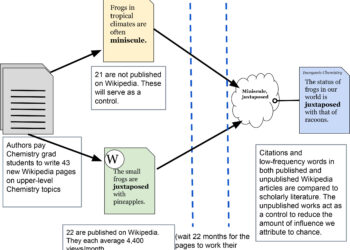
Wikipedia was the earlier answer to the same reader need, and was initially critiqued as unreliable, though today it is widely trusted as a source. It is free and easy to access, and for many readers it ends their search without a click to anything else. It is not a machine summary because volunteers write and revise it, it cites the sources behind its claims, and its edit history is public, making it a human-curated synthesis assembled outside the publishing industry. And it shows that zero-click behavior, meaning getting what one needs without opening the underlying sources, did not begin with AI tools. Readers seem willing to use a synthesis that is good enough and accessible, regardless of who produced it.
How Just-in-Time Synthesis Compares
Table 1 compares the three methods for producing a synthesis side by side. The commissioned column describes the scholarly publishers’ method, uses Wikipedia as an example of the volunteer method, and describes AI-generated overviews in general, since they differ in whether they show sources, how they select them, and what they do when evidence conflicts.
Publishers largely controlled the commissioned synthesis method of the prior era. They have also supported the volunteer approach: through The Wikipedia Library, participating publishers give active Wikipedia editors free access to subscription databases so that volunteers can read and cite sources behind paywalls.
Recognizing the new reality, some publishers are now trying to develop their own AI platforms or contribute to just-in-time synthesis as AI tools deliver it. Elsevier announced its researcher AI platform, now known as LeapSpace, in September 2025, and a growing number of publishers are pursuing a Model Context Protocol (MCP) strategy, seeking to integrate their content into AI assistants.
Table 1: Approaches to Creating a Synthesis
| Commissioned | Volunteer | Just-in-Time | |
|---|---|---|---|
| Starting Point | An editor decides a field needs a review | A contributor decides a topic needs an article | A reader asks a question |
| Author | Named experts | Volunteer editors, who may be pseudonymous | A system working from retrieved sources |
| Quality Control | Peer or editorial review before publication | Community review and editing policies | Varies by tool, and not always visible to the reader |
| Timing | Written and published in advance, then dated | Revised, with revision history and discussion | Assembled at the moment of the question |
| Form | A fixed document | A living page with a public edit history | A response that may differ each time |
| Citation and Correction | Cited by others, corrected by erratum or update | Can be cited to a specific revision, and corrected by other editors | Not generally citable as such, and no obvious mechanism to correct |
What Has Changed
The most notable difference with just-in-time synthesis is who is responsible for the synthesis and whether it can be collected and preserved. In the commissioned model, named authors and editors put their reputations behind a review. A review article is also a fixed object that can be cited, versioned, and corrected, so later readers can see what earlier readers saw. In the just-in-time model, responsibility is unclear – is it the AI tool provider, the sources it retrieved, or the reader who chose to rely on the output? In addition, a response that can differ each time the same query is made is hard to cite, check, or teach from.
Often, the reader cannot check the answer at all.
An additional difference is who pays and who is paid. Commissioned reviews carry costs for editors, authors, and reviewers, recovered through subscriptions, licenses, or fees. When a generated overview draws on licensed content, it is not yet settled how, or whether, the publishers and authors who produced that content will be credited or compensated. Who is paid when the answer itself is the product?
Implications for Publishers and Libraries
For publishers that supply content to these tools, the shift from publishing a synthesis to enabling its generation raises the question of what they add. Their authority and control have been disintermediated.
The answer lies in what travels with the content. When a publisher offers an MCP connector, the version of record, its metadata, and the terms of its license can accompany what an assistant retrieves, so that a reader can trace a statement in a generated overview back to the article it came from.
For libraries, the practical consequence of just-in-time synthesis is that such a synthesis typically cannot be located and evaluated as an object, nor preserved or collected for future use. Many librarians have historically taught students to begin with encyclopedias, handbooks, and review articles as authoritative foundations for building their knowledge. That advice needs a counterpart for an overview generated by an AI assistant: check how it selected its sources, whether its citations are verifiable, and what the tool did when evidence was thin or conflicting – and then keep at least your own personal record of the summary.
Publishers and libraries alike would benefit from shared expectations for what a generated synthesis must show a reader, including its sources, method, and date. Though some are understandably concerned about usage tracking, my concern is the intellectual integrity of the outputs.
Where Next?
If the genre is old and the method is new, the open question is not whether it is good to use these tools (people are using them!) but which parts of the old method we can, and want to, carry over. Commissioned synthesis earned reader trust through named authors, editorial review, and a documented method. Volunteer synthesis earned trust through public revision histories and community editing policies. But a just-in-time synthesis that cannot be checked asks for trust without those safeguards.
Readers should be able to see the sources and method behind an AI-generated overview. Publishers are positioning themselves as suppliers of the content these tools draw on, and the connectors and licensing terms they adopt will likely shape how the version of record is presented and whether credit is given to the people who produced the works used. Libraries, for their part, will need criteria for evaluating these tools.
How these issues are settled will determine whether the just-in-time synthesis keeps the functions that readers have long expected of the genre, which are to orient, to judge, and to direct, and whether it earns our collective trust.
AI Disclosures: Claude was used as a conversational interlocutor in developing the essay. Grammarly was used to polish the writing.