Over the last few weeks, I’ve been thinking a lot about foxes and hedgehogs.
The ancient Greek poet Archilochus told us of the difference between the fox and the hedgehog: “a fox knows many things, but a hedgehog knows one big thing” (or as per Erasmus in 1500, “Multa novit vulpes, verum echinus unum magnum”). British historian and philosopher Isaiah Berlin expanded upon this idea in his 1953 essay, The Hedgehog and the Fox, where he divided writers and thinkers into two categories corresponding with the animals. Hedgehogs view the world through one single defining idea, while foxes draw on a variety of viewpoints and experiences.
These animals, as metaphors for these different approaches, keep coming to mind as our community struggles to confront the potential changes that will be wrought upon scholarly communication (and the world at large) from all the new AI (artificial intelligence) tools entering the market.
I am speaking on a panel at Silverchair’s “Platform Strategies” meeting, which will address the question, “What is your strategy if there is no platform?” To think about this, I will posit that (at least in the sciences) there are two types of reading that scholars do — fox reading or hedgehog reading.
The first is a very broad set of information gathering, essentially reading the abstracts of a lot of articles and then bookmarking or downloading those that might be of interest. Every academic has a hard drive full of largely unread PDFs or a stack of printouts on their desk (maybe both) that they will get to when they have time (which, given that time is an academic’s most precious commodity, often means “never”). Still, this grazing allows one to see the big picture of one’s field and to remain current. Let’s call this “fox reading.”
The second type of reading is the deep, focused reading that happens for a small number of papers directly relevant to one’s research. Here, a quick scan will not suffice, and hours are spent poring through the details of the research presented, with each data point in each figure recognized and understood, often resulting in a trip down the rabbit hole (to keep the animal metaphors flowing) following links to cited references. I would call this “hedgehog reading,” and it is essential for the in-depth, studied comprehension needed to formulate one’s own experiments.

AI Favors the Fox
AI tools, as I currently understand them, will be much more helpful for fox reading than for hedgehog reading. The real strength of most AI tools is in dealing with large sets of data, quantities too large for the human brain to process. AI can find previously unfound correlations across enormous datasets. AI will allow us to think at a systems level rather than with a reductionist approach. AI can add significant efficiency, particularly in an era when “there’s too much to read” and information overload are common complaints.
At last week’s New Directions Seminar hosted by the Society for Scholarly Publishing, several speakers posited a future where the research paper will, at the very least, be seen as archaic and mostly read only by machines. AI agents providing summaries and analyses will become the way one interfaces with the broad corpus of information on what’s happening in a given field. With the volume of papers published each year, this offers a potential route to keeping up in a world of information overload. Nature offered a glimpse of this future: the paper as an interactive experience governed by an AI agent. Why should a fox look at an individual figure in an individual paper when it can instead ask for a quick summary of an entire field?
One researcher at the meeting boasted that one of his graduate students fed 500 of his publications into an LLM to create an AI avatar that the student could use as a substitute mentor, providing advice on how to proceed with experiments. The speaker went so far as to say that it would be ridiculous to expect the student to read those 500 papers, and that this was instead a fantastic way for them to gain domain knowledge. By this reasoning, achieving a grounding in the field one hopes to study is now a task that can be outsourced by a student. (As an aside, one can’t help but think there’s perhaps an unsubtle critique of the academic career and funding system inherent in a prolific researcher publicly stating that their own publications are both too abundant and not worth reading, even for their own students.)
Whither the Hedgehog?
Throughout my career as a scientist, a journal editor, a books commissioning editor, and a publisher, older (perhaps wiser) scientists have consistently complained about the next generation of researchers, essentially bemoaning their refusal to read the original literature. There’s no way to truly understand a field, I have been repeatedly told, from reading review articles. One must engage directly with the science rather than relying on shallow summaries. Review articles create foxes, while the original literature leads to hedgehogs — and only hedgehogs can dig deeply into specific, thorny problems.
If this is indeed accurate, and reading review articles alone is an inadequate route to gaining deep understanding, then what will we be left with if the primary approach becomes reading even less, and instead relying on short summaries of reviews? Will this further removal from the original literature create not only a generation of foxes, but a generation of shallow foxes?
Process Versus Outputs
AI tools will certainly bring efficiency — it’s a lot faster and more manageable to read a three-sentence summary of a paper or to have the numbers behind a figure calculated rather than having to derive them yourself. But, like most things AI, this places all of the value on outputs, rather than on processes. The processes of reading, analyzing, reflecting, and theorizing are important to how we learn to think. ChatGPT can churn out an infinite number of low-quality papers about Hemingway, but the world doesn’t really need more low-quality papers about Hemingway — we have enough of those. What we do need, however, are educated people who, through the process of writing a low-quality paper about Hemingway, learned to think and to analyze information. The output doesn’t matter, but the process of reaching that output does.
As historian and former Chef in The Scholarly Kitchen, Karin Wulf wrote recently, “information provided is not teaching.” Getting to the answer fast doesn’t make you a better scientist if you don’t know what that answer means. The end result of graduate school is not a thesis; it is a scientist who can think as a scientist does. What cognitive development and critical thinking skills are we trading away in return for these new efficiencies?
A Mixed Menagerie
I don’t mean to disparage foxes. Philip Tetlock’s work suggests that foxes are much better than hedgehogs in long-term forecasting. For a balanced research ecosystem, we need both, and realistically, we all need to be some combination of fox and hedgehog, in order to thrive. It’s important to be able to see the big picture and keep a handle on what’s going on elsewhere, and also to go deep on the things that directly matter. But if the dominant tools controlling how research results are disseminated and ingested bias things toward the creation of foxes (and shallow foxes at that), then are we creating an imbalance that will harm progress? How do we gain the foxy benefits that AI efficiency offers without losing our hedgehog digging skills?
Business Considerations
Reflecting on Silverchair’s question about impacts on our publishing platforms, my initial reaction is to ask: What will happen to the way we sell journals if all of our fox reading is done by machines? I would assume that the vast majority of the traffic to our journal websites currently come from foxes broadly gathering information, and a smaller minority from hedgehogs who care deeply about a handful of papers each year. Journal sales are reliant upon a metric, COUNTER statistics, that is all about the quantities of papers viewed by a subscribing institution. The more papers read, the greater the value to a library.
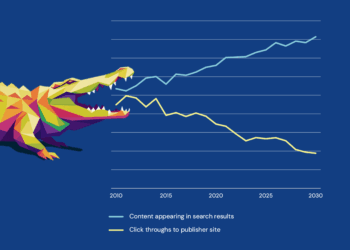
If AI tools are the new foxes and readers instead rely on them for summarization, they will never see the original papers, and our traffic levels will drop off a cliff. How, then, do we measure the value provided to subscribers, particularly if the small number of papers downloaded will be absolutely essential for their patrons? When cost-per-download no longer makes sense, what measurements will we use to understand whether a journal subscription is worth maintaining?
Your thoughts are appreciated in the comments below — and let me know, as the band Luna asked: “Are you a fox or a hedgehog?”

Discussion
8 Thoughts on "AI and Scholarly Reading: Foxes versus Hedgehogs"

I’ve been talking about this a lot, recently, too! I have drawn on Marcia Bates (“Berrypicking”) and Pirolli & Card (“foraging”). It’s interesting how so many of the metaphors orient around animals’ grazing. I shall have to add “Crotty (“fox vs hedgehog”) to my graphic. Either way, it becomes a question of how we track this off-site grazing and how we report / value that compared to on-site consumption. As part of my current work I’m looking not only at what kinds of metadata we need to create to become more consistently visible / cited in AI-mediated search, but also how we then track that consistently.

David, I enjoyed this, especially the Berlin reference. I had the pleasure of meeting him over dinner in Oxford many years ago, so it brought back a happy memory.
I wonder whether the best AI tools will help researchers move between these two kinds of reading. They can survey hundreds of papers, then lead us to the particular claim, figure, or methodological choice worth examining closely, with a clear path back to the original evidence. One such encounter with a paper may matter far more than dozens of PDFs downloaded and never opened. That makes your question about how we measure value especially interesting.

That’s a really interesting article; as a retired librarian I am a fox; as a published (but independent) historian, I am a hedgehog. But I find in my fox reading in the wider world I find useful slugs for my hedgehog appetite. I think this is the serendipity factor that is too easily lost in too reliant a concentration on the digital.

Many thanks for this comment. I happen to have the same combination but only at younger age. As a professional historian turned almost six years ago a librarian dealing with Open Access and Open Educational Resources I can only agree with this perception.
The combination of both – looking towards the horizons to get the best possible overivew (the eagle perspective, to remain within the animal field) and digging underground like a mole or going down the rabbit hole – is fundamental for any scholar.
What gets lost with the digital is the serendipity factor. To put it in a further analogy, any potential Newtons of our age will get thousands of calculations but not a single apple falling down the tree while in the garden that ignites thinking.

Thanks David, thought provoking article. Lots of thoughts, but to focus on two:
1: Casting a wider eye across the media world, publishers are already adapting to a world where usage counts for less. A good example of this is Reach in the UK: https://pressgazette.co.uk/news/reach-to-cut-editorial-team-by-further-160-jobs-as-key-metric-becomes-active-engaged-time/ . They have pivoted their strategy and the new emerging KPI is active engaged time, focusing on time on page and measuring engaged readers, aka your hedgehogs.
2: We should be careful about saying traffic declining. From humans, arguably yes. From machines definitely no. Machines with close to infinite attention will consume far greater volumes of content, and managed in the right way, we can count that usage and report on it. See the great work being done by COUNTER in this space.

On point 2, I think the thing that gives me worry is that those bots are not subscribers. If traffic shifts from paying subscribers to freeloading bots, how does that affect our business?

Hedgehog, I think, though I’ve learnt a lot from the foxes. If AI ends up doing the fox reading for everyone, the specialists’ job gets bigger: someone still has to explain their one big thing well enough that a generalist wants to go and dig. If anything, it’s time authors got more control over their own communication. I work on this for medical research, and explaining is much harder than summarising.

This metaphor has been strained, laboured and muddled quite often in various contexts. The original poem is referring to the strategies of the fox and hedgehog in a predator-prey situation, where the fox knows many different ways of cornering and catching prey, whereas the hedgehog knows one big thing and that is to curl up in a ball.
I agree that using AI to review research does create shallow foxes and this also applied in the pre-AI era when too many researchers relied on (often biased) reviews without questioning their content/interpretation. Primary research still needs to be read and interrogated because there are always new insights to be gained from checking methods/results and pondering small details (and missing details in some cases). Reviews are a gateway to a subject but real insights are to be gained from reading the actual research publications that they review (and those they don’t of course, which can be fruitful territory).