Editors’ note: Today’s post is by Paul Tuinenburg, co-founder of Global Campus.
A growing number of the systems researchers and institutions rely on every day are being built on the same underlying map of who published what. The Sorbonne University in France was the first major university moving from using the proprietary Web of Science data to the open infrastructure of OpenAlex in 2024. In that specific case, OpenAlex serves as an assistant layer for the library.
But OpenAlex is also used as an assistant layer for a funder’s reporting dashboard, a global ranking like the CWTS Leiden Ranking, and a new AI research assistant. Most people using these tools never see it directly, which is exactly why it matters: an error in that underlying map doesn’t stay contained to one platform; it propagates silently into every tool built on top of it, including the ones publishers and researchers use to track their own impact.
OpenAlex: The Data Infrastructure Organizations Quietly Build On
Named after the ancient Library of Alexandria, OpenAlex launched in 2022 as an open successor to Microsoft Academic Graph, maintained as a public good by the non-profit OurResearch. It indexes hundreds of millions of works, authors, institutions, sources, and funders, along with the links between them, and it makes all of it available under a fully open license (CC0), free for anyone to read, reuse or build on (within certain use limits).
As a piece of infrastructure, what OpenAlex has built at this scale, with no subscription wall, is genuinely impressive. It has become one of the largest connected records of scholarship in existence. But scale is also where its hardest problem lives. Matching tens of millions of papers to the correct person,is one of the most persistent unsolved problems in bibliometrics, and even a very good algorithm produces a meaningful number of errors when applied across hundreds of millions of works.

Why Disambiguation Breaks, and How it Gets Fixed
The failure modes are well understood. Common names create ambiguity that only grows with scale. Researchers publish under inconsistent variants of their own name over a career. Whether it’s maiden names, middle initials present in some records but omitted in others or simple typing mistakes. Institutional affiliations change, and two researchers at the same institution with similar names can be nearly indistinguishable from citation data alone.
The result is either split identities, where one person’s work is scattered across several profiles, or merged ones, where the work of two academics is merged in one profile. Some researchers have a linked ORCID in OpenAlex, which is the strongest signal the algorithm has to work with, but not everyone has an ORCID, or uses it, so this only solves part of the problem. This leads to wrong data; not wrong on purpose, simply unconfirmed until a human checks them. And this isn’t only a discovery problem. Research-integrity tools built to catch paper mills and citation manipulation depend on the same authorship data. When a record is thin or misattributed, those tools lose precision precisely when it matters most.
An unclaimed profile isn’t wrong on purpose — it’s simply unconfirmed. And unconfirmed data propagates into every tool built on top of it.
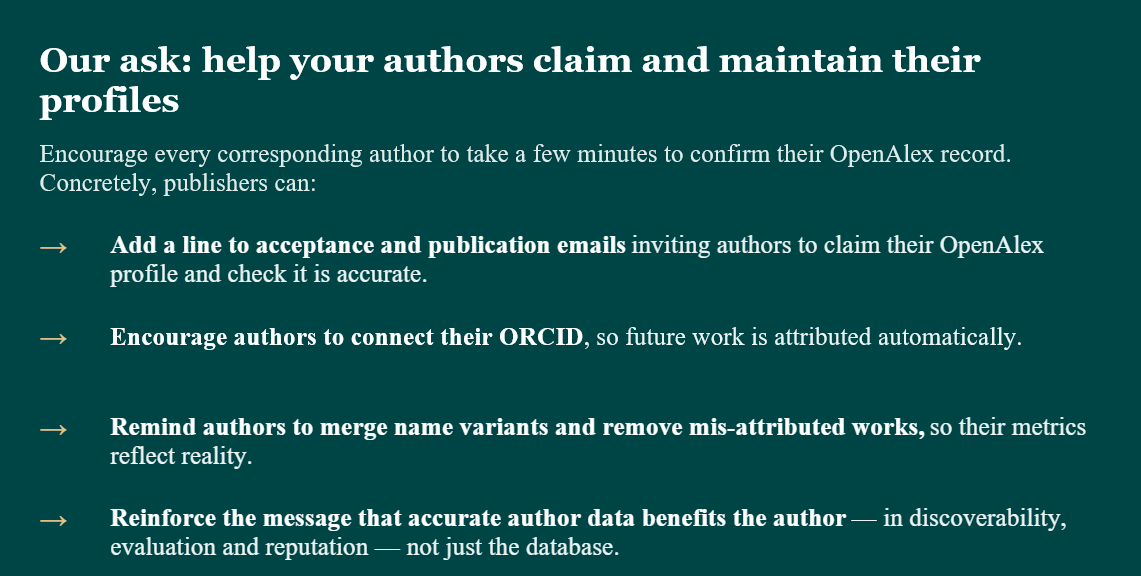
The fix is almost entirely a human one: an author claiming their own profile, merging their name variants, and linking their ORCID resolves the ambiguity an algorithm alone cannot. Publishers are unusually well placed to prompt this, because they’re in direct, trusted contact with authors at the moments they’re most engaged with their own scholarly identity: upon acceptance and at publication. A short, well-timed prompt from a publisher will do more than a generic invitation for an administrative chore ever could. In addition: publishers have an additional source of unification in accounts of submission systems: An academic with a common name that has published without specifying an ORCID, might still have used a single account in a manuscript submission system, proving that the output belongs to a single academic author.
Can We Ask Researchers to Update Another Profile?
Researchers already update their presence on Google Scholar, ResearchGate, ORCID, institutional repositories such as Pure, and profile sites like Loop. So is it reasonable to ask them to maintain another?
We believe researchers should because OpenAlex is combining taking the responsibility to build and maintain this ledger of academic content with the commitment to doing that in the open, thereby returning its value to the academic community. This combination of ambition in setting the record straight, combined with opening up both the source code and the data, is why OpenAlex deserves the time and support of the academic researchers.
Conclusion
So why should publishers care about authors claiming their OpenAlex profile? For those publishers that use OpenAlex data directly, the answer is very simple, it directly improves their own analyses on the data. But besides that, a lot of vendors that publishers rely on use the OpenAlex source data to deliver their value. Improvements in that data directly impact the quality of reviewer suggestions, citation checks, integrity checks, potential conflicts of interest, etc…The same records also affect how a journal’s own output is attributed, discovered and counted in rankings and funder reports. Every author claiming and curating their own profile makes the data feeding these reports and rankings more reliable.
The cost of acting is very small when compared to the benefit. A single sentence in an acceptance email reaches authors when they are most invested in their work. It requires no new systems, budget or time from staff. Because OpenAlex is open, a correction made once improves every platform that builds on it. And every profile an author confirms makes the shared map a little more trustworthy — for that author, for the publisher whose metadata depends on it, and for every reader and tool downstream.
Open knowledge is maintained not by its owners, but by all of us. Publishers can help more authors play their part. Publishers have long been responsible for the quality of the scholarly record within their own journals. Helping authors claim their OpenAlex profiles extends that responsibility to the shared infrastructure a lot of people in academia rely upon, and very few organizations are as well placed to do it.
Author note: AI-assisted editing tools were used to create images and to help revise wording and structure for clarity.
Discussion
9 Thoughts on "Guest Post — Improving OpenAlex Data: Why Publishers Should Help Authors Improve the Scholarly Record"

Wikidata runs into the same disambiguation problem, and it handles it by storing identifiers side by side on each researcher’s item: ORCID iD (P496), OpenAlex ID (P10283) and Google Scholar author ID (P1960) are all properties there. When a split or merged OpenAlex profile gets corrected, it is worth checking that the matching Wikidata item points to the right ID too, because tools like Scholia and the authority control box on Wikipedia biographies read from those items. An author who keeps an ORCID record current makes that matching much easier for everyone downstream.

Within economics, RePEc has been doing this for close to 30 years, with all the data types (paper, author, institution) natively linked. All the tools mentioned above use RePEc data, yet they do not exploit those links and also do not refer back to the authoritative RePEc records. Too bad!

I started to read this an was immediately turned off by the AI-aided writing style. Please don’t allow AI written articles, Scholarly Kitchen! I won’t read it. I don’t want to be told about what is doing the quiet work and why it matters.

Hi Elise,
There is a clear AI disclosure at the end of the piece. A discussion of the use of AI in The Scholarly Kitchen can be found here:
https://scholarlykitchen.sspnet.org/2026/08/27/ai-use-in-the-scholarly-kitchen/

While we are pleased to see that OpenAlex has recently built functionality to allow researchers to claim their profiles in OpenAlex and link their ORCID iDs, this functionality is at present quite rudimentary and creates exactly the parallel curation problem that the author cites.
Rather than trying to convince researchers to manually curate their profiles in every single database that has an author profile capability, ORCID has long proposed a different approach. By building integrations with ORCID that synchronize profile data in both directions, we can empower researchers to use the system of their choice to manage their profile, while relying on ORCID as a central hub of profile data that automatically propagates profile changes to any other integrated system that the researcher so chooses.
Every month, over 600 ORCID member organizations contribute authoritative profile data to ORCID, always under the privacy control of the researcher. More and more systems are now building the two-way profile synchronization feature following our community-derived best practices for discovery systems (see the list at https://info.orcid.org/vendors-and-service-providers/orcid-certified-service-providers-list/#h-discovery-systems)
We have encouraged the OpenAlex team to follow these guidelines and become an ORCID Certified Service Provider, and hope to see such functionality forthcoming in their roadmap in a future release.
We are also happy to work with other holders of curated profile data on how best to integrate their systems with ORCID so that all of the work they put into profile curation can be harnessed and propagated throughout the scholarly ecosystem for the benefit of all.

Few authors understand the importance of metadata and their role in helping keep it correct. Publishers also seem not to make it easy to include ORCID iD.
RefRunner offers tools to track your ORCID (https://www.refrunner.com/orcid/) and openalex (linked from every reference card) and see them formatted in any style. It’s worthwhile to check your records as publishers make mistakes more often than you would like to think, omitting authors, adding junk to titles, failing to register DOIs they advertise. Sometimes they’ll fix things if you bring it to their attention.

I’m going to offer this as a case of one re: why the ask in this post is bigger than it might seem. I hadn’t looked at my OpenAlex profile in some time, and what I found will take a fair bit of time to address.
First, I wonder how many other librarians will be as surprised as I was to learn that OpenAlex includes LibGuides as part of the “scholarly research system” (and includes each page of a guide as a separate item in OpenAlex). I would love to remove these from my profile, as they were just handouts for a workshop and have also been deleted, so the links don’t connect to anything. Unfortunately, as soon as I apply the LibGuides filter, as far as I can tell the interface no longer offers an option to remove them. I will probably scroll through all 150 entries on my profile to find them at some point as well as the other things that don’t belong (e.g., other people’s publications about me/my work).
Next, I will also figure out how to merge the four different name records for me and claim works that are in the database but not on any of the four profiles.
Finally, I will see if I can figure out how to add data for the Green OA copies of my works that are getting filtered as “not open access” when there is open copy.

OpenAlex pulls stuff from lots of places indeed! It’s a tough balance between getting everything anyone wants and lots of stuff people don’t. Are you sure that no one will won’t want to cite those? You might be surprised. Of course dead links are dead links.
They have been working hard to improve the author matching, but it’s also very tricky. Attaching your ORCID iD everywhere you can should help. They are pretty quick to respond to requests.
I’m very sure that handouts I made for a campus workshop don’t belong in the record of the “scholarly research system.” Side note … interestingly, none of my Scholarly Kitchen essays appear in to be in OpenAlex, which I would say are part of that system, and don’t appear in spite of being already cited in numerous journal articles.
BTW, as a past chair of the ORCID Board, I am very familiar with the issues around author matching and disambiguation and the way that using ORCID helps, not only when authors use their ORCID but also when platforms implement the full CSP service.