Editors’ note: This guest post is by Will Schweitzer, Chief Executive Officer at Silverchair.
On February 3 of this year, nothing happened in scholarly publishing. Anthropic released a legal plug-in for Claude. No library canceled a subscription, no journal folded, and no publishing platform broke. Yet by the close of trading, RELX had fallen 14%, Thomson Reuters roughly 18%, and Wolters Kluwer about 13%.
That gap between what happened and what got priced is the problem with reading headlines for strategy. We have had a year of loud ones, and most of us have been asked by a board or a society president to explain at least three.
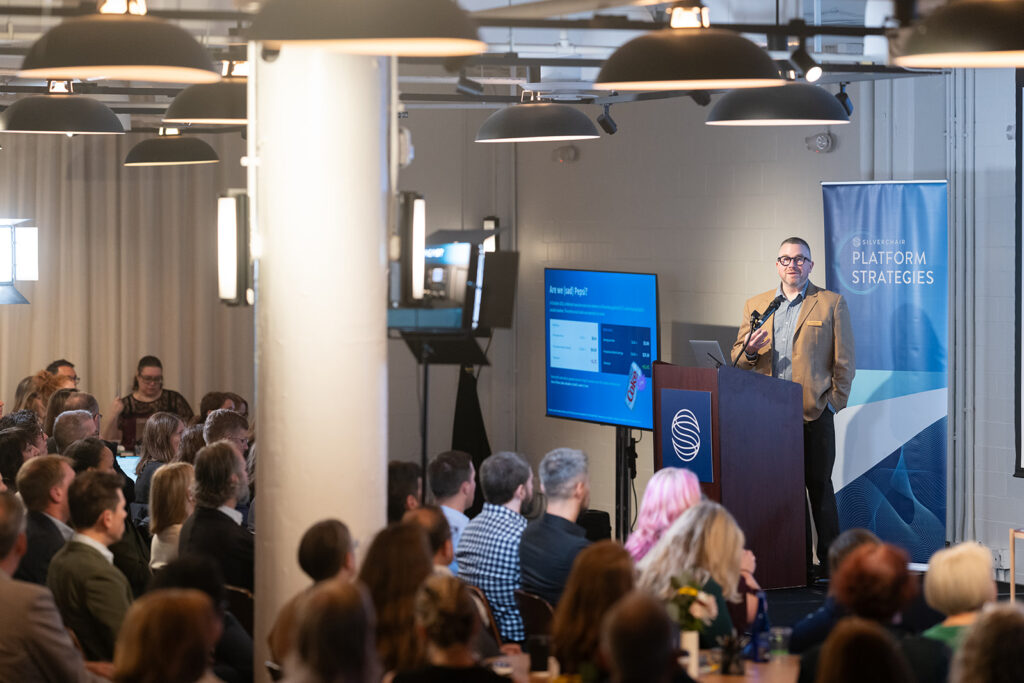
What follows began as the welcome address I gave at Platform Strategies in Washington, DC on September 23, and it is better for the day that followed it. Our scholarly publishing colleagues spent that day arguing with me and with each other, and several of these sections changed as a result. The framing is Wendy Queen’s, from her opening keynote: which signals deserve action now, which are context, and which are weather.
What the Room Said
Wendy Queen of Johns Hopkins University Press opened Platform Strategies by refusing the premise that we lack information. Our problem is not a shortage of signals, she argued, it is deciding which ones deserve action now. She then did something I wish more keynotes did and asked the room.
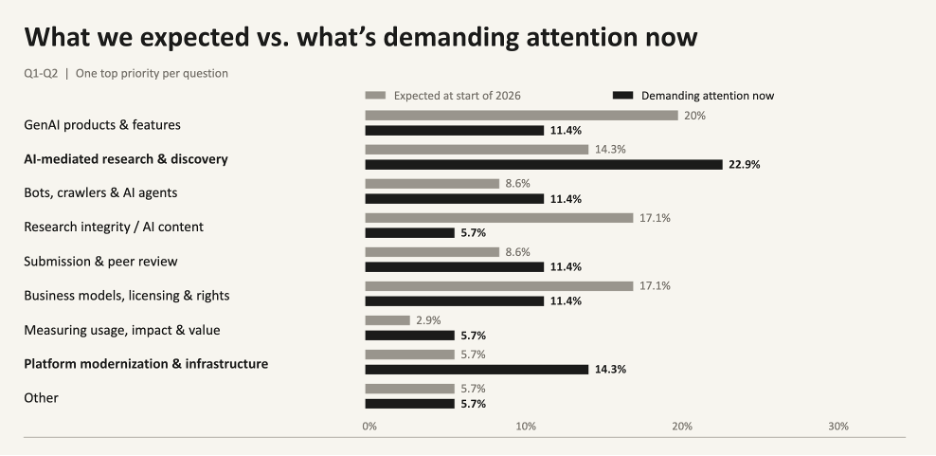
Between January and September, attention moved toward AI-mediated research and discovery, from 14.3% to 22.9% of respondents naming it their top priority, and toward platform modernization, from 5.7% to 14.3%. It moved away from research integrity and AI content, from 17.1% to 5.7%. These are small-sample room polls rather than research, and Wendy said so, but they describe something real: our attention has moved from what AI produces to how research is found. Two further results are worth sitting with. First, 97.1% described their organization as doing something beyond watching and learning; this community is not standing still. Second, the most acute signal-to-noise problem, named by 22.9%, is changing researcher behavior — ahead of which technologies matter or what to build. The hardest question is not which tool to buy. It is whether the people we serve are doing something different.
She also surfaced the question I hear most often from society publishers: how smaller publishers sustain rising platform costs without comparable revenue. Her closing framework is the part I have borrowed since. Three questions for any signal:
- Is behavior actually changing?
- Does it change the flow of value?
- What happens if we wait?
Then the two costs held together — acting prematurely against waiting too long. Most of us are fluent in the first and silent about the second.
The Money Is Saying Something the Product Announcements Are Not
The broader context is that six of the seven public companies in our market grew faster in the first half of 2026 than they have in a decade. Four lost between a fifth and half of their market value over the same period. Growth has not been the problem. Clarke and Esposito have tracked this divergence all year in The Brief, which is the best running account of it available to us.
The clearest way to see what happened is the grocery store snack aisle. In October 2023, a Walmart executive told Bloomberg that customers taking GLP-1 drugs were buying slightly smaller baskets. Within a week the entire packaged food sector had been repriced. Three years on, PepsiCo earned more per share in 2025 than in 2023, and its shares are down about 16%. What changed was the price investors would pay for each dollar PepsiCo earns, which fell from about $21 to $16.50. Coca-Cola, on the same shelf facing the same drug, saw that number rise from $19.80 to $29.30. The difference is business model. Coca-Cola sells concentrate and handed bottling to independent partners in 2017, so it runs lighter assets and fatter margins (roughly 26% operating margin in North America against about 12% for PepsiCo’s beverage business) and by 2026 it was growing volume while its peers bought revenue with price. Investors were not pricing the drug. They were pricing which company looked better positioned to absorb it. The revenues never fell — confidence did, and confidence reprices in an afternoon while revenue takes a decade to build. While few publishers in our market are publicly traded, our Coca-Cola will have sufficient profitability to absorb disruption, fast growing AI products, and a broad corpus of unique, licensable, and high-quality content.
Underneath the equity story is a credit story that matters more to those of us without a share price, which is most of our community. Five companies issued $121 billion of bonds in 2025 to build AI infrastructure, against an average of $28 billion a year before. By the Bank of England’s count, those five were 3% of outstanding U.S. investment-grade debt at the end of 2025 and more than 15% of new issuance by May. Moody’s has identified a further $662 billion of data center leases not yet begun and sitting off balance sheets — more than those companies’ total adjusted debt.
When the Chair of the Federal Reserve was asked on September 16 why long-term yields keep rising, his second reason was competition for capital, and he named the hyperscalers. When a handful of companies borrow on this scale, they compete with everyone else for the same money, and the price of borrowing rises for the rest of us. Credit lines cost more, endowment and reserve assumptions change, and any investment has to clear a higher bar. That reaches a society publisher with no share price and no exposure to any of these companies. Two things since have sharpened it: Oracle invoked force majeure on a $165 billion data center lease, the first such commitment walked back rather than questioned, and the ten-year Treasury reached 5.24% while equity volatility sat near a one-year low. This is priced as a credit problem, not an equity one.
Nobody can forecast how it resolves. What we can do is factor a higher cost of money into our 2027 budgets and give those plans a longer runway than the news cycle. Being privately held or mission-driven is a real advantage, because we are not obliged to rewrite the plan every ninety days.
Our Readers Changed While We Were Reading the Headlines
On an exemplary publisher site running on our platform, only 41% of content requests scored as likely human between June and August, and the number falls every month. Caveat: this is a single site over only three months, so I would not build a strategy on that figure alone. It is also the kind of number most publishers have never looked at.
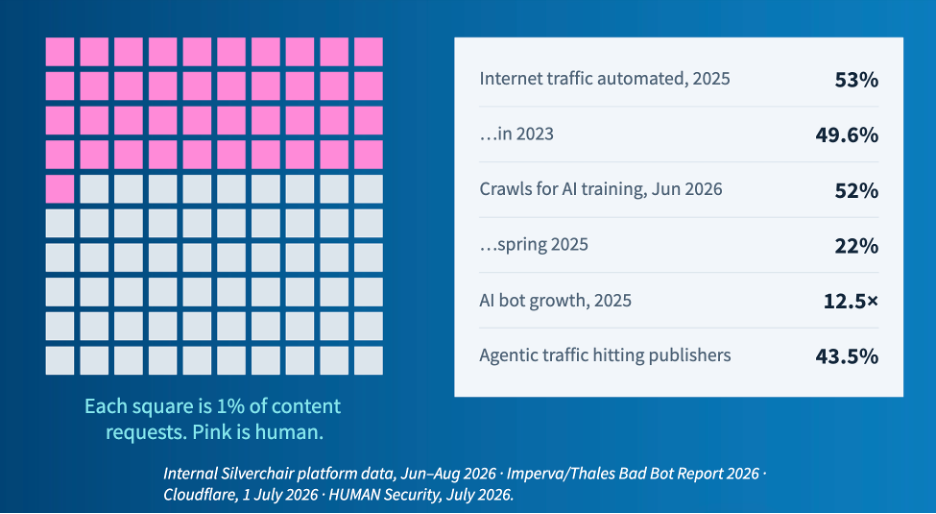
Published data on non-human traffic to scholarly platforms is thin, though not absent. In May, LibLynx reported that of 50 million access requests across around thirty scholarly publishers, 36% were robotic — a floor, since those publishers had already applied their own filtering — and that on Michigan’s Deep Blue repository, humans accounted for only a quarter of 30 million requests. A COAR survey of 66 repositories found more than 90% dealing with aggressive bots. What we lack is data at the granularity news media takes for granted. The crawl-to-referral ratios everyone quotes come from Cloudflare and TollBit, whose panels are news sites. We are describing our own readers with somebody else’s instruments.
Some of what we know is unambiguous. Pew’s study of nearly 69,000 searches found users click through on 8% of searches when an AI summary appears, against 15% when one does not. Cloudflare reported that crawling for AI training grew from 22% to 52% of all crawler requests in a year. Agentic browsers arrive in server logs as ordinary Chrome sessions, on real institutional entitlements, indistinguishable from a person. COUNTER’s second phase goes after off-platform usage and adds an “AI retrievals” metric for use that never surfaces as a citation. This presents infrastructure, cost, and value proposition challenges for publishers as machines are now the primary reader of our content.
The Defaults Are Being Set Right Now
What keeps me up is not any single announcement. It is that the pathways by which research will be found are being established this year, largely by people outside our industry, and those defaults will be hard to revisit.
Anthropic’s connector directory now lists 862 connectors. Among them are Clarivate Cortellis products and Springer Nature’s AdisInsight (a drug pipeline database rather than a journal corpus) with Consensus, Scite, and Elicit there as third parties. No society publisher is listed. When Claude Science is turned on, its entire default literature layer is OpenAlex and arXiv, and no paywalled publisher corpus is on by default at all. Absent licensing or inference arrangements, like MCP-endpoints, publisher paywalls risk becoming a discovery liability and an impediment to fulfilling our societal misson.
The same week we met in DC, Consensus became available through ChatGPT, Claude, and Microsoft 365 Copilot at once. Two days after our conference, AAAS put the full text of six Science family journals into it, explicitly not for training. Two days later, De Gruyter Brill licensed its English-language list through Cashmere, again for inference only; Sage did something similar with Causaly in July. A model has settled quickly: content licensed for retrieval and grounding rather than training, brokered through an intermediary rather than a frontier lab. That is a real change from the training-corpus deals of 2024 and 2025, and a more defensible position — but one that requires you to be in the channel to occupy it.
The access layer changed in September too. On September 1, cryptographic bot identity became a working group document at the IETF, authored by Cloudflare and Google. On September 13, the AI preferences working group published a vocabulary with three verbs: training, use, and search. On September 15, Cloudflare replaced its “block AI bots” switch with those same three controls and created an “Accountable” designation for crawler operators, naming Apple, Google, and Microsoft. The largest intermediary on the web built a compliance ladder and decided who stands on it, in the same fortnight the taxonomy arrived through the standards process. Its figures are the ones I would put in front of a board: 17% of sites block AI training in any form, fewer than 1% block search.
Whose Corpus, and What Is Actually Substitutable
China’s plan to become a leading supplier of AI training data by 2028 names scientific research among its strategic fields. The risk is not which country built the model you use: research in Nature this spring found ChatGPT and Claude answered more favorably to Beijing in Chinese, and traced it to state media in the training data. Brandon Stewart of Princeton, one of the authors, put it to the New York Times in a sentence I have not stopped thinking about: AI disconnects the messenger from the message. Reconnecting them is what we do. If the scholarly record is unreachable in a channel, the gap gets filled by whoever is most motivated to supply data.
This is also where I would push back on the most-quoted line of the season. When the unredacted OpenAI filings became public on September 17, the sentence that traveled described the products as “largely substitutive, period.” Read alongside Satya Nadella’s deposition, where he describes the assistant substituting for “needing to go to the underlying source,” the claim is about the trip, not the worth of what is at the end of it. For news, those are the same thing. For primary research they are not. A summary of a trial is not the trial — this is the one of the few structural advantage our community has, and it only pays if the record can be reached by a user who values provenance and verification.
On the litigation, read Roy Kaufman rather than me. I would flag only that the case with actual scholarly plaintiffs, Elsevier and others against Meta, moved to the Northern District of California on September 25, and that a class action filed in July against Google expressly covers journal articles. No court has ruled, and no appellate court has yet decided whether AI training is fair use.
Meanwhile, Google DeepMind published a paper in July arguing that AI agents are conjecture machines, and that refutation remains physical and institutional, and therefore costly and slow. Everything around judgment is getting cheaper, which is what makes (human) judgment the expensive input. Our own Future of Peer Review report found it now takes 4.5 invitations to secure one review, against 2.3 in 2018. We cannot buy enough expert judgment at the price we pay, and anything that increases the volume of plausible material arriving at our doors makes that arithmetic worse. This is troubling as verifying and maintaining the provenance of expert judgement is our value proposition.
What I Would Act On
If I were a publisher, here are three things I would do before the end of the year.
- Measure your non-human traffic this quarter. Not next year, and not as part of a larger program. You will not act on a number you cannot see, and nobody outside your organization is going to analyze it for you.
- Run one agentic reachability experiment with a number attached and a date by which you will judge it. One channel, one corpus, one question.
- Price the cost of waiting in the same document where you price the cost of acting. If the second number is absent, the decision has already been made. And say what you are afraid of, specifically, with a number beside it. Vague dread is noise. A named, quantified risk is something a team can work on.
One observation rather than a recommendation. Oxford University Press published a study this month of more than 2,600 researchers: 74% are unclear what AI use requires disclosure, only 36% record their own, and 44% believe disclosure would damage how their work is judged. Under-disclosure is a reputational problem rather than an ignorance problem, and clearer guidance will not fix a fear of being judged. This is the kind of problem we are slowest to solve, because so much of how research is credited and assessed is governed by academic norms where publishers can influence but have no direct say. Removing the stigma around corrections and retractions took years of patient work. AI disclosure is the same shape of problem, and we should start that conversation while the norms are still forming.
Where This Leaves Us
The financial signals are loud and mostly about other people’s balance sheets. The behavioral signals are quiet and mostly about ours. The defaults governing how research is discovered are being set this year by organizations that will not consult us.
The first-mover concern that follows is narrower than it sounds. It is about being present in the channel while its terms are still negotiable, a window measured in months rather than years. Every previous shift in how research was distributed was settled early, by whoever was in the room when the defaults were set; what Google Scholar could not reach became invisible to a generation. Scale advantages compound the same way.
The publishers already in the assistant directories are among the largest in our industry, and the smallest organizations — those with the most distinctive content and the least capacity to run a standards program — have the most to lose from waiting. We risk perpetuating in agentic distribution the same scale asymmetry we spent thirty years building everywhere else.