Editors’ Note: Today’s post is by Chris Reid. Chris is Senior Director of Product Management at Wiley, working on the Atypon platform and Wiley Scholar Gateway, with a focus on the future of the platform, including how discovery and consumption of scholarly content evolve in the AI world.
In many ways, the AI transformation has just begun. We are, after all, a mere four years past the launch of ChatGPT 3.5, the definitional point where AI really caught the wider world’s attention and began this new era of technology transformation. Four years in, those who regard this as a storm in a teacup are in a declining minority. In my day-to-day work across scholarly communications, I’m seeing the true impact of a technology that may be genuinely transformative, more akin to the invention of electricity than the internet.
This piece, however, is not here to argue the ins and outs of how transformative this moment is, but rather to take a deeper view into how researchers are engaging both with AI and with scholarly content.
The Era of Agentic Discovery
Working with Atypon, the scholarly publishing platform that hosts over 35 million articles in more than 16,000 journals across publishers small and large, has afforded me the privileged position of both being able to look at cross-publisher data and to speak to a wide range of professionals across journals. What is clear to me is that we are now deep in the era of agentic discovery.
To start, we should define what we mean by agentic discovery. In short, this is the mechanism where researchers are using AI tools as the first point of their research discovery journey. Whether by choice, through engaging with tools like ChatGPT or Claude, or through automated AI overviews by search engine power players like Google.
In the last ExplanAItions report from Wiley, 84% of researchers now report using AI tools as part of their research. This includes the discovery of content. Across user interviews, it is hard to find researchers or librarians who are not seeing this firsthand, and the data backs this up.
In the wider world, it is estimated that 60% of Google searches now end without a click, and recent reporting has shown that US web traffic to around 100 of the world’s top news sites fell by 30% from their peak. In the scholarly publishing world, we are seeing referrals drop from the perennials such as Google Scholar (and their recent introduction of mediated reading can be seen as an effort to stem this) and PubMed. Meanwhile, traffic coming in from direct sources is up, with a strong hypothesis being that this includes referrals from a wide range of AI tools and robotic traffic. This robotic traffic itself is harder to identify than many realize, coming in a wide range of types, from agents working on behalf of humans to search crawlers and bots dedicated to crawling for training purposes.
At this point, you may be thinking that you’ve read this before. We know researchers are using these tools; we know that traffic is changing, and we are thinking about how to adapt to a world of agentic discovery. This piece will argue that a potentially bigger change is coming, and that the era of agentic consumption is beginning.
From Discovery to Consumption
To further add definition, I use the term “agentic discovery” to describe systems that find and interpret literature for a person. “Agentic consumption” goes a step further. It describes a system that uses literature within a workflow that takes an action, evaluates the result, and determines a subsequent step. In this context, an agent is software that can select and use tools toward an objective.
In some ways, this is not new either. Researchers have long used text and data mining, computational pipelines, and automated instruments. What is different is the connection of retrieval and interpretation to repeated action with little human intervention between steps.
What could this look like? Indeed, what is this looking like already?
The loop I see emerging is illustrated below. An agentic system proposes a hypothesis. It then reads prior work and methods before compiling a protocol to create executable steps. These steps form the execution stage, run in cloud labs or self-driving labs, often in parallel. This data is then analyzed and fed back into this experiment loop.
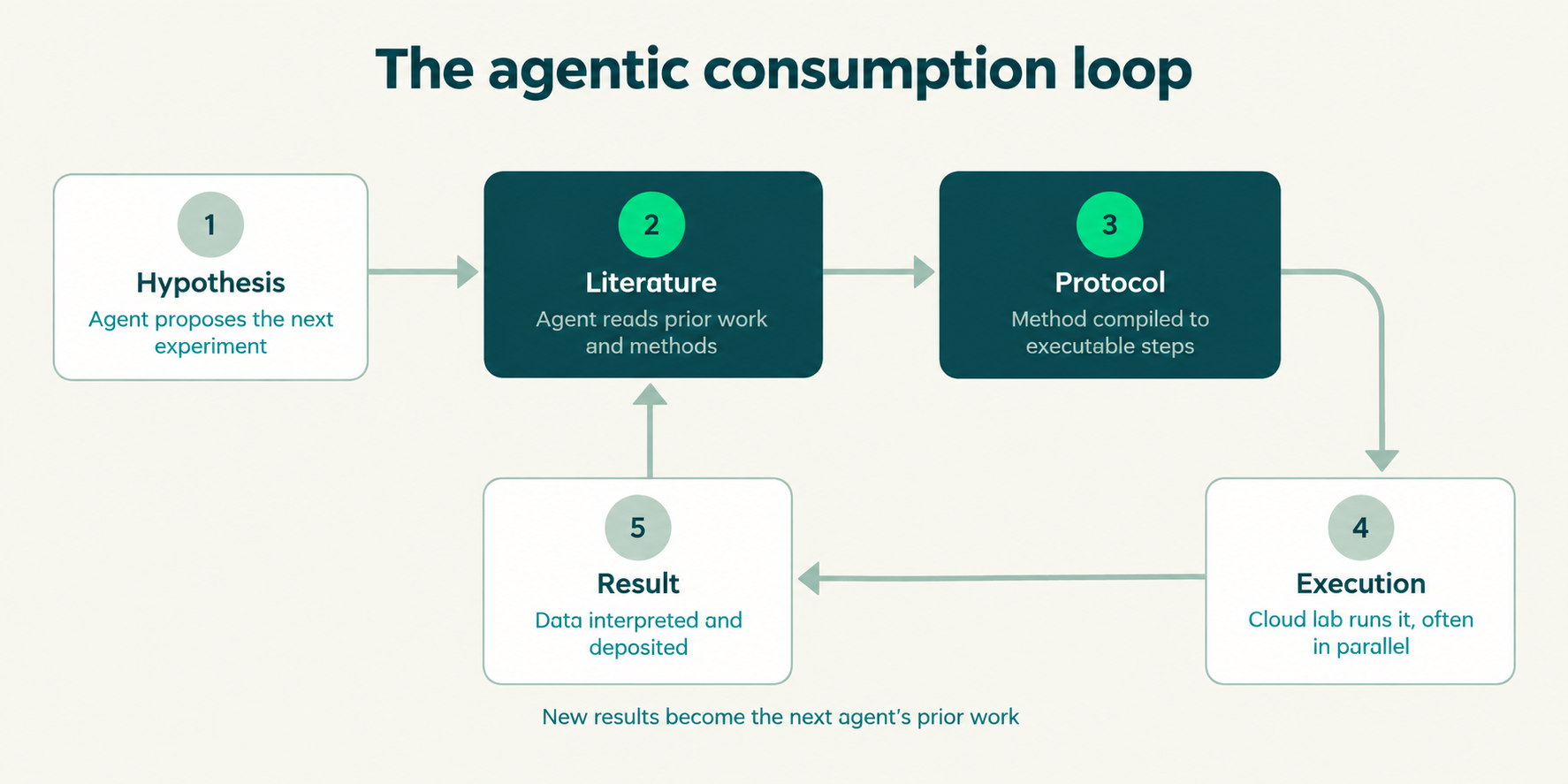
While this illustration is based around cloud labs, the robotic element is optional. Reusing code, configuring a simulation, or extracting evidence into an analytical workflow also qualifies. In the humanities, interpretation and context may remain inseparable from close reading; even in experimental science, automation will vary sharply by task. There is no reason to expect one pattern across scholarship.
Why this Hypothesis Deserves Attention
We are already seeing this become more than a hypothesis. In July 2026, the US National Science Foundation announced $380 million for 20 teams developing programmable cloud laboratories, matched with funds of upwards of $20 million from the Astera Institute. The program includes work on reusable data, standardized metadata, and new ways of publishing results. This is an investment in building out capabilities in this frontier space, and the money involved shows a high level of interest. This is not unique to the US. For example, in Canada, the Acceleration Consortium at the University of Toronto received $200 million, Canada’s largest-ever research grant, to develop self-driving labs. The same pattern, though harder to spot, is also happening across China.
There is also early evidence from computational research. A 2025 preprint in AgentRxiv describes agents sharing research reports and building on earlier results. In its experiments on reasoning and prompting methods, access to shared research improved benchmark performance. While this is a limited demonstration and not evidence of reliable autonomous wet-lab discovery, it does make a useful point: the record an agent retrieves can affect what it does next.
This is not limited to governments and funders. We are seeing significant growth in the commercial sector, not just through tools like Claude for Science, but also dedicated start-ups like Discovery Loop. Discovery Loop, founded by high-level talent from Google and beyond, describes plans to automate experimental cycles, initially in machine learning research. As a sign of the potential in this area (or arguably the state of the AI hype cycle for more cynical readers), they are already seeking a $50 billion valuation, and look likely to attract more than $1 billion in financing already. This is not unique; money is flowing to other start-ups in this sector, like Periodic Labs ($300 million) and Lila Sciences ($235 million). Big bets are being made on the power of AI to accelerate the scientific process.
In the work we are doing at Wiley, we are also seeing researchers develop systems at institutions that repeat these processes. In interviews with users of the Wiley Scholar Gateway, we have heard that researchers are using it to help power self-driving labs and to accelerate guideline writing processes. Recognizing that these are use cases from some of the most prolific users, we expect that where they lead, others will follow, rapidly.
However, we should emphasize that these are early days. While this space is evolving fast, these developments give publishers a reason to test how their content behaves inside such workflows without the pressure of the market being fixed. There is time for adaptation and for discussion around how this will influence our industry.
Machine Reader Needs
Publishers are used to considering what humans need to get the most out of their content, but how do machine readers differ?
One key aspect is access. Many systems today are built for agentic discovery, using agents to crawl abstracts to guide their human readers to relevant content for them to read and act upon. This will not work for machine readers, as experiments cannot be run based on abstracts alone. Full text access is needed. This is perhaps best illustrated through the humble method section in an article. To run and plan an experiment, a machine reader needs access. This is also where systems built for humans create challenges. For good reason, detailed sections on materials and methods lie buried in supplemental data (if they exist at all). This is okay for humans, but problematic for machines.
Access to full-text research raises several other challenges. How do we know who is requesting the material, whose entitlement applies, and what use is permitted? This is partially solved by machine-readable permissions, which can help a system act within agreed terms, but what happens outside those terms? This is partially solved by machine-readable permissions, which can help a system act within agreed terms. This is something that we are increasingly focused on.
How do we also handle the fact that the scholarly record is a living, breathing artefact? Those of us in the industry know articles can change, for example, through a correction or retraction process. How is this communicated to machines? A connector based on the Model Context Protocol (MCP) is one route for exposing tools and content to an AI system. This allows machines access to the current version of record, the most up-to-date version, the version of truth. This creates an environment to work across the interfaces researchers choose, ensuring AI tools and agents connect directly to publisher content. This includes researchers who use an institution’s existing AI environment. Publishers should expect demand for content access through those tools as well as through publisher-built applications.
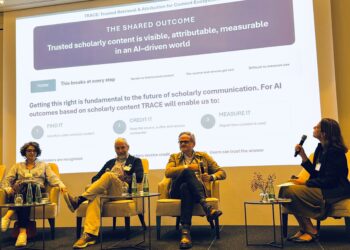
Beyond access, there are a myriad of aspects we need to consider. This is where ongoing work by groups like NISO and COUNTER, such as through the new TRACE initiative, to solve key challenges around provenance, attribution, and usage is so important. This work is looking beyond just discovery and considering these challenging questions.
Content itself will need to adapt. A good example of this is in publishing negative results from research. Systems that repeatedly learn from successful experiments while failures remain inaccessible risk reproducing publication bias and wasting resources on known dead ends. Building on this, the loop described above will generate massive amounts of data, a lot of it negative as experiments fail, which will need to be incorporated into the scholarly record. Does this look like papers generated by machines or more like data sets with machine-readable signals?
What Happens Next?
The good news is that we have time. This is in its infancy. What can publishers do?
The first step is to engage. Across the industry, we broadly see three postures among publishers: passive, transactional, and strategic. Passive players are increasingly rare and can be characterized as blocking all crawlers, waiting for litigation to rule on areas like fair use, and adopting a wait-and-see approach. Transactional players are the most common, with publishers reaching licensing deals, but often at the cost of losing visibility into how content is used and losing touch with the consumer of their material. Strategic players emerge at the frontier. This is where content is delivered by governed, metered, attributable infrastructure. It is the harder route but arguably the most enduring, ensuring publishers retain data and relationships.
In this third posture, players embrace difficult conversations and engage with community groups like NISO, COUNTER and beyond. Standards are agreed, and the industry adapts.
Where I Might Be Wrong
I have framed this concept of agentic consumption as a hypothesis; one where I see strong signals, but I don’t have a crystal ball for the future. What could change my mind? If we see early adopters start clicking through to full text as the interface improves, then perhaps the low click-through rate we increasingly see is a product weakness and not a signal. If autonomous laboratories stay stuck on a narrow band of materials and in very distinct and limited subject verticals, humans will dominate readership for another decade.
What makes this so interesting is not just the hypothesis, but the open questions it raises. What happens when an agent reads 300 papers and runs one experiment? What chain of custody does a model-extracted, robot-executed protocol require? If agentic loops cache, how do you stop a withdrawn method from running long after the retraction notice goes up? How do we prevent this house of cards effect?
This is where our strong position, decades of expertise, and entrenched relationships are so important. Now is the time for the community to question, debate, and engage.
Author note: AI was only used to generate the original graphic in this post.