Is open access (OA) publishing a vanity press industry?
At one end of the OA publishing spectrum are highly-selective journals like PLoS Biology; at the other, journals that may accept any manuscript — even a piece of computer-generated nonsense — as long as the author was willing to pay. In the middle of these extremes is some vague territory that has not been explored outside of anecdotes and speculation.
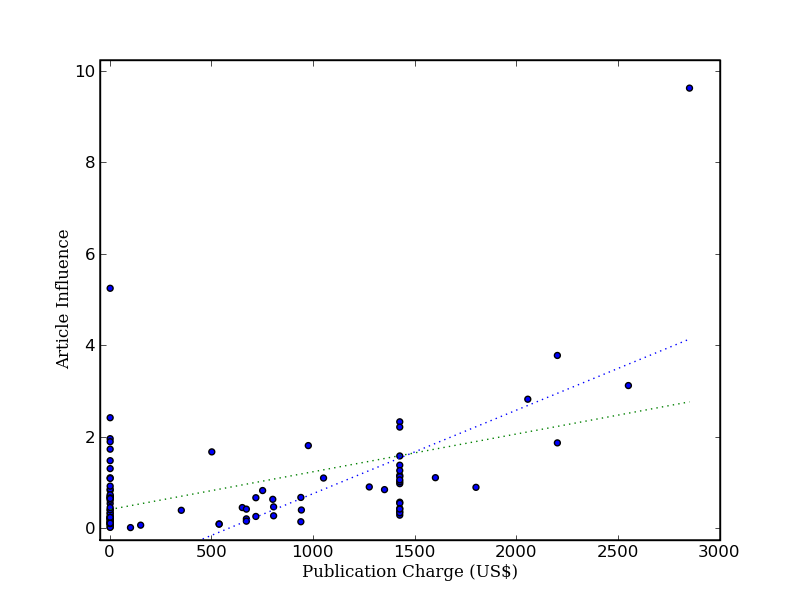
Last week on his blog “The Occasional Pamphlet,” Stuart Shieber attempted to answer this question empirically. In his post, Shieber plots an OA journal’s Article Influence Score (a measure of article quality) by the journal’s article processing fee. The direction of the relationship is his chief interest.
Shieber argues that a negative relationship between quality and price is indicative of a vanity press market. His argument is derived from the trade book publishing market, where vanity presses publish low-quality books at high prices to authors, while at the other end, very selective publishers generate high-quality books at zero cost (or often negative cost) to the authors. Shieber summarizes this inverse relationship between quality and price:
In summary, the higher the publisher’s quality standards, the lower the fee the author must pay for services. Conversely, if an author is willing to pay enough, some publisher will be willing to take on the publication. This is the genesis of vanity publishing, and its hallmark is the inverse correlation between publishers’ quality standards and the fees they charge.
Shieber then applies this logic to the OA journal market. Not surprisingly, he finds a strong, positive relationship between quality and price and concludes that OA publishing — while not immune to vanity press publishers — is no more prone to this kind of business model than subscription-access publishing.
Does Shieber’s argument make sense? Yes, but his starting assumptions are incorrect, leading Shieber to misinterpret his data and derive the wrong conclusions.
First, Shieber confuses fixed costs with marginal and total costs. The fixed costs to produce a book include the editorial work, design and layout of a book. These are often referred to “first-copy costs,” and they do not vary whether you print ten, one hundred, or a million copies. Marginal costs are the additional expenses required to print and distribute one more book. Total costs, are simply fixed costs plus total costs, as I’ve illustrated below.
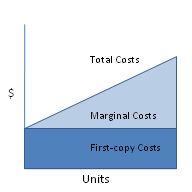
In the print book market, each copy that is sold includes its marginal costs along with some fraction of fixed (or first-copy) costs. When hundreds or thousands of copies of a book are sold, total revenue can cover the entire first copy costs involved in producing the book. When even more are sold, the publisher can make a profit and even share some of these profits with the author in the form of royalties.
For a hypothetical vanity press that sells no books — and thus incurs no marginal costs — first copy costs are borne entirely by the author for the privilege of publishing. Provide higher-quality editorial services, professional layout and design, and these costs must be transferred entirely to the author. Hence, for a publishing model that incurs only first-copy costs and no marginal costs, one would expect that quality is directly related to price, and thus one would expect a positive correlation between the two. Still with me?
Now an open-access publisher is like that hypothetical vanity press described above because it only deals with first-copy costs. While there are certainly overhead costs incurred with setting up computers and purchasing bandwidth, the cost incurred to the publisher for sending one additional copy of an article to a potential reader is essentially zero. And like that hypothetical vanity press described above, we should expect a positive correlation between author processing charges and article quality, which is exactly what Shieber reports in his study.
Second, Shieber is only plotting those journals which have been given an Article Influence Score by ISI — that’s just 103 journals out of the 4,370 OA journals listed in the DOAJ, or about 2%. While he computes the correlation between price and quality for journals that do not levy an article processing fee, what’s missing from his analysis are those 98% of OA journals which levy a processing fee but have no Article Influence Score. Had these journals been included in the analysis (either with imputed influence scores, or by given arbitrarily low scores), the graph may have looked very different.
Third, there are some other issues with the analysis which should be raised:
- Prices charged to authors may not be the true costs incurred to the journal for publishing an article. PLoS ONE authors are charged more to publish their article with revenues diverted to subsidize authors who publish in PLoS’s flagship journals, Biology and Medicine.
- Journals have many sources of revenue and these sources of revenue may keep article processing fees lower than the true costs.
- Publishers may keep article processing fees below cost because there is no author market at the true cost. Remember how BMC introduced article processing costs at $525 just a few years ago, fees that are now more than three times that figure, with some titles charging substantially more?
In sum, prices charged to consumers may not reflect true costs, and true costs should not be equated with prices.
In conclusion, Shieber’s positive correlation between quality and price cannot be viewed as evidence against an OA vanity press industry. If anything, they support the claim.
Moreover, by plotting only the 2% of open-access journals, we may only glimpse what is taking place in the most successful strata of open-access journals. This is like reporting on the book publishing industry by focusing solely on the New York Times Bestseller list.
Open access publishers have flooded the market with thousands of new author-pays titles in recent years, advertising fast publishing at very competitive prices, some now as low as $99.95. Shieber’s analysis entirely misses this emerging publishing market geared to service the needs of authors first and readers second. This may be the dominant paradigm in author-pays, open access publishing, with publishers like PLoS bucking the trend. We would not know this, unfortunately, from this study.
![Reblog this post [with Zemanta]](http://img.zemanta.com/reblog_e.png?x-id=156ecd21-8df5-4a70-bdd0-cf9010c2a1a9)

Discussion
21 Thoughts on "Open Access and Vanity Publishing"

Excellent. Well argued. I had concerns about the Shieber article myself (it contained a number of non-sequiturs), but you have put it very much more elegantly.

Re: “Shieber’s analysis entirely misses this emerging publishing market geared to service the needs of authors first and readers second. This may be the dominant paradigm in author-pays, open access publishing, with publishers like PLoS bucking the trend.”
There is a false dichotomy here between serving the needs of authors and serving the needs of readers. In scholarly communication (unlike in most other forms of publishing), the authors and readers are overwhelmingly the same group.
So the relevant concern is not about which group is served better by Open Access publishing. But rather, which publishing model best addresses the underlying goal of effective communication between scholars.
Under the Open Access model, the service of communication tends to be paid for directly by research funders (via authors). Under the subscription-access model, the service of communication is paid for indirectly via the transfer of licensing rights.
The OA model offers many advantages to both readers and authors.
Meanwhile, the high ranking of Open Access journals from BioMed Central, PLoS and other OA publishers in the Thomson Reuters Journal Citation Report has largely silenced those critics who originally suggested that Open Access would not be compatible with high editorial standards.

Matt,
Thanks for your comment, but I think you’re missing my point (and committing the same logical fallacy as Shieber in the process).
I’m not saying that all OA journals have low editorial standards, only that Shieber’s analysis focuses on the top 2% of the OA journal market, and thus, he cannot make generalizable statements about the market as a whole.
Similarly, the fact that some BMC journals have Impact Factors does not mean that all OA journals have high editorial standards.
In philosophy, this is called the Fallacy of Composition.
Phil,
You may have misread my post.
What I said was:
“the high ranking of Open Access journals from BioMed Central, PLoS and other OA publishers in the Thomson Reuters Journal Citation Report has largely silenced those critics who originally suggested that Open Access would not be *compatible* with high editorial standards”
[emphasis added]
Clearly, there are large numbers of titles in existence (some closed access, some open access) which do not have high editorial standards.
The only point I am trying to make is that BMC and PLoS (and many other high quality OA journal publishers) demonstrate that there is no *incompatibility* between author-side fees and high editorial quality. This seems rather uncontroversial, especially given that many traditional subscription journals also charge author-side fees of various kinds.
Thanks for the clarification. I don’t know to which silenced critics you refer, but we need to be careful when making arguments about the market versus individual journals
If someone says that OA publishing is strictly incompatible with high-editorial standards, then a single exception should dispel that argument. But no one here is making such a categorical statement.
Shieber is making a market argument based on the general trend of two regression lines.
Since his dataset is only composed of journals with article influence scores, he eliminates the possibility of even deriving a reverse conclusion. If we were to find evidence of a vanity press market, it should be in those journals that charge authors but have no scholarly influence.
I agree, Matt. I should have said that I found Shieber’s article problematic because he sets up a straw man (that author pays OA = vanity publishing). No one seriously thinks this, or at least, no one I know!
Shieber also makes the nonsensical statement “A profit-maximizing open-access journal can only increase revenues by increasing the number of articles published or raising the fee per article, both of which will require lowering its quality standards.” By what stretch of the imagination does raising the per article fee require a lowering of standards? Try telling that to Cell Press!

I think that the idea that raising the per article price will lower quality standards comes from the intuition that at a higher price, there is a smaller pool of authors who are willing or able to pay. If one assumes that price is not correlated with quality (e.g. that raising the price does not increase the percentage of higher quality articles or that we have the same distribution of quality), then there would be a smaller pool of articles that meet the quality standard. (And the journal will need to drop standards to make the same profit.) I’m not sure if that is the reasoning behind Shieber’s statement, but it was the only interpretation that vaguely made sense.

The cost of delivering electronic publications is most certainly not a zero marginal cost. Also, printing has economies of scale, web delivery does not.
It is very easy to double or triple your print run — call the printer. It is much more difficult and expensive to double or triple your web traffic.
Carter,
What would you estimate the cost of delivering a PDF article?
Even if you estimate something as high as a penny, the first-copy costs of publishing an article amount to hundreds to thousands of dollars. I think we can be safe to assume that the marginal costs incurred by a publisher for electronic delivery are close enough to zero to be considered irrelevant.
(remember, we are talking marginal costs and not overhead costs).

Web delivery does not have economies of scale????? Ok, take your downloads per day and your total web delivery cost, including R&D and do a division. Then multiply by a 300 million, then multiply by 365. If your number is greater than $10 Billion ($0.09/download), then you’ve proven the existence of web delivery economies of scale.

Philip Davis makes two arguments here. He argues that the graph of the relationship between price and quality would have looked very different if all DOAJ indexed OA journals have been taken into account (which I understand as he is expecting that the positive correlation would have been negative). But then he also argues that the positive correlation found in the current study is evidence supporting the claim that OA scholarly journal publishing is vanity publishing.
I have to ask myself what should the results of the study have shown for Philip Davis to come to a different conclusion than the one he already has in mind. Would a negative correlation (which he expects if the study covered more journals) change his mind or would a higher positive correlation (in case it turned out to be the case if more journals were taken into account) change his mind about the issue? It seems to be that he would have arrived to his conclusion no matter what the data would have revealed.
Ahmed,
Thanks for you comment, but I think you missed my argument and are implying conclusions I did not make. Let me summarize my two points:
1) The trade book industry is a poor comparative model to the online-only OA journal market, leading Shieber to make a reverse prediction based on economic theory alone.
2) The 2% of the journals analyzed by Shieber is not a representative sample of the entire DOAJ list. Any attempt therefore to make a generalization from this sample to the rest of the market may lead to completely erroneous conclusions.

Hi,
1. Why do you want to include OA journals that charge no author fees in this analysis? If they charge no author fees how can they ever fit any definition of “vanity press”?
2. Shiebers graph is “impact” vs. author price. You make an argument about the relation of the quality of publisher services against the fixed cost of those services. Why is that relevant to Shiebers graph? How strong do you think the correlation between quality of publisher services and scientific impact is?
Best
Anders
Reply:
1. Zero is a price just like any other price. In the trade book market (Shieber’s comparison), there are publishers who charge zero prices to authors, as well as a negative prices (author royalties). Without including all the data, we have no idea of what the entire market is doing.
2. If I understand the first part of your question, author publication charges should have some positive relationship with production quality in a business model where total costs only include fixed — but not marginal — costs.
I think there is (and should be) a strong correlation between quality of publisher services and scientific impact, although the correlation may be associative and not causal. The real driver of scientific impact is content.
Hi again,
1) “Without including all the data, we have no idea of what the entire market is doing.” – But “including all the data” is exactly the mistake. Because then you will include data from outside the market. Eg. you will include grant based not-for-profit publishers and society journals. If some publishers don’t publish for profit, they are simply not in the same market as vanity publishers.
2) “The real driver of scientific impact is content.” – I think so too. But with that in mind, I don’t think your comment about publishing cost and quality of publisher service, can be applied to Shiebers graph. Right?
Best,
Anders
Thanks for the reply,
1) Shieber does not make the distinction between commercial and non-profit journals. He only plots those journals that have article influence scores. Likewise, his economic model that predicts a negative correlation does not make a distinction based on profit/non-profit. Perhaps, as you argue, he should have.
2) I’m not sure I understand your question. If the publishers that select and publish high-quality articles also tend to provide high-quality production services, then we should see the same positive relationship between article influence and article processing fees.
A side comment:
You don’t have to agree with everything Chris Anderson writes ( http://www.wired.com/techbiz/it/magazine/16-03/ff_free ) to realize that free is *not* “a price like any other”. Yes, free is a price. But in most fundamental respects free is a price totally unlike any other. The economics of something which is priced as “free” are very different from the economics of something that is priced at, even, say, $0.01.
And so if you are seeking to come up with an equation to link price to some other factor, then excluding free makes a lot of sense, as an equation which accurately links a finite positive price to that factor is unlikely to extend accurately to the case of something being free.
Reply to Matt Cockerill:
I agree that zero price may work differently than a non-zero price.
My main argument is that Shieber systematically ignored two major journal groups in his analysis:
1) zero-priced journals with no article influence scores, and
2) non-zero priced journals with no article influence scores
These two groups make up 98% of the OA journal market (as represented in the DOAJ) and are ignored in Shieber’s analysis.
But more importantly, if we are to look for evidence of a vanity press market, we should be looking at the uncited journals, not at the journals that have built prestige (like PLoS Biology).
This is like looking at the incomes of Bill Gates and his friends and declaring that there is no evidence of poverty in the United States.
Hi again, again :o)
1a) Shieber does make a distinction between 0-price publishers and others. There are two lines in the plot. The blue one doesn’t include 0-price publishers.
1b) Also his analysis is explicit about the profit motive. It starts: “A profit-maximizing open-access journal can only increase revenues […]”
2) Shiebers point was to show that there is a correlation between price and impact. Your argument seems to be more like “if you pay more, you’ll get more glittery paper” – (publisher price, publisher service quality) which seems to need something more to be relevant to Sheibers point.
But Shiebers conclusion is so unsurprising that I don’t know why you bother quibble with it: Vanity journal *domination* is not occurring, nor is it likely to occur, among OA journals.
Best
Anders
Hi again Anders,
1a) Yes, Shieber plots two lines (one which includes zero-price journals and one which excludes them). Remember, however, that he is is missing two other kinds of journals: 1a) zero-priced journals with no article impact score, and 2) non-zero priced journals with no article impact score. These two excluded groups make up a full 98% of the DOAJ. To reiterate one of my points, Shieber cannot make a statement about the general OA market based on his data.
1b) Yes, Shieber makes an argument about profit-motive related to pricing (something that Stuart Taylor (comment #3)critiques as “nonsensical”). If you look at Shieber’s dataset, you will note that profit status is not a variable nor does he include it in his analysis.
2) No, my principle argument is that Shieber cannot derive his conclusions (that vanity publishing is not a dominant model) from his data because of 1) a flawed economic model, and 2) a biased dataset.
Sincerely,
Phil