In May, the US Government’s Office of Management and Budget (OMB) released proposed changes to the “Uniform Guidance” (rule 2CFR Part 200) for how organizations may use funds received via federal research grants. A great deal has been said and written about this proposed change in the last few weeks, so, with less than one week remaining for the public comment period, we asked the Chefs: How are you (or your organization) responding to the OMB proposed rule change?

Lettie Conrad
Essentially, money is energy — and the OMB rule change is a blatant attempt to redirect the flow of energy that supports scholarly communications. This power grab is the latest battle in this war against science and our trusted systems of research and discovery that codify our collective human knowledge.
Although I am finding it exhausting to remain vigilant and fired up in the face of unrelenting corruption and chaos in Washington, DC, after reading Darla Henderson’s call to action last month, I submitted a response to the OMB. I drew on the various resources she recommended and crafted a simple 2-page letter explaining my vantage point as an information professional and information science lecturer, and my disagreement with the rule change.
My letter offered a list of eight concerns, supported by technical policy details from Sarah M. Trimmer’s amazing Google doc “OMB Comments for Busy People.” Here are just a few of those points:
- Burden reduction: The OMB’s stated objectives of limiting administrative burden for grant recipients would not be met by the proposed rule change — in fact, it would exacerbate these wasteful policies.
- Contracting existing law: The OMB claims to restore legal alignment, but in fact, the proposed rule change overrides statutory frameworks it fails to acknowledge.
- No accountability: While transparency is touted as a leading reason for this change, governmental accountability is systematically removed.
- Ideology, not fiscal control: The OMB grounds the proposed rule change in its authority over financial management — however, the most significant provisions in the rule use fiscal control as a means to force undemocratic ideological alignment of research funding programs.
I’ll admit, sending this letter felt a bit like yelling into the wind. I’m encouraged, however, by so many examples of the current US administration folding in the face of organized resistance — from Jimmy Kimmel to illegal slush funds. The fact is: Resistance works! Democracy requires (y)our (cou)rage!
Robert Harington
In late June 2026, The American Mathematical Society (AMS) Committee on Science Policy officially responded to the proposed rule on “Regulation for Federal Financial Assistance (2 CFR Part 200)” in strong opposition to the proposed rule, focusing comments in four areas: 1. the nature of mathematical collaboration and the importance of conferences, 2. award stability and termination, 3. the merit review process, and 4. reducing award recipient burden.
Last week, The President of the AMS, Ravi Vakil and the CEO of the AMS, John Meier released the below statement that explains what is going on and why scholarly societies and indeed all of us need to be aware, alarmed, and ready to respond:
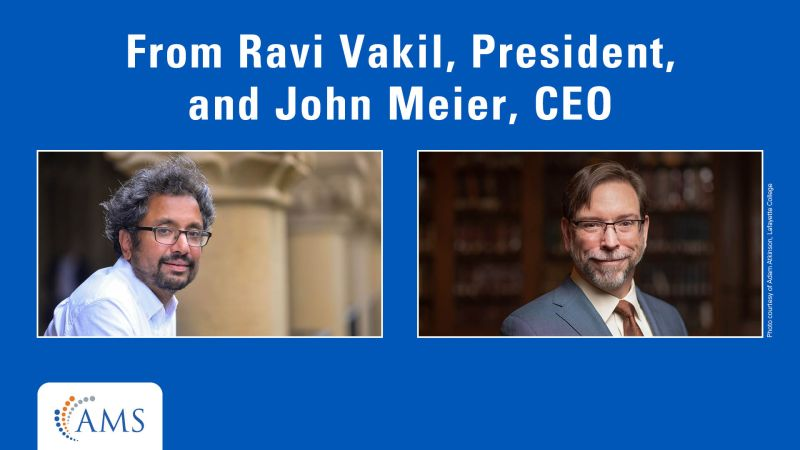
“On May 29, 2026 the White House Office of Management and Budget released a proposed rule, Regulation for Federal Financial Assistance, revising the entirety of federal grantmaking and federal cooperative agreements in the United States.
Proposed new rules for federal financial assistance, including research grants from the National Science Foundation, would significantly reshape how research and education in the mathematical sciences are funded, conducted, and communicated. These proposed changes are alarming and would negatively impact the United States’ mathematics research infrastructure that has been built over decades. Because of the significance of these changes in how grant proposals are reviewed, awarded, and how awards can be terminated, we ask AMS members to review these proposed changes and then consider taking a few minutes to file public comments on or before the deadline of July 13, 2026.
What’s being proposed
The Office of Management and Budget (OMB) has put forward a comprehensive revision to 2 CFR Part 200, a regulation that impacts all federal research and education funding. The National Science Foundation, in coordination with OMB, is proposing to replace its Proposal and Award Policies and Procedures Guide with policies and procedures that align with the rules proposed by the OMB.
Taken together, these proposals would:
- Place political review over peer review. A senior political appointee would have authority to approve or reject any discretionary award as part of a pre-issuance review, and this review must consider if the award will demonstrably advance the President’s policy priorities. The current merit-review system, where the expertise of review panels is core to the evaluation of proposals, insulates scientific judgment from politics. This additional review also adds a layer of bureaucratic delay and expense to the process.
- Expand the authority to terminate grants. Agencies would have broader discretion to terminate awards, with little notice, less process, and less recourse. For research that unfolds over years, this creates uncertainty that will affect what projects can be proposed and our home institution’s ability to underwrite the risk of employment opportunities and investments in research infrastructure.
- Curtail scholarly communication. Costs associated with publication and conference attendance would only be allowable if they are approved in advance by the funding agency, with the presumption that publication costs such as article processing charges and open-access fees would not be allowed.
- Restrict international collaboration. Proposed provisions would impose new requirements on grants involving foreign collaborators, making international collaboration more difficult.
What we’re asking you to do: Submit public comment
We are asking AMS members to submit comments on the OMB Uniform Guidance by the deadline: July 13, 2026.
Please do not wait until near the deadline for submitting comments as the system can slow significantly in the final days.
If you would appreciate some guidance on what to say, The AMS Committee on Science Policy (CSP) has submitted detailed comments about this [PDF]. The CSP comment is a valuable resource in thinking about your comments, but it does not remove the need for individuals to comment as the public record is shaped by individual voices, and specific, credible accounts from AMS community members are needed.
When you write, please keep the following in mind:
- Say who you are and why your perspective is relevant. Mention your role, your institution, and your connection to federal funding.
- Reference the specific section you’re addressing (e.g., [§ 200.205], [§ 200.340], [§ 200.461]).
- Be concrete and write in your own words. A real description of how a provision would affect your research program, your students, or your department is far more useful than a general objection. One specific consequence, clearly explained, is enough.
- Keep your comments public-safe: describe your work in general terms, and do not include award numbers, grant titles, or specific dollar figures.
We note that comments do not need to be long.
You can also make use of the American Physical Society portal, which offers suggestions for comments about four areas of impact this rule would have. All comments are funneled to Regulations.gov.
After submitting your comments, reach out to your congressional delegation to share what you wrote. If you need help in making a connection to your Senators and Representative, we encourage you to reach out to the AMS Office of Government Relations.
Why this moment matters
Mathematics and the more general scientific enterprise have benefited greatly from a partnership among private entities, governmental support, and higher education that has advanced science in ways that demonstrably benefit the United States and humanity broadly. The decision to invest in foundational science in a manner that is efficient and informed by disciplinary experts has been key in creating this robust ecosystem. The proposed rules and regulations directly contravene this historic investment.
The federal government seeks, and is required to seek public input on proposed rules and regulations before they are implemented via the Federal Register. We appreciate all those who take the time to weigh in on these proposed changes before the deadline of July 13th, 2026.”
Haseeb Irfanullah
As a Bangladeshi scholarly publishing enthusiast, I take a different view on the proposed revised rule by the OMB. I focus on Section 200.461 — publication and printing costs, which disallows article processing charges (APCs) under Federal funding.
Academic publishing suffers from multifaceted injustices — by maintaining exploitative peer-review processes, by manipulating trust and biases, or by opaquely framing Diversity, Equity, Inclusion and Accessibility (DEIA). The APC, in the name of promoting open access, is no doubt one of the biggest sources of injustice in the publishing industry. I therefore believe the OMB’s proposed refusal of the APC has created an opportunity to transform the current APC-dependent open access system.
At an institutional level, the NIH has already been trying to reform the APC by introducing a fee limit. Preprints, however, could be a great option to connect the US government’s two related mandates: i) to make federally funded research openly accessible (as in the 2022 OSTP Memorandum), and ii) not draining out federal funds in the name of APCs (as proposed in the latest OMB revisions). But no US federal agencies offer notable support for preprints.
Besides a few research funders, we don’t see any strong support for the preprint becoming a mainstream scholarly communication channel by the majority of information professionals. This is apparently because such a change would undermine the status quo that the journal publishing industry is trying to maintain; be it commercial publishers, mega-journal publishers, or society publishers, journal publishing is a source of revenue for all. That’s why many publishers express ‘token acknowledgement’ toward the preprint.
To readers of this article who are planning to submit comments on the OMB proposals, please think if the apparently disruptive OMB proposals are all bad for the scholarly ecosystem. We definitely shouldn’t fight old injustice by introducing new injustice. But with the systemic changes the scholarly ecosystem needs to overcome its APC-related biases, shouldn’t we capitalize on the opportunity the OMB is giving us to mend and mold our individual selves?
Those of you who are worried about the future of publishing, let me tell you a quick story. In January 2025, we were very anxious about the end to USAID’s support in Bangladesh, along with the rest of the Global South. How have Bangladesh’s people, NGOs, and development workers been surviving over the past 1.5 years? It seems that the now-closed USAID was indeed important for us (as it provided almost US$ 400 million a year), but we have moved on by adapting to the situations in our own ways.
Is scholarly publishing resilient enough to survive the new OMB rules?
Roy Kaufman
As I write this on July 6, more than 80k comments have already been submitted to the OMB. CCC’s submission, like these comments, will be short. The proposed Uniform Guidance has quite a few challenges. We focus on the proposed limitations on funding for publications, author fees, and conferences. These will collectively undermine the ability of researchers to share the results of US-funded research and will undermine the stability of publishers and learned societies. Research will become the proverbial “tree that falls in the woods.” Those who rely on the research, including businesses and universities, will suffer.
Alice Meadows
The proposed OMB rule change should be setting alarm bells ringing loudly for everyone in our community and beyond. If implemented, it will have devastating consequences for research and researchers in the U.S. and around the world. The proposed changes will shape what research is selected to receive federal funding and impact almost every aspect of how that research is evaluated, financed, and disseminated. Rather than being conducted based on its scientific and scholarly merit, research will be conducted based on the whims and political goals of the administration. There’s so much in the proposed change to object to that it’s hard to know which elements to comment on. Because of my work with the #DefendResearch team, I decided to focus on a couple of the areas related to censorship — restrictions on international collaborations and on association membership and professional activities/conference attendance.
- Prohibition of Using Federal Funds for Covered Foreign Collaborations. Research is, by its nature, a global endeavor. Efforts to make the world a better place for everyone — through healthcare developments, technical innovations, archaeological findings, and more — necessarily involve bringing together the best and brightest minds globally. In some disciplines, such as physics, research projects routinely involve literally thousands of contributors from hundreds of institutions around the world. Placing restrictions on American researchers’ ability to collaborate internationally won’t just affect our international partners; it will result in the U.S. losing its long-held position as world leader in science and scholarship.
- Conferences; and Memberships, Subscriptions, and Professional Activity Costs. These two proposed changes, like the one above, run completely counter to how research is, and always has been, conducted. Science and scholarship can’t thrive in a vacuum, and research is iterative. Researchers need to engage with each other in order to share and get feedback on their hypotheses and early findings, which then enables them to refine and successfully complete their work. Conferences, memberships, and other professional activities are where and how that engagement occurs. Limiting participation based on political, rather than scientific, merit will likewise limit researchers’ ability to produce timely and rigorous research that incorporates community input ahead of the formal peer review process.
I sincerely hope that, as a reader of The Scholarly Kitchen, you (and your organizations) will also submit your comments if you haven’t already done so. It’s vital that we all make our voices heard.