- Image via Wikipedia

Last week was busy for those attending both the SSP Board meeting and IN conference. The Board considered broad industry topics, one of those being, “How do we work with a new cast of characters, including competitors and collaborators, in the scholarly information space?” Immediately thereafter, we swiveled to grapple with interactive learning, serious gaming, and product innovation at IN.
Enter The Scholarly Tycoon, loosely modeled on the AppleIIe game Lemonade Stand and the more recent Lemonade Tycoon (with a little Magic: the Gathering thrown in for good measure), which takes a lighter-side look at using gaming models to get comfortable with new players, business relationships, and outcomes in a postapocalyptic digital information landscape.
The Mission:
You lead a team of specialists navigating uncharted territory. There are unparalleled opportunities for success, but the terrain is riddled with traps and karmic zingers. It takes courage, discernment, agility, and persistence to reach digital Valhalla.
Progression of Play:
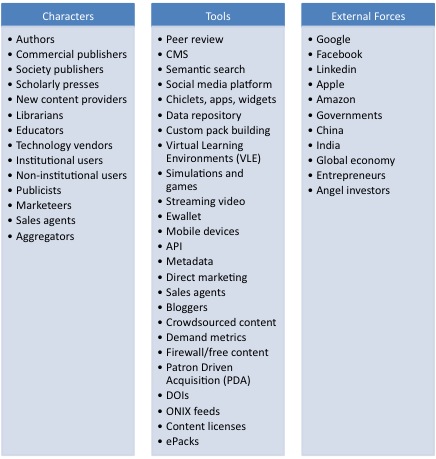
Each player or team blindly selects eight virtual asset “cards” consisting of four character cards and four tool cards. A description of character, tool, and other cards in the deck follows.
Players choose paths to follow as they explore an ever-evolving landscape. They achieve success by reaching new levels of play, maximizing and winning encounters with other characters and external forces, and accruing new tools along the way. Chutes and Ladders style, they experience near-disastrous setbacks and discover shortcuts that speed them to next levels. If alert, they may uncover disguised assets to add to their decks along the way.
Players build or lose points by challenging or partnering with other characters and external forces in the field of play. Wins and losses depend on the assets that are held in the player’s hand, which can be spent to overcome the challenges of each encounter. Players receive bonus points for each new encounter, even when the outcome is not positive. Players draw new cards after each engagement.
The deck is also interspersed with unexpected karmic zingers (discussed below), which may have positive or negative results.
Characters, Tools, and External Forces in the Deck:
Karmic Zingers and Point/Category Impacts: (examples)
- Accept a bogus research article: -4 Reputation
- Develop a sub-disciplinary taxonomy: +4 Breakthrough
- Competitor beats you to market: -3 Energy
- Offshore select editorial production work: +3 Energy
- Your sister marries Mark Zuckerberg: Lose all reputation points but win the game
- Your favorite technology vendor is acquired by a commercial competitor: -5 Energy
- Develop an app-based mechanism for ILL: + 5 Breakthrough
- Present at TED: +6 Reputation
- Find an error in your semantic search algorithm: -3 Breakthrough
Winning:
The game exists within a time- and resource-delimited framework in which players can collect and play asset cards and score points based on engagement outcomes and karmic surprises. When playing time expires, the system generates a cumulative mission impact score, which is algorithmically generated on the basis of:
- Levels attained
- Number of meetings/collaborations
- Points in four categories: Revenue, Energy, Reputation, and Breakthroughs
If you’d like to play this game, stop reading now and get back to work.
Happy Friday!


Discussion
3 Thoughts on "Introducing “The Scholarly Tycoon” — Gaming for STM Publishers"

Sounds like fun Alix and excellent follow up from IN, can’t wait to see the online avatars … I had a fun idea that you could have a game environment that helps catch real world publishing pirates … the game helps you issue notices on the pirates, while having an online army of pirate police, and they get real world rewards for helping find and take down pirated content … just a thought if you want to combine with your game, happy to share the royalties 😉 or are we an OA not for profit game ?

Excellent question, Adrian. The topic of good guys, bad guys, and tracking down copyright violation connects interestingly with Kent’s post yesterday.
Somehow I think the only folks interested in our $39.95 off the shelf game will be those of us who, in fact, play the game everyday. It’s nice to try to get the 30,000 ft. perspective once in a while.
I was reading Dave Rapp’s coverage of the ITHAKA conference yesterday, musing about how these many valid and innovative but diverse approaches to discovery actually fit together (contemplating the big picture data strategy). May be the beginnings of yet another session!
Best. A