Editor’s Note: Today’s post is by John W. Warren. John is Professor and Director of the Graduate Program in Publishing, College of Professional Studies, George Washington University; founder and publisher of the GW Journal of Ethics in Publishing; organizer of the GW Ethics in Publishing Conference; and founder and co-organizer of the Student Journal Symposium for Literary and Research Publications.
Student publications are a vital element of the research ecosystem. Experience with a student-led journal can inspire young people to pursue a career in publishing, instill valuable leadership lessons, and nurture best practices in scholarly communications for students in any field of study.
The 2nd Student Journal Symposium for Literary and Research Publications demonstrated these values and created community among student-led journals who gathered at the George Washington University and online, May 1-2, 2025. We heard from 73 undergraduate and graduate students, faculty, administrators, academic librarians, and publishing professionals, collectively representing 34 undergraduate and graduate student journals from 28 universities in the United States, Canada, and the United Kingdom.
Students, faculty, librarians, and others involved in multidisciplinary research at the undergraduate and graduate level, literary magazines and presses, and journals engaged in surprisingly diverse topics, including law, science, medicine, international affairs, public health, political science, public policy, philosophy, history, religious studies, Spanish and Portuguese, curriculum and education, creative writing, Women’s studies, community development, language and literacy education, and ethics in publishing shared their experiences and best practices.
For students who publish in these journals, publication experience may lead to graduate school or professional opportunities. Students editing and publishing journals learn valuable leadership experience in addition to copyediting, design, and technology skills. Faculty advisors, library publishers, and other staff gain experience and service opportunities. A few student journals make an impact on their discipline, beyond their campus. The Symposium provides a space to share best practices on funding, sustainability, leadership, and peer review as we navigate through a challenging time for research, academic freedom, and higher education.
We hope that the Symposium might encourage students who lead or contribute to these journals to consider a career in publishing. Most students involved in student-led journals pursue these opportunities due to interest in the topic, or in getting involved in honors or other extracurricular activities, and a few student journals also comprise a for-credit course; these students are not necessarily thinking of publishing, and in particular scholarly publishing, as a career choice.
Support for Student Journal Programs
Undergraduate- and graduate-level research journals and literary journals are published at many universities, with direct support by the university or independently funded. Previously, however, no national organization or conference focused exclusively on student journals existed in the United States. The Library Publishing Coalition (LPC) includes members who provide support for student journals, the Council on Undergraduate Research (CUR) includes a community of interest group for student journals, and the Community of Literary Magazines and Presses (CLMP) includes several student literary journals as members. Simon Fraser’s PKP School provides online resources for faculty and student-led journals and supports Canada’s annual Student Journal Forum, which celebrated its 10th year in 2025.
I conceived the Student Journal Symposium, recognizing the need and opportunity for creating dialogue and community around student-led journals. Student journals often launch with a flurry of energy, passion, and talent, but it’s rare for these publications to achieve sustainability and consistency for five years or more. Key issues include sustainability and continuity when students graduate. Long-established student journals can abruptly cease operations after a faculty adviser departs or an unfortunate leadership transition. Though facing similar issues and challenges, there is infrequent dialogue among student journals, even at the same university. Operating at a different scale from professional scholarly journals, the challenges they face as well as the opportunities for impact are nevertheless remarkably comparable.
As a pilot project, our inaugural symposium, in April 2024, focused on literary and research journals in the DC metro area. Two GW undergraduate honors students, Jaylee Davis and Amelia Nason, and GW Publishing graduate student Dominique McIndoe, collaborated with me to develop the first Symposium, researching the community of student literary and research journals, inviting panelists, and moderating sessions. Our first Symposium exceeded expectations, with sixteen speakers from eight student-led journals from American, Howard, Maryland, and George Washington universities. The first Symposium received a Silver award in the category of Publishing Education and Training Initiatives at SSP’s Epic Awards during the 2025 Annual Meeting.
My interest in student journals and their role in the publishing ecosystem has emerged over several years. I wasn’t aware of student journals, if they existed at all, as an undergraduate in Spanish and Portuguese at UC Santa Barbara in the early 1980s, nor as a graduate in international management at UC San Diego in the late 1980s. As Marketing Director for Georgetown University Press (2012-2014), I assisted in a distribution partnership with the student-led Georgetown Journal of International Affairs, currently published by Johns Hopkins University Press and available through Project Muse. I served as the founding director of the George Mason University Press from 2014-2018, supporting several student journals, and as an LPC Board Member, where I authored the LPC’s Curriculum Impact module.
An inspiration for the Student Journal Symposium has been dialogue among LPC colleagues and the research of Merinda Hensley, a dual speaker at this year’s Symposium, who, with Heidi Johnson, in 2014-2015, conducted research on and compiled a database of student journals. Hensley and Johnson identified more than 400 student journals across the US and compiled detailed information on ~280 student journals, predominantly undergraduate research journals.
GW Journal of Ethics in Publishing
As Director of GW’s Publishing program, I founded the GW Journal of Ethics in Publishing (GWJEP), in 2020, as an open-access journal managed by students in the Master of Professional Studies (MPS) in Publishing program. Our goal is to publish student capstone work on ethics in publishing alongside scholarly articles by other publishing and library scholars, students, and professionals, and provide students with experience managing a professional journal that will prove useful for their career prospects. I worked with students to develop peer review guidelines and launch the journal as a Diamond Open Access model. Inaugural Editor-in-Chief Randy Townsend and, since 2022, EIC Lois Jones, have led student committees, which now include Editorial, E-Publishing, Marketing, Strategy and Sustainability, and Content. We have sought to involve the scholarly publishing community as authors, peer reviewers, and advisors. The journal, which is sponsored by SSP, has led to positive outcomes for students searching for their first opportunities in the publishing field and received a Gold Award in the category of Excellence in Student Journals at the SSP Epic Awards.
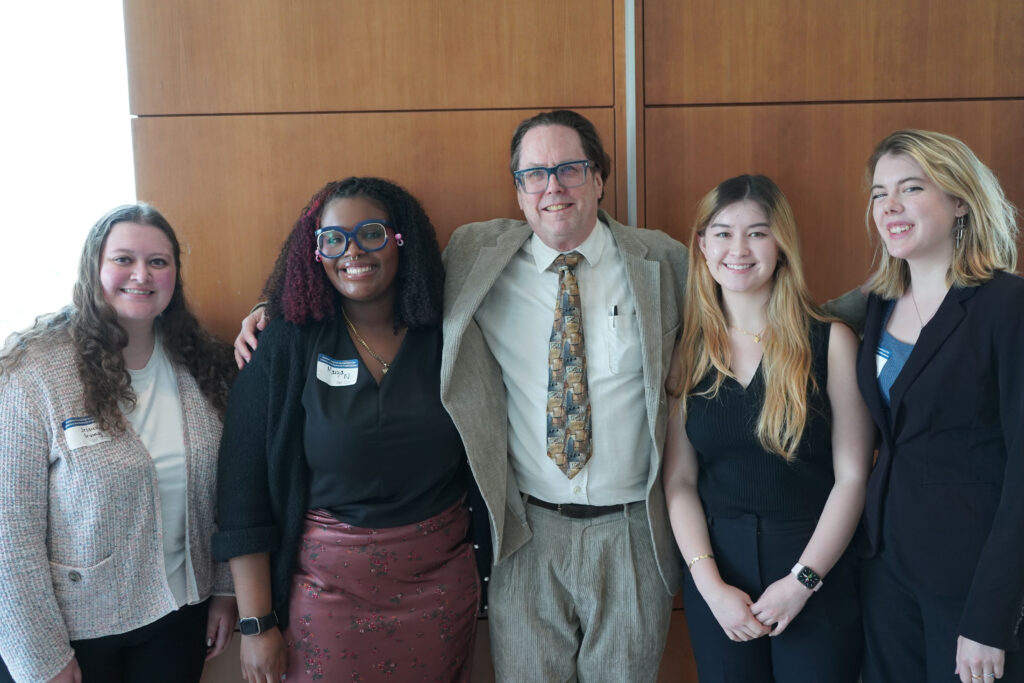
The second Student Journal Symposium encompassed a wider representation of student journals, universities, and topic areas. Amelia Nason returned to co-organize the 2025 Symposium. GW undergraduate honors student Breanna Crossman, who spoke as a panelist in the inaugural Symposium, joined as co-organizer of this year’s second Symposium, as did Maiya Norwood, who also served last year as a student panelist and subsequently joined GW’s MPS in Publishing Program, and Jessica Irving, also a publishing student. Over eight months, we researched and conducted direct outreach to ~200 undergraduate and graduate-level student journals across the US and internationally, and worked with CUR, LPC, SSP, and the Association of University Presses (AUPresses) to invite panelists and speakers.
Reflections on the 2025 Symposium
After our 2025 Symposium, we solicited feedback and comments from presenters, panelists, and attendees about the conference as well as student journals and their role in the publishing ecosystem. [Comments below are provided with the author’s permission and have been edited for brevity.]
Organizing and implementing a publishing conference has served as an important learning experience for the student co-organizers, as we invited presentations and panelists, determined themes, and were inclusive in accommodating all those who submitted proposals.
Amelia Nason, GW Columbian College of Arts and Sciences, Class of 2026, 2024 and 2025 Symposium co-organizer: “In my second year planning the Symposium, I had the great benefit of knowing what the result — a successful, engaging program — looked like, and I’m proud of how our team grew last year’s DMV-focused event into an international conference. With five busy people organizing a multi-day symposium for eight months, I believe the key to our success was our centralized organizational systems. We shared spreadsheets and communications tools on our journal research process that extended to points of contact for panelists and presenters, improving consistency and efficiency with the journals we reached out to and partnered with, eliminating redundancy in the information they received.”
Breanna Crossman, GW Elliott School of International Affairs, Class of 2026, 2024 Symposium speaker and 2025 Symposium co-organizer: “Returning as a student co-organizer and collaborating with our team for the 2025 Symposium was a highlight of my year, seeing the diversity of interests and engaging with student researchers whose passions ranged from scientific communication and philosophy to literary arts and zine-making.”
Maiya Norwood, GW MPS in Publishing student (expected Summer 2026), 2024 speaker and 2025 Symposium co-organizer: “As a result of my participation last year, speaking on behalf of The Amistad, a student undergrad literary arts journal at Howard University, I’m now student in GW’s Publishing program. This year, I was able to see what happens behind the scenes: communication and hard work, but also collaboration that resulted in an event that was well-received and successful.”
Jessica Irving, GW MPS in Publishing student (expected Summer 2025), Symposium co-organizer: “It was rewarding to create a space where student editors and scholars could connect, share ideas, and support one another’s work.”
Hind Berji, managing editor of the GW Journal of Ethics in Publishing, GW MPS in Publishing student: “The Symposium offered us an opportunity to critically evaluate the current state of GWJEP, our student-led journal, and chart a course for future growth. We traced the evolution of its editorial structures, functional workflows, and broader organizational insights, and identified and shared actionable strategies to address persistent challenges such as student turnover, onboarding inconsistencies, and outreach efforts. These conversations are essential not only for sustaining the journal’s operations but also for ensuring it can scale to meet the needs of a dynamic, evolving publishing landscape. The symposium itself provided a wonderful forum to compare these experiences with my peers and to gather new ideas that can inform the journal team’s work moving forward.”
Nicole Bespalov, Co-Editor-in-Chief of CommonHealth, Doctor of Nursing (DNP) candidate, Temple University: “The Symposium allowed students in all stages of academic and journal experience to convene and learn; hearing from scholarly professionals also contextualized the broader picture of publishing. Student-run journals are integral to the promotion of just about any university’s mission for dissemination of research and encourages student and faculty collaboration.”
Hannah Crago, Open Research Development Librarian, University of Essex: “Student Journals are increasingly relevant, giving students a voice on topics that are important to them, and allowing for new ideas and perspectives to enter academia.”
Danielle Padula, Head of Marketing and Community Development at Scholastica: “College students often miss out on opportunities to learn about the scholarly publishing industry as a field they might want to join. GW’s MPS in Publishing Program and Student Journal Symposium help fill that lacuna by highlighting and inspiring the development of undergraduate and graduate student-run journals as tools to train the next generation of publishers. Students leading these journals are grappling with many of the same challenges as professionals, and they shared great advice for dealing with them, from ensuring continuity during editor transitions to cultivating welcoming work cultures to devising innovative journal marketing strategies.”