Editor’s note: Today’s post is by Chef Alice Meadows, along with Dylan Burris and Simone Taylor. Dylan is Senior Manager, Production Services, at Wiley. Simone is the Chief of Publishing at the American Psychiatric Society.
Introduction
Last year, The Scholarly Kitchen (TSK) held its third readership survey to gather perspectives and feedback from our community. Organized by the Kitchen Cabinet (the SSP committee responsible for supporting TSK), the survey is meant to help us better understand the readership base of TSK and ensure that we keep pace alongside the rapid evolution of the scholarly communications industry.
The survey was open for three weeks (February 21 – March 7, 2025) and received a total of 714 respondents. It was structured similarly to the previous two surveys conducted in 2018 and 2021, with some minor changes to address current issues.
Our primary findings focused on the diversity of topics, locations, and perspectives found in TSK content, as well as the reading frequency and career demographics of the readers. We also reviewed longitudinal data from the previous two surveys, where possible, to track the evolution of perspectives about the Kitchen by its community. The results were shared with the SSP Board at the Annual Meeting in Baltimore earlier this year, and we are pleased to now share them with TSK readers.

2025 Results
TSK remains the leading source of information for its readers at 75%, in the face of growing competition from The Brief (28%) and Journalology (28%). Respondents also prioritize email notifications from outside organizations (48%) and directly visiting professional news sites (25%) as very important for discovering key developments. LinkedIn is emerging as the social media outlet of choice (64%), with a notable decline in X (Twitter), which is now of the lowest interest (15%). Readers tend to occasionally share posts within their organizations, but never or rarely share publicly through social media for a range of reasons – sometimes because they assume that most of their colleagues and peers already access the posts on their own, but sometimes because readers would prefer posts with a wider range of perspectives, and/or that are more accessible to early career professionals. Overall, the highest proportion of readers find TSK relevant to their professional needs as well as those of their employer, and view it more as a professional interest blog or a group of experts and analysts, and less as a service from SSP.
A majority of readers (58%) have read the publication for at least five years, and just over half of respondents (51%) read at about the same frequency as two years ago. For those that don’t, reasons vary from having less time because of increasing responsibilities, to needing more analytical and tutorial content. This comment/observation is borne out in the topics that readers find most interesting, with strategic issues in the publishing sector and industry trends being important to 82% and 86%, respectively, of the 682 respondents to the question. Videos, podcasts, and content on social media were of the least interest, scoring below 10%.
This is likely a feature of the age split of the sample, with the 46 to 55 year age range making up the highest proportion of respondents at 26%, followed by 36 to 45 years and 56 to 65 years at approximately 22% each. Respondents aged 25 and below represented less than 1% of the readership survey, offering an opportunity for more engagement with those who are relatively new to the workforce and the industry. Librarians are represented in a higher proportion of roles at 22%, followed by editorial and publishing functions at 13% each. Even though Society/Association/Not -for-profit publishers represent the highest proportion of organization types at 26%, fewer respondents feel that the TSK content covers the perspectives of this sector as well as it does for commercial publishers, which account for 15% of organization types. Also interesting is the relatively high proportion of respondents (39%) with more than 25 years of experience. Finally, 77% of respondents (n=672) report that they are not members of SSP, nor do they (87%, n=671) attend the SSP Annual Meeting – a good reflection of TSK’s reach beyond the society itself.
Respondents mostly identify as white (80%) and live predominantly in North America and Europe (61% and 28%, respectively; n=673). They would like to see more coverage of regions not well represented by the readership: China and East Asia, Latin America, India and South Asia, and Africa. This presents an opportunity for membership and content growth strategy as we aim to build on these findings.
Longitudinal Results
Since the two previous readership surveys (2018 and 2021) were conducted using different platforms and with somewhat different question sets, it was challenging to track longitudinal changes. However, where reasonably comparable data was available, we looked at the changes over time to readership demographics, the degree to which readers see The Scholarly Kitchen as a service of SSP, frequency of reading TSK, and the diversity of perspectives represented in posts on the Kitchen.
In terms of demographics, we compared responses from the 2018 and 2025 surveys, as well as mapping this information to current (optional, self-reported) SSP membership data. Key changes included:
- Race/ethnicity. In 2018, 87% of respondents identified as white, compared with 80% in 2025 and 77% of current SSP members. Most of the shift was an increase in people identifying as Asian — from 3% in 2018 to 5% in 2025 (and 9% of SSP members) — and those who preferred not to say (6% in 2018 and 9% in 2018; just 3% of SSP members chose this option).
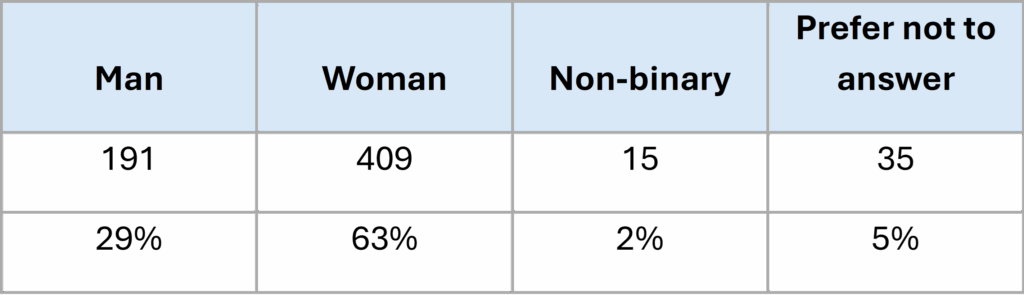
- Gender. Based on the survey results, the percentage of men reading TSK declined from 34% in 2018 to 29% in 2025.
- Career stage. Early- and mid-career readers (ages 26-35 and 36-45) have declined from 19.5% to 14%, and 26.5% to 23%, respectively, while later-stage career readers (ages 56-65) have increased from 18.5% to 22%.
- Country/region. While TSK readership is still largely based in the US and Canada, the proportion has shifted from 66% in 2018 to 61% in 2025. This compares with 84% of SSP members from the US/Canada.
- Organization/job role. These demographics were harder to compare, since the categories we used in the 2018 and 2025 surveys were different. From the data available, it appears that readership by people working in universities and higher education institutions has declined significantly, from 35% in 2018 to17% in 2025; respondents who identify as librarians have declined from 29% to 22%. However, given that just 54 SSP members (around 5%) are librarians, it’s clear that The Scholarly Kitchen readership continues to extend well beyond membership.
We have also made some progress in terms of the diversity of authors and perspectives represented on the Kitchen, with 59% saying that TSK is very or somewhat diverse compared with 53% who felt it represented a good balance of perspectives in 2021.
When it comes to both how often respondents read the Kitchen and how closely they identify it with SSP, there was very little change between 2021 and 2025. In both surveys, people reported that they are reading TSK about the same as two years ago; and most respondents continue to see it as either “a professional interest blog with daily articles” or “a group of analysts, experts, and industry professionals,” rather than “a service of SSP.”
Recommendations
We made several recommendations to the Board, based on our findings, including:
- Exploring ways to understand early career professionals’ needs — what content are they interested in and what formats do they prefer?
- Experimenting with different options to increase how early career professionals (and others) read, share, and contribute to TSK
- Continuing to communicate the link between TSK and SSP’s values and neutrality
- Developing a strategic plan for TSK
Conclusion
Overall, the survey pointed to some clear areas of focus for The Scholarly Kitchen over the coming months and years. TSK will maintain its goal to increase its audience by continuing its experimentation with different formats, like podcasts, as well as ensuring a regular flow of content more accessible to early career readers. We will continue to hold regular readership surveys to evaluate how we can best serve the scholarly publishing community. We appreciate the feedback shared through this survey and throughout the year via the article comments — thank you for continuing to support The Scholarly Kitchen!



Discussion
4 Thoughts on "2025 Readership Survey"

Can you make the anonymized data openly available?

Sorry for the delay replying, Alan — I checked with SSP and this is their response:
Thank you for your interest in the readership survey results. Anonymized readership data from the survey is not shared publicly. However, you are welcome to contact SSP (info@sspnet.org) to request individual access. Any potential sharing of the data would be considered on a case-by-case basis, subject to review and approval of the intended use by SSP.

Thank you for sharing these results. I’m surprised that interest in video content was not of interest to TSK readers.
The Society of Young Publishers may be able to assist with Early Career outreach/research (at least in the UK!).
Thanks Sam — I wonder if the lack of interest in video may be (at least in part) because the survey respondents skewed older? Many thanks for suggesting that SYP might be able to help with early career outreach — SSP has an Early Career Subcommittee so I will let them know.