Editor’s note: Many thanks to Chef Stephanie Lovegrove Hansen for leading this installment of our Ask the Chefs series.
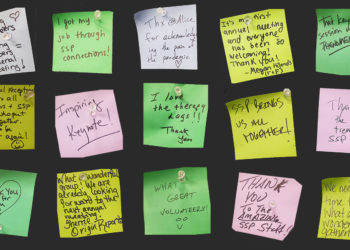
Last week, the scholarly publishing community gathered for the SSP Annual Meeting in Chula Vista, California, for a whirlwind few days of celebrating our achievements, taking stock of our opportunities and challenges, and connecting with industry colleagues. From posters and breakout sessions to exhibit hall swag and karaoke, the SSP Annual Meeting was a reminder of the power of our collective efforts.
To extend our learnings to those who couldn’t join us in person, we asked the Chefs:
What did you take away from the Annual Meeting, and what’s one thing that delighted you?

Alice Meadows
It’s hard to pick just one takeaway, so here are three (and there were more!). First, the opening keynote, where Dr. Chinasa T. Okolo gave a very thoughtful — and thought-provoking — talk about AI innovation in Global Majority countries (ie, not the Global North). This included some interesting case studies that I wasn’t aware of and that I definitely want to dig deeper into (eg, NOODL and Kaitiakitanga). I also loved her focus on the need for a Global Knowledge Commons, which she described as “a set of interlocking commitments to open research infrastructure, multilingual knowledge systems, democratically accountable AI governance, and equitable participation in the tools and decisions that shape AI development.”
The plenary panel on Thursday was also full of great content. One comment by Chirag (Jay) Patel has really stayed with me. He noted that 77% of Americans say they have confidence in scientists to act in the public’s best interests. This percentage is largely unchanged, and Jay urged us to focus our efforts on making more of the 77% real ambassadors for science — moving some of the 49% who currently have a fair amount of confidence up to the (currently 28%) who have a great deal of confidence.
I also enjoyed the Previews session, and was especially interested to learn about DeltaThink’s researcher survey results and Liblynx’s new prototype, The Bot Filter.
As always, the thing that delighted me most about the conference was the people. That includes those whom I already knew I’d see and those whom I was thrilled to run into unexpectedly (you know who you are!) — or met for the first time — thanks to the serendipity of attending a conference where everyone is working towards the same overall goals and shares the same overall values. For that reason, I always love the Awards Lunch, where we get to recognize some of the many contributions our community makes — congratulations and thanks to all the awardees, new and retiring Board members, and others who were honored. And kudos and thanks to everyone involved in once again making the meeting such a success!
Rick Anderson
The Friday morning session on the degree to which China’s journal policies have the capacity to shape global journal publishing was pretty sobering. The concept wasn’t new, but the data and modeling that were shared made the potential implications feel much more immediate. Given the explosive growth in research and publishing output from China, a relatively small (in percentage terms) shift in publishing patterns on the part of Chinese researchers away from American, British, and European journals towards Chinese ones would have an outsized impact on Western publishing — and it could also significantly decrease the percentage of scientific research published in English, which up until now has been the lingua franca of scholarly publishing. I don’t see any reason to doubt that this shift represents a likely scenario.
As for what delighted me this year: the most delightful thing about the SSP meeting was, as always, seeing and catching up with colleagues I love and admire and don’t get to see nearly enough. But another delightful thing was being reminded how fragrant Southern California is. Every morning as I ran along the bayfront, I enjoyed the smell of the plants and flowers along the running trail while also reveling in that particular blend of warm sun and cool air that makes San Diego such a pleasure to visit.
Todd Carpenter
During a session on data sharing in an age of AI, Jeff Lang emphasized the point that scientific discovery is rarely a matter of certainty. Instead, science — and scholarly communication — is a process in which new claims, whatever they might be, should be tested, challenged, and revised over time as our knowledge grows. It is this process, and the skepticism that is embedded in it, that drives trust. Similarly, published research relies on its own validation processes to build trust, even despite its failings.
With so much shifting under our feet, it is constructive to keep these values in mind as we face the current challenges to scholarly communication. The past several years have seen wave after wave of concerns and issues arising regarding abuses of the scholarly publication process. From paper mills, citation-boosting schemes, fraudulent DOI registries, to fundamental questions about authorship and provenance. The community has done much to improve the situation, including communicating retraction information (CREC — [shameless log rolling] an EPIC Award winner!), validation tools, and manipulation detection tools. The work in these important areas continues, which drew such attention over the past few years, even as the novelty and immediacy have shifted.
Several sessions and hallway discussions centered on how we can ensure trust in research, how publishers can signal trust, and what might be new ways to validate these trust signals. Although there wasn’t a particular session focused on trust markers per se, it seemed there was a lot of buzz about it, at least as much as the discussions centered around AI. The two conversations almost dance with each other, despite flowing from different sources. Straight out of the gate during the Thursday morning opening plenary, Rebecca Lawrence pointed to new work from NISO on a framework for trust markers that was just announced as an important initiative to help grow trust in research. The topic of trust came up again at a session on persistent identifiers and how chains of related PIDs and metadata can be a source of trust signals, which Julie Petro, Alice Meadows, and I each spoke about the current state of PIDs. The interconnections can serve as other signals about research validity, as noted in a joint Crossref and Datacite paper, Why Metadata Matters for Research Integrity and How to Contribute, released earlier this spring, as well as in the session on Improving Trust through Verifying, where Lang made the comments I noted above.
In this environment, it is not surprising then that systems of trust be reinforced and expanded. One important framing question is how much time and energy we will likely spend arguing over what elements constitute trust. Which of those trust markers are most relevant and to whom are they most relevant will vary by different communities of readers. As we move to formalize these notions and build them into systems consistently across the community, the conversations that were advanced during the meeting in Chula Vista will certainly pick up speed and intensity.
Lettie Conrad
Content-wise, I was very happy to see several sessions not talking about AI — and those that did brought very actionable ideas and unique perspectives to the challenges of coping with this brave new world. In fact, it struck me that authentic humanity is the killer app right now, as no intelligent automation can replicate the magic of our emotional, cultural, and ethical lives. Those products and services that leverage social connections and genuine interactions will beat out the fully automated solutions, I predict. What Cassyni is doing with author videos is a great example of this priceless human touch, in this case breathing life into a static manuscript. I was proud to contribute to the conversation about the role of empathy in scholarly communications, and how we might measure our ability to lead with trust and the belief that others’ experiences are as valid and important as our own.
This year’s Previews event was especially exciting, with two presenters vying for the top spot: LibLynx’s new Bot Filter and the start-up Pub2Post. It was neck-and-neck for a tense few moments, and the room was simultaneously hushed and buzzing with excitement. Although LibLynx was one point ahead in the end, I thought it was the right call to award two winners — one more example of the kindness, equity, inclusivity, and community-focused values that ground and sustain this organization, in good times and bad.
Personally, beyond the usual excitement of SSP’s annual meeting and connecting with old and new friends alike, I was extra pleased to see so many members of this wonderful community enjoy an event in my home turf of Southern California. Huge thanks to SSP for maintaining the rotating West Coast events!
David Crotty
Though I’ve been attending SSP Meetings since 2010, this year’s was a new experience for me. Having spent the last few years as a consultant, SSP meant trying to get meetings scheduled with as many clients (or potential clients) as possible. This year I was attending as the head of house for a publishing organization, which suddenly meant that everyone else wanted to talk to me. My overly stuffed schedule turned out to be a blessing, as SSP provided a one-stop shop for catching up with the latest services and products on the market. I came away feeling much better informed than I was coming in.
Another positive I took from the meeting was the pragmatism of everyone I spoke to regarding AI. I’m sure that, like me, you feel bombarded with a nonstop stream of hype regarding AI as the “everything machine” that’s going to do all our thinking for us as well as replace all of our scientists and poets. But everyone I spoke with at the meeting had a very clear-eyed view of AI — it’s a technology that will be incredibly helpful, but largely in tools built to do specific tasks where it is appropriately applied. People are really thinking about it practically, rather than buying into all the hype.
As for delight, I still maintain that I have yet to find a decent breakfast burrito on the East Coast of America, and so returning to my old stomping grounds of Southern California allowed me to reacquaint myself with one of my great loves.
Ashutosh Ghildiyal
I spent most of my time in one-on-one meetings by design, which meant missing many sessions, and I have no regrets. Reconnecting with colleagues and meeting people I had wanted to see made the trip worthwhile on its own. I was also lucky to spend time with my fellow Chefs, whose warmth and camaraderie made the experience even better.
What struck me most about SSP (once again) is the strength of its community. The visible appreciation for volunteers and the people running things behind the scenes was a good reminder that this is more than a conference; it is a community built on participation and a shared commitment to scholarly communication.
The mood of the meeting reflected an industry in transition. Submissions and research output continue to grow, but there is real caution in the air: a tougher employment market, slower hiring, policy uncertainty, and unresolved questions about AI’s long-term impact. No one has clear answers yet, and the predictions on offer varied widely. What I did sense was a genuine willingness to learn and adapt together, which matters more than certainty right now.
The thread running through most of the AI (and trust) conversations was this: what we are really debating is how the scholarly communication ecosystem is being reorganized. I do not think journals or scholarly content are becoming less important. Their role is shifting. AI will become the primary interface for discovering and consuming knowledge, but the work scholarly publishers do will continue to remain important as the trust and validation layer underneath it all. The question is not whether AI replaces existing structures, but whether publishers, researchers, and institutions can adapt to a world where trust, context, and verification are as valuable as the content itself.
Roy Kaufman
While it is no doubt contrary to the original intent, many of us correctly assumed that gold and green OA mandates would drive consolidation in scholarly publishing, as existing business models for smaller and society publishers were uprooted.
What I hadn’t realized before SSP is the degree to which the growth of Chinese research and publishing would further the consolidation trend. Working as closely as we do with the American Chemical Society, I knew that it was extremely successful with Chinese authors/partnerships. What I did not understand was the scale of ACS’s efforts to achieve this result. Teo Pulvirenti’s presentation Friday morning was eye-opening as he detailed the many, many trips, programs, and meetings ACS runs in China. I cannot imagine more than a handful of publishers — whether commercial or society — who could, if they wanted, sustain such an intense focus. As Chinese researchers become ever more important contributors to journals, publishers will need reach and scale and above all else, long-term commitment. However, as we also learned during the session, there is a major push to encourage Chinese authors to publish in Chinese journals, rendering any investment risky. Risk will cause flight to safety, which means consolidation and gains for the largest publishers.
Robert Harington
I must admit that I had reservations about trekking out to Chula Vista for SSP this year. With financial pressures on one hand and travel costs spiraling on the other, I needed this conference to step up.
I am happy to report that this year’s SSP was a resounding success. There are many reasons for this, but perhaps first and foremost was the pacing of the meeting. There were meaty sessions but not so many that you could not find time for networking. The layout of the facility itself and the comfortable weather meant that many of the conversations were held outside on one of the many patios to the hotel. The hotel was a resort, with water parks, barely used, but the lounge chairs were full of SSP conference-goers discussing heady topics. I was especially pleased to be able to talk with a few of the new SSP student / early career Fellows. I am looking forward to shepherding some Scholarly Kitchen posts from a few Fellows, as we progress through 2026.
I will highlight one session that I think deserves special mention — the opening plenary session for day two, Navigating the Paradox: Adaptation, Innovation and Collaboration in 2026. Tim Lloyd from LibLynx masterfully moderated a panel of articulate thinkers. We had Teodoro Pulvirenti from ACS, Rebecca Lawrence from Taylor & Francis, and Jay Patel from Cactus Communications.
The idea was to ask questions and set “provocations” to tease out where the panel may see us in 5 years’ time. The first of the provocations was perhaps the most challenging, asking where we may be in 5 years’ time if scholarly publishing was no longer relevant. Perhaps the most interesting response to this provocation was Teo’s notion that the strongest brands may not be the loudest brands. He also asserted that perhaps most important of all may be a new system of truth focusing on verification, trust and stewardship. Jay also pointed to the future not focusing on counting “eyeballs on a page” but the value of interactions themselves.
SSP is thriving, it seems, and I do look forward to more such opportunities to gather with others across the SSP family.
Stephanie Lovegrove Hansen
As for me — can I just say “ditto” to all of this? I flew home almost entirely in silence as my brain slowly processed all the insights, conversations, and ideas that came from the conference. SSP is always simultaneously energizing and exhausting as we pack all we can into a few short days, but boy, did we.
My biggest takeaway was how present the “user” was this year. More than previous meetings, the presentations and discussions centered researchers as key voices in products, policies, and outreach strategies. The “Beyond the Flyer” marketing session talked about differing audience needs and channels, and how to lead with the end user when working with other teams. Groups in the Shark Tank session I hosted spent a good chunk of their time considering the real problems being experienced by researchers, even if unglamorous (the winning pitch was for an identity solution!). And allllll the AI sessions talked about how to make our offerings match the evolving workflows of today’s real, actual users. It was refreshing — and likely overdue — and I hope it’s just the beginning of this trend.
I also wanted to include in this ATC a space for what delighted each Chef, since I often think it’s those small moments of delight that those not in attendance miss out on the most. For me this year, it was the EPIC Awards. This was my first time attending the Gala, and I was so blown away not only by the many achievements of our community across a wide range of categories, but also by the levels of incredible nerdiness we get to share in (said as the utmost compliment). It doesn’t get more delightful than a scholarly publishing-themed rendition of the Backstreet Boys while cheering each other on as a united voice.
Drop your takeaways and delights in the comments, and be sure to register for the Annual Meeting Highlights virtual event on June 17th to get even more summaries from the conference.