Editor’s Note: Today’s post is by Sonika Jha. Sonika is an Assistant Professor of Management at FORE School of Management, New Delhi, India. Her research sits at the intersection of open innovation, strategy, knowledge spillovers, and digital ethics and AI.
In June this year, John Wiley & Sons completed their acquisition of Emerald Publishing Limited, in an all-cash transaction valued at £337 million (approximately $452 million). The deal adds nearly 500 journal brands, 8,000 book titles, and 3,000 business case studies to Wiley’s portfolio, establishing the company as a dominant force in economics, business, finance, and the social sciences.
For most of the scholarly communications community, this is a story about market concentration and publishing economics. But for early career researchers in the Global South, especially those working in management, organizational studies, and the social sciences, it is something more. It is a reshaping of the infrastructure on which their careers, their teaching, and their institutions are built. This reshaping merits examination because it simultaneously carries genuine promise and structural risks.

Emerald’s Particular Significance to the Global South
Emerald is not just another publisher absorbed into a larger entity. For researchers across South Asia, Sub-Saharan Africa, Latin America, and Southeast Asia, it has occupied a special position as an accessible entry point into international scholarship. It has offered rankings that count toward promotion. And it has taken their research seriously when other publishers didn’t.
Emerald’s journals span knowledge management, international business, human resource management, organizational behavior, and public policy. Their Australian Business Deans Council (ABDC) and Chartered Association of Business Schools (ABS) rankings range from B to A. These rankings carry real weight in promotion and tenure decisions. For an early-career researcher at a management institution in Delhi or Nairobi, an Emerald publication is not a consolation prize. It is often the most credible path into international research. It doesn’t require a Harvard or Cambridge affiliation. It doesn’t require a $3,500 article processing charge (APC) at a flagship journal.
This matters beyond rankings. A significant strand of Global South scholarship engages with decolonizing knowledge production. This work argues that Western commercial publishers shape which research questions count as important. It argues they also shape whose theoretical frameworks count as rigorous. Emerald has been one of the few publishers willing to take non-Western frameworks seriously, on their own terms. Whether Wiley’s editorial culture can sustain that openness is still an open question.
85% of Emerald’s revenue comes from outside of North America. This is precisely where Wiley’s infrastructure can help. Wiley has deep library relationships across the US and Canada that Emerald lacked. With thoughtful integration, researchers publishing in Emerald journals could gain real citation reach into North American institutions.
The teaching dimension is just as concrete. Emerald’s 3,000 business case studies have long served as an affordable alternative to Harvard Business Publishing cases. This matters for business schools across the Global South, where Harvard’s licensing fees are often prohibitive. That case portfolio now belongs to Wiley. Wiley’s priorities may lean toward AI content pipelines. What that means for case pricing and commissioning is a question that could affect classroom decisions as soon as next semester.
The Wiley versus Emerald Debate
The Wiley acquisition of Emerald is best understood not as a meeting of equals but as the absorption of the middle tier of management scholarship by an elite incumbent. The prestige asymmetry between the two portfolios is stark. Emerald holds no journals on the Financial Times list of 50 journals (FT50), and its A star presence on the ABDC list is limited to a small number of titles such as the International Journal of Operations and Production Management and Accounting, Auditing and Accountability Journal. Wiley, by contrast, publishes a substantial share of the discipline’s apex outlets, including the Journal of Finance, the Strategic Management Journal, and the Journal of Management Studies. What Emerald brings is volume and breadth in the A and B tiers, the workhorse journals in which the vast majority of business school faculty, particularly early-career researchers in the Global South, actually build their publication records. Wiley did not purchase prestige; it purchased the productive middle of the field, along with the recurring subscription revenue and proprietary content that the middle generates.
This asymmetry matters. Consolidation rarely treats all tiers of a portfolio equally. Apex journals carry reputational weight. They get protected. Mid-tier journals carry margins. They get rationalized. Wiley has committed to thirty million dollars in annual cost synergies within three years. History suggests how such targets get met: journal mergers, title closures, and pricing realignment. These changes tend to concentrate in the mid-tier, the exact segment Emerald dominates. For researchers at well-resourced institutions, this merger will be largely invisible. They have access to elite outlets already. But many scholars depend on accessible A- and B-ranked journals. Their tenure cases depend on them. Their national accreditation requirements depend on them. Their research assessments depend on them. For these scholars, a quiet restructuring of the middle tier means something specific: the publication ladder narrows at exactly the rungs they stand on.
The concentration of roughly 2,500 journals under a single publisher is therefore not merely a market event; it is a redistribution of academic opportunity, and the costs will fall hardest on those furthest from the center of the system.
What Wiley’s Framing Signals — Including for China
The acquisition deepens Wiley’s proprietary content position for use in artificial intelligence (AI) and data analytics, at a moment when demand for trusted peer-reviewed research content is accelerating. Research content, as explicitly framed, is fuel, and the combination of Wiley and Emerald, in the words of Wiley’s President and CEO, Matthew Kissner himself, means that their “proprietary content and data fuels AI, and AI accelerates the pace of publishing.”
This is not inherently sinister; AI-assisted tools can genuinely help researchers navigate literature and accelerate synthesis. But the asymmetry is stark. Researchers produce the content underpinning a $452 million valuation, receive no equity in that extraction, rarely receive meaningful compensation, and in many cases pay to publish. The question of how value created by AI use of research content flows back to researchers, if at all, deserves a direct answer. For Global South scholars specifically, the data governance dimension is pointed out: Wiley is a US-listed corporation, and the research output of Indian, Chinese, Latin American, and African scholars processed through AI systems governed under US corporate frameworks raises data sovereignty questions that research councils in several countries are only beginning to ask.
China’s situation deserves specific attention. The Chinese government, through the Double First Class university initiative, has actively pushed researchers to publish in high-ranked Western journals as a condition of career advancement and institutional funding, while simultaneously pursuing geopolitical decoupling from Western institutions and investing in the China National Knowledge Infrastructure (CNKI) as a domestic alternative. The relationship between Wiley and Chinese research has already been complicated: Wiley’s subsidiary Hindawi retracted over 8,000 articlesinvolving Chinese co-authors in 2023 following a large-scale peer review manipulation scandal that damaged both parties. A combined Wiley-Emerald entity controlling a larger share of credentialed management journals deepens Chinese researchers’ structural dependency on Western publishing infrastructure at precisely the moment national policy is trying to reduce it.
The Invisible Workforce: Editorial Labor and Society-Owned Journals
There is a dimension of this acquisition that has received almost no attention: the editorial boards. Every Emerald journal has one academic, many from the Global South, who perform substantial unpaid intellectual labor: handling peer review, shaping editorial direction, and maintaining the scholarly identity of the journal over years or decades. That labor is part of what Wiley has paid £337 million to acquire. The academics providing it were not party to the transaction, did not consent to the transfer of their labor to a new corporate owner, and have no practically exercisable exit rights.
Wiley has a genuine opportunity to distinguish itself from the pattern of post-acquisition editorial attrition that has characterized several major consolidations. Proactive commitments to editorial independence and meaningful consultation with boards during integration would represent a substantively different approach and reduce the risk of high-profile resignations that have damaged publisher reputations elsewhere. A subset of Emerald’s portfolio is also published on behalf of learned societies that negotiated agreements with Emerald specifically. Those societies now find their journals in the hands of a company they never contracted with, and most have been publicly silent since the announcement, presumably still determining what their contractual positions actually are.
Concentration, the Early Career Researcher, and the Predatory Publishing Vacuum
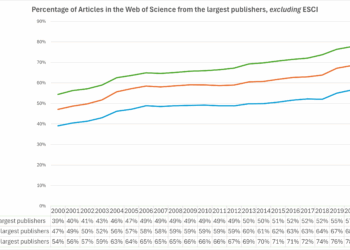
The Wiley-Emerald deal is part of a longer arc of consolidation. A small number of large commercial publishers now account for a substantial majority of the world’s journal articles, reducing competitive pressure on pricing, access terms, and author conditions. For early career researchers, concentration creates specific issues: Early Career Researchers (ECRs) have the least institutional leverage in subscription negotiations, no voice in transformative agreements, and face hiring committees that require publication in ranked journals increasingly controlled by a handful of commercial publishers. Wiley’s $30 million cost synergy target, primarily from platform integration and elimination of duplicate costs, raises real questions about the specialized, lower-volume Emerald titles that Global South researchers depend on most.
There is a downstream consequence here. When credible, accessible journals disappear or become unaffordable, the vacuum is reliably filled by predatory publishers. Researchers in the Global South are disproportionately targeted; they face the greatest pressure to publish and typically have the least institutional guidance on publisher quality. If cost synergies produce title discontinuations, researchers who depended on those titles will not migrate upward to more prestigious journals. Many will be harvested by the worse ones. That is a concrete, preventable harm,
Open Access Is Not a Silver Bullet — Especially Not in Management Research
Open access as a structural corrective is both partly true and substantially incomplete, particularly for management and social science researchers, whose publishing ecosystem operates by different rules than the STEM fields that dominate scholarly communications discourse. There is no widely credentialed preprint server for management scholarship. Green open access is far less normalized as a career-safe practice. The journal brand carries more weight, and the alternative infrastructure is thinner. Policy remedies designed for STEM do not straightforwardly transfer.
This is not an unsolvable problem. Latin America’s Scientific Electronic Library Online (SciELO) demonstrates how regionally governed, publicly funded open access infrastructure can work at scale and serve researchers on their own institutional terms. Africa’s African Journals Online (AJOL) is building in a similar direction. These experiments and alternatives tell us that the Global South cannot just consume, but rather own how research is done and published. Wiley’s transformative agreement coverage does create new open access pathways for some researchers, but it applies unevenly. Many institutions in lower-income countries hold no such agreements, and waiver systems remain inconsistently applied and structurally inadequate as a substitute for equitable access by design.
The scholarly communications community therefore would be better served by investing in alternative models than by assuming that transformative agreements negotiated between large Western publishers and large Western universities will reach researchers in Chennai or Nairobi.
India’s Policy Moment and the Negotiating Landscape
This acquisition arrives at a moment when India is actively building its research infrastructure, the National Research Foundation, evolving University Grants Commission (UGC) open access mandates, and has ongoing discussions about a national subscription model. What the Wiley-Emerald deal changes is the negotiating landscape.
A combined entity controlling approximately 2,500 journal titles, with deep strength in the disciplines where Indian research output is growing fastest, is a different counterparty than two separate publishers, one that concentrates leverage on the publisher side of any national-level negotiation. Institutions can navigate this only if they negotiate proactively and with the full weight of this consolidation explicitly in view, rather than engaging reactively after terms have already been set.
Questions the Community Should Be Asking
Let us be direct about what this acquisition could represent at its best. Wiley is a more stable long-term owner than a private equity-backed entity. Its platform infrastructure is materially stronger than Emerald’s. Its North American reach could expand the discoverability of journals that have historically struggled to penetrate that market. Its transformative agreement network may open open-access pathways for researchers who previously had none. These are not trivial potential benefits, and intellectual honesty requires naming them.
But potential benefits and structural risks are not mutually exclusive. The scholarly communications community has a consistent habit of waiting until after integration to ask the hard questions, by when editorial boards have been restructured, journals discontinued, and APC schedules set in stone. The time to ask them is now.
Will Wiley maintain Emerald’s specialized journal portfolio, including the lower-volume titles that primarily serve Global South research communities? What commitments are being made to preserve editorial independence during integration? What obligations does Wiley now hold toward learned societies whose journals it has inherited? How will APC structures evolve across the combined portfolio, and how will waiver access be managed for researchers at institutions without transformative agreement coverage? How will AI use of research content be governed, and will researchers, particularly those in the Global South, whose data sovereignty concerns are most acute, have any meaningful say in that governance?
Publishing infrastructure shapes careers. It shapes what questions get asked, what research gets validated, and whose voices enter the global scholarly conversation. The Wiley-Emerald acquisition transfers the labor of thousands of researchers, editorial board members, and case study authors into a new corporate architecture at scale, at speed, and largely without their awareness. Whether it ultimately serves the communities that built Emerald’s value or extracts from them will depend on decisions being made right now, and the researchers with the most at stake deserve a seat at the table.
Beyond This One Deal
This discourse attempted to focus on this one acquisition because it is the one in front of us, and because Emerald’s particular relationship with Global South scholarship makes the stakes unusually visible. But nothing above is specific to Wiley or to Emerald. Scholarly publishing has been consolidating for two decades and shows no sign of slowing, and each time a discipline-specific or regionally-rooted publisher is folded into a larger commercial entity, whichever company, whichever journals, the same landscape of concerns recurs.
Four relevant questions that should be asked: Which tier of the acquired portfolio carries the researchers with the least institutional leverage, the ones for whom that portfolio is not a “nice to have” but the actual ladder they are standing on? Which editorial boards performed years of unpaid intellectual labor that has now changed hands without their consent or their vote? Which learned societies find their negotiated agreements transferred to a counterparty they never chose? And which researchers, disproportionately in the Global South, depend most on the specific titles most likely to be rationalized once cost synergy targets are set?
These are standing questions, not questions particular to Wiley, and the scholarly communications community would be better served by asking them at the announcement of every such deal rather than reconstructing them afterward from what the integration left behind. Wiley and Emerald are simply the occasion for asking them this year. The next consolidation, and there will be one, deserves the same scrutiny.

Discussion
1 Thought on "Guest Post — Buying the Middle: Reading the Wiley Emerald Deal from the Global South"

Thank you for the insights.