Editors’ note: Today’s post is by Hannah Heckner Swain, VP, Strategic Partnerships & Platforms, Silverchair.
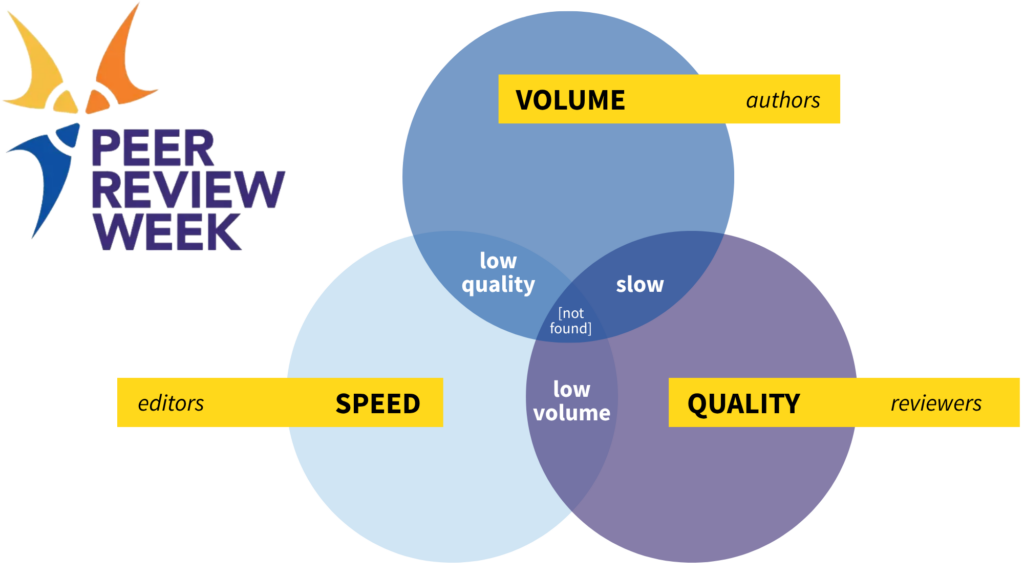
Convention says that every dollar you spend contains a hidden choice, because nothing can be good, fast, and cheap all at the same time. As we look at peer review, struggling to balance volume, speed, and quality, should we be wondering the same thing?
That question is harder to answer than it sounds. Each of those vertices on the triangle is owned by a different stakeholder: authors control volume, editors control speed, and reviewers and editors together control quality. We already know submissions are surging, and desk reject rates are rising to meet the demand. What we don’t know is whether that’s good or bad: are editors raising the bar, protecting the standards of their journals, or are they allowing the queue behind each manuscript to influence faster decisions?
Is the desk reject rate a function of quality or capacity, or both? When volume, speed, and quality all move at once, do we lose the ability to tell whether we’re getting more selective or more overwhelmed?
Volume: Structural Floods
Submissions have increased approximately 68% between 2018 and 2025, according to our 2026 Future of Peer Review Report. But desk rejects have similarly surged: in 2025, editors desk-rejected approximately 2.5 manuscripts for every accepted manuscript (a sharp rise from 1.7 desk rejects per accepted manuscript in 2022). This growth isn’t leveling off or staying stable: early indicators from 2026 show submission increases as high as 34% from the same time period the previous year.
Volume, we have in spades.
The question remains: why? What new drivers are contributing to this state beyond the normal expansion of a growing research ecosystem? One big driver is the ubiquity of AI-assisted writing tools, sitting on top of a pressure-filled culture where PhD students and early career researchers are asked to double their outputs to advance their careers. The incentive to publish more collides with a technology that makes writing and publishing easier to do. The result is a flood of submissions, rushing a peer review system that was already strained at the seams.
Speed: Buckling Capacity
Volume also strains reviewers and slows turnaround times. But look at the volume of submissions growing each year, and even with a rise in desk rejects, there are still more papers to review each year than ever before. Reviewer acceptance rates, how often a reviewer says yes to an invitation, fell every year from 2018 to 2024, from 43 percent down to 22.3 percent. It now takes an average of 4.5 invitations to secure a single review, and reviewers take 1.5 times longer to decline an invitation than to accept one, evidence that the decision itself has gotten harder, not just less frequent.
Getting the right reviewer for a paper isn’t just a matter of asking more people; it’s a matter of asking the right few people, over and over, until they stop answering. The cost shows up downstream. Reviewers who feel like an endlessly renewable resource are the ones most likely to stop saying yes.
Quality: AI, AI Everywhere
On the submission side, it’s likely that the proliferation of AI writing assistant tools is contributing to the capacity challenges of peer review today. On the review side, things are quieter, but no less under pressure. According to a 2025 Frontiers Media survey, 53% of reviewers report using AI for peer review tasks. Contrast that with the fact that only ~20% of journals have policies around appropriate use of AI in peer review, and you’ve got a disconnect. At the same time, 52 percent of reviewers say automated integrity checks would have the biggest impact on their own work.
So AI is writing an increasing share of what gets submitted, and AI is quietly reviewing an increasing share of what gets evaluated.
These data reveal a system closing in on itself with a patchy at best governance layer connecting authorship, review, and editorial oversight. Right now, the trust forming the foundation of peer review is being asked to hold in a scenario where a machine may be writing the manuscript, a machine may be helping evaluate it, and no one has agreed on the rules for either.
Where Do We Go From Here?
We can’t slow down until the volume recedes, and trust is the foundation of our industry, so compromising quality is a non-negotiable. But with the onslaught of submissions enabled by AI tools, editors and reviewers are drowning in an attempt to maintain high standards. Conversely, if volume slows too much, it risks publishers’ ability to earn the revenue required to maintain journals and their peer review practices. Instead, the way forward is to ask ourselves what editorial judgment needs to keep functioning at this scale.
The first thing we need is tools. It is not realistic to manage a submission flood partly driven by AI authorship without editorial tools that can help filter for it. Automated pre-screening and integrity checks aren’t a replacement for editorial judgment; they’re what protects it.
The second thing we need is harder to build and easier to ignore: the relationships that make reviewers want to keep saying yes. A reviewer acceptance rate that’s fallen by half since 2018 isn’t a problem tools alone will fix. It’s a signal that the people peer review depends on increasingly feel like an extractable resource rather than partners in something. Community, mentorship, and recognition structures, the kind that treat reviewers as collaborators working toward a shared goal rather than capacity to be drawn down, are the retention lever no integrity check can replace.
Tools buy back time, for editors sorting through volume and for reviewers sorting through invitations. What gets done with that reclaimed time, whether it goes toward deeper engagement with the manuscripts that matter or toward genuinely investing in the reviewer relationships that keep the system running, is where the human side of this has to show up.
Whether or not the rising desk reject rate is a sign that editors are protecting peer review standards or a sign that the queue has gotten too long to fully evaluate each manuscript on its own terms likely varies from journal to journal. To make sure we’re protecting the time and valuable service of editors and reviewers, we need to build a system with tools to help filter the noise and people who are motivated to do the judging. A system that makes sure that we resolve the tension between volume, speed, and quality in a way that protects editorial judgment and preserves research integrity.
Author’s note re: AI disclosure — Claude Desktop was used for editing support (reviewing drafts and suggesting revisions, some of which were then made by the author), and all suggestions were fully reviewed by the author before inclusion.

Discussion
2 Thoughts on "Guest Post — Peer Review Triage: Deciding What’s Worth Saving"

Thank you, Hannah, for your perspective on journal peer review issues. Here is a practical suggestion. Reviewing a paper requires some expertise in that one usually does not need to check all the references. But further understanding a paper involves checking those references and, when one reads those papers, sometimes checking their references, potentially “ad infinitum”. All very labor intensive and discouraging to busy potential peer reviewers.
Most journal editors are too kind to authors. The task of associating each reference with a link (URL) is optional. If this were made mandatory, more potential reviewers would, I believe, say yes. However, then another discouragement emerges.
The references in the referenced papers mostly do not have URLs. So a conscientious reviewer who is not happy with the references’ references is faced with what we can call “the ad-infinitum option.” Happily, publishers armed with AI, are now much better able to remedy this. Surely, it should not be too difficult to write software that will go back through time pulling out papers and permanently attaching URLs, should they still exist. Should they not exist, then tell AI to make new ones! This might not only greatly ease peer-reviewing, but might also greatly assist historians.

I would suggest two things:
1. Universities stop forcing young academics to publish. Instead, link career advancement to engaging with learning to teach. Most academics can’t teach to save their lives. Why force them to publish rubbish research that only serves to enrich publishers.
2. If publishers lose revenue, which in turn forces them to close journals, well then so be it. A large number of academic journals should be well-administered Substack pages at best.