Editor’s Note: Today’s post is by Dmitry Kochetkov. Dmitry is Associate Professor at RUDN University, Leading Research Fellow at the Institute for the Study of Science of the Russian Academy of Sciences, and a PhD candidate at the Centre for Science and Technology Studies of Leiden University.
Some time ago, I submitted a manuscript to a reputable academic journal and waited ten months for reviewer comments. The editor-in-chief managed to secure only one review. The editors apologized, but the situation was beyond their control.
My case is not unique. Peer review faces several well-documented problems.
The tidal wave
The rapidly growing volume of manuscripts, combined with increasing workloads for researchers and faculty, has produced a shortage of reviewers. Between 2004 and 2024, the annual number of Crossref-indexed outputs increased more than fourfold, rising from 2.28 million to 10.12 million records. What is happening now with scholarly publishing looks like a huge tidal wave. Journals on the ScholarOne Manuscripts platform received 33% more submissions in Q1 2026 than in the same period of 2025. The growth rate itself practically doubled year over year, indicating the acceleration is compounding, not steady.
Peer review remains almost entirely dependent on volunteer academic labor, and this burden is distributed unevenly. A Publons study (2018) found that ~10% of reviewers are responsible for ~50% of the peer review records. Thus, every additional manuscript submitted creates a proportional demand for reviewer time drawn from the same limited pool of faculty.
Generative AI appears to be one important accelerator of the current submission surge. A recent study associates LLMs with a 42% increase in manuscript submissions to the journal studied, though the added volume showed a marked decline in readability and denser jargon, rather than higher quality. Manuscripts with extensive AI use are desk-rejected at roughly double the rate of others, and those with 70%+ AI content almost never survive to revision.
The same study found the peer-review reports themselves increasingly show signs of AI-assisted drafting, indicating the volume pressure is propagating through the entire review pipeline. Perhaps AI will help solve the problem that it created. Perhaps not. Dr. Michael Bruno believes that AI alone cannot rescue it without a “revolutionary change” to academia’s underlying incentive structure, which rewards publication counts over rigor. This statement lends support to Ludo Waltman’s argument that assessment and publishing reform must proceed together.
I would add that the use of AI in peer review raises a number of critical ethical issues, the most obvious of which is confidentiality. Besides, large publishers can afford to deploy AI reviewer assistants on their own computing power, while this is not an option for most small publishers, especially those in developing countries. As a result, AI is exacerbating inequality rather than helping to bridge it.
The second factor for accelerated publication growth is publisher-driven expansion. A handful of large publishers account for more than 70% of the net increase in yearly article counts, with MDPI alone responsible for 27% of the increase, expanding the review burden faster than the reviewer pool.

A billion-dollar black box
Beyond capacity constraints, peer review tends to favor established approaches at the expense of novelty, a bias that may limit opportunities for game-changing scientific discoveries. NIH grant renewal data show that riskier research has lower renewal rates, with the penalty steepening in more novel domains. Interdisciplinary research faces a related but distinct disadvantage: because true subject-matter peers for cross-field work often do not exist, reviewers evaluate proposals through their own narrow disciplinary lens rather than assessing the work’s integrated value.
Not all recent evidence supports the “conservatism” narrative, though. A 2022 PNAS study of 49 life- and physical-science journals found the opposite pattern at the manuscript level: more novel submissions were more likely to be accepted than conventional ones, even at comparable reviewer enthusiasm. Yet the same study found a negative association between interdisciplinary breadth (unique journals referenced) and acceptance in the pooled and life-sciences data. This suggests the conservatism effect may be concentrated in grant review and interdisciplinary research specifically, rather than being universal across journal peer review.
Conflict of interest further complicates peer review. Disclosure and recusal safeguards are difficult to apply in small fields with few qualified experts, while editor–author associations have been linked to shorter acceptance times even where formal recusal policies exist. Even where such policies are in place, enforcement is weak. All of this together indicates a black box problem damaging the entire academic enterprise.
Finally, the process is inefficient by design. Slow review cycles delay the dissemination of new knowledge, while the frequent need for multiple review rounds across journals contributes to the review costs estimated at billions of dollarsglobally. When a manuscript is rejected, it typically must undergo a completely new round of peer review at the next journal, even if the paper is resubmitted with little or no revision. Because journals rarely share review reports with one another, and because authors often want a “fresh start” with each resubmission, this cycle can repeat multiple times per manuscript, meaning the same or highly similar work is redundantly reviewed from scratch at each venue.
What I find most problematic about pre-publication peer review is the difficulty of drawing a clear line between acceptable and unacceptable science. Most scientific outputs occupy the middle ground. Every year, hundreds of thousands of works are rejected on the basis of reviewers’ subjective judgments, while many of these contain findings that are genuinely worth further scientific discussion even though they may not yet be supported by fully robust evidence.
This is arguably the core problem to solve: not simply speeding up peer review but decoupling dissemination from the binary accept/reject gate. Models like preprint-first publication with open, ongoing evaluation (e.g., MetaROR, F1000Research, eLife) let promising-but-unproven findings reach readers immediately, with assessment continuing in public rather than once, invisibly, before anyone else sees the work.
Innovations in peer review
In a recent paper, I compared several peer review models and argued that no single approach can fulfill all four functions of scholarly communication equally. Among those functions, dissemination and certification sit at the opposite ends of the continuum. Publish-Review-Curate (PRC) is the model that best balances both, making it suitable across most disciplines and research types. PRC makes the full process of scientific dispute visible: instead of concealing deliberation behind editorial decisions, it exposes disagreement, revision, and assessment as integral parts of scientific discovery.
Transparency is the characteristic feature of the PRC model, but it differs substantially from transparent (open) pre-publication review, such as the model Nature recently piloted, which opens up the review reports for a paper that is still ultimately accepted or rejected through a single gatekeeping decision before publication. Peer review reports are opened up only for the accepted papers, not for the rejected ones.
Authors at The Scholarly Kitchen have previously explored this model in the context of cOAlition S’s push for editor-based, author-driven publishing, where PRC was considered the leading alternative to conventional journal workflows.
In keeping with the principle of “practice what we preach,” my study of innovations in peer review underwent three rounds of peer review by the MetaROR platform. The experience was substantive: in the first round alone, I received 63 comments from reviewers (see author response). Their critiques led to significant improvements in the argument.
The future of the PRC model
PRC is not merely a policy preference but a technology. Applying Moore’s (1991) Technology Adoption Life Cycle (the adaptation of Rogers’ (1962) diffusion of innovations) allows us to locate its current stage of diffusion and anticipate the conditions for broader uptake.
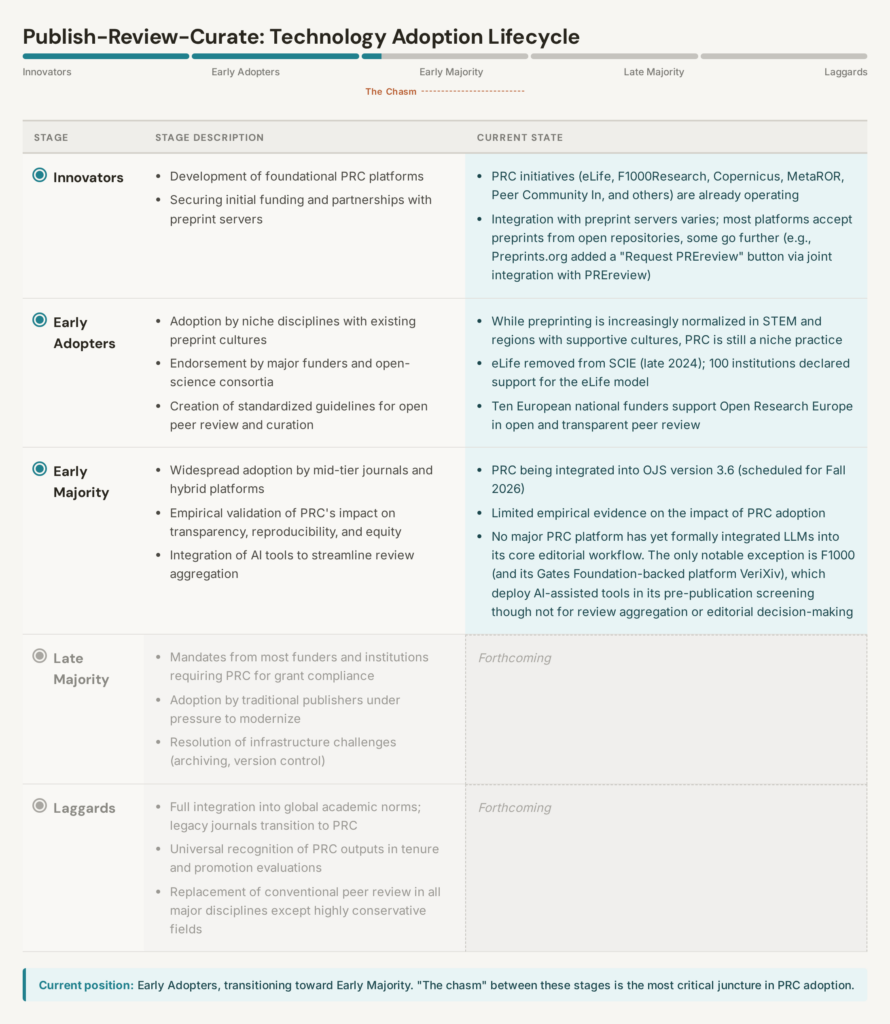
On this reading, PRC is currently at the Early Adopters stage, though the infrastructure developments described above suggest that the conditions for broader uptake are beginning to form. The transition between Early Adopters and Early Majority is arguably the most critical juncture in Moore’s model, known as “the chasm.”
The introduction of OJS 3.6, which is planned to include native preprint and open review support, has the potential to significantly lower the infrastructure barrier for mid-tier journals, provided that implementation proves sufficiently straightforward in practice.
The PRC Alliance is a coordinating initiative established in early 2026 by COAR and ASAPbio to standardize and promote PRC workflows across platforms and institutions. Its formation signals an attempt to create the “bandwagon effect” that Moore identifies as essential for crossing the chasm, which is establishing PRC as a de facto standard rather than a niche experiment.
However, the community still lacks empirical evidence, implementation guidelines, and best practice compendia.
Trust markers
Decoupling publication quality from the journal-as-umbrella model requires moving evaluation down to the level of the individual publication rather than treating a journal’s brand as a proxy for rigor (quality, etc.). In May 2026, voting members of the National Information Standards Organization (NISO) approved the formation of a Working Group to develop a Recommended Practice for the Identification of Trust Markers for Increasing Credibility and Trust in Research, aimed at giving readers, researchers, and policymakers a consistent framework for understanding which signals in a piece of scholarly content actually indicate trustworthiness.
The diagram below illustrates one possible model for such publication-level trust markers, arranged as a four-tier trust ladder with optional modifiers capturing dataset and code availability, preregistration, review transparency (open reports and identities), and public reviewer-response documentation.
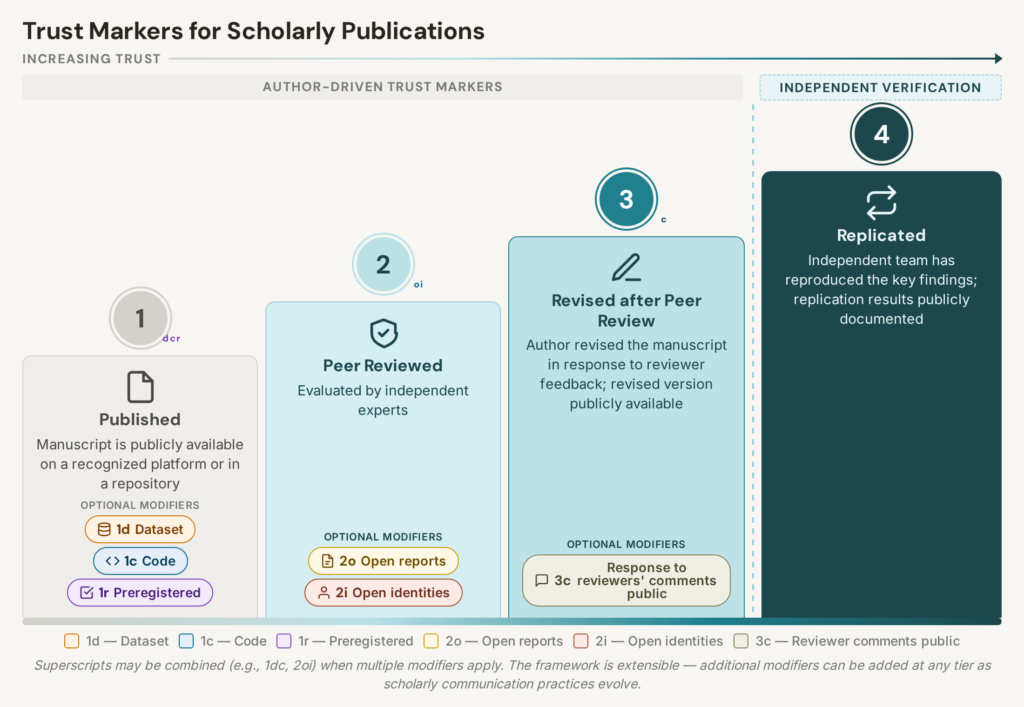
CRediT offers an instructive precedent: it evolved from an informal taxonomy in 2014 into the ratified ANSI/NISO Z39.104 standard by 2022. If trust markers follow a similar path, publication-level signals like peer review, revision, and replication could become as embedded in scholarly metadata as contributor roles are today.
Conclusion
Whether peer review needs revolution or evolution may be the wrong question. The more pressing one is whether the academic community is prepared to let scientific ideas be published, contested, and refined in public, rather than behind closed doors.
The journal that kept my manuscript waiting for ten months represents a typical case. PRC would not have made that delay disappear, but it would have made it irrelevant: the work would already be public, already in conversation, already improving. Just imagine – in the near future, the work is evaluated through the trust markers: peer review, revision, and eventual replication, each visible and building cumulatively rather than hidden behind a single accept/reject gate. Transparency, then, is not just an efficiency fix but a precondition for fairness: only by making disagreement, revision, and assessment visible can novel and non-traditional science earn the scrutiny and visibility it needs, rather than being filtered out before anyone sees it.
Acknowledgements
I am grateful to Ashutosh Ghildiyal and Ludo Waltman for valuable suggestions that helped improve the argument significantly, and to the entire Scholarly Kitchen editorial team for their careful treatment of the manuscript. All errors and omissions remain my own.
Competing Interests Statement
The author is affiliated with the Centre for Science and Technology Studies (CWTS) of Leiden University, which is involved in the development of the MetaROR platform and in setting up the PRC Alliance.
AI Contribution Disclosure
The diagrams were generated using Claude Opus 4.5 via Perplexity (computer mode) based on the author’s conceptual framework. The author takes full responsibility for the content and accuracy of the figures.
Discussion
3 Thoughts on "Guest Post — Do we need (r)evolution in peer review?"

I’m not sure where the innovations in peer review really are here? But to the more important point, PRC is categorically not about trust signals. It’s about peer review & a duplication (in many ways) of the current status quo, one that almost invites publishers to adopt. It’s designed – as per the updated proposal from Stern & O’Shea – to pave the way for review services to charge authors for each review and for curation services (which can be the same service) to also charge for that step. It’s not an experiment to widen trust signals, in fact it works against that effort in a multitude of ways. It will, in the current approach, introduce more inequity, more inequality and make future change vastly more difficult. It’s like taking the US healthcare system and forcing the world to adopt that over a public health system – break the steps into small components, each of which have different standards, behaviours and prices and leave it to the researchers to navigate and find funding for all of this. The richest will be able to afford the more prestigious reviews and curation whilst the poorest will be ignored – not to mention how confusing this system could end up becoming. I’d argue it’s clear to anyone who has experienced the US health system that it is not a good model….
“Decoupling publication quality from the journal-as-umbrella model requires moving evaluation down to the level of the individual publication” is absolutely true. But the trust marker section here feels forced and – by my definition at least (https://katinamagazine.org/content/article/open-knowledge/2026/system-for-measuring-trust-failing-better-way) – certainly is not what trust markers should be; this doesn’t really expand beyond peer review, again largely ignoring room for real innovation. It’s also disappointing to not see any discussion about how the PRC model would actually bring about the wider changes that proponents keep stating. How many researchers read peer review reports (eLife would presumably have data on that)? How does this model actually improve the issues with peer review? How does this help find reviewers in better timescales than tradition journals? How does this reduce AI slop and other issues getting through peer review? Quite simply, where is the evidence? And why are so many pushing this in the absence of evidence (noting that many have direct CoIs and stand to benefit financially)?
There is very little-no evidence about the efficacy of this model yet it’s being pushed as though there is. Yet without significant consideration to other options – beyond those that hinge around peer review – proponents are pushing something that isn’t fully considered.
The PRC effort itself seems to be made up of those who prefer to mandate, rather than genuinely listen to researcher needs and doing the hard work of education and strong, evidence-based, advocacy focussed on researchers. Some of those driving this model engage in exceptionally exclusionary behaviours (flying in the face of public “value” statements) and there are significant questions that need addressing over various other behaviours. That alone should be a major red flag for any researcher.
I’m not keen on being overly critical but the PRC effort continues to lack things I’d consider quite basic considerations and approaches.

Thanks for this useful update! I’m left wondering about your example of a 10-month delay rendered irrelevant by PRC – wouldn’t preprinting also have made it irrelevant? In which case, isn’t the most pressing question not whether academics are prepared to let public discourse take place, but whether they are prepared to actively do that using mechanisms that are currently available?

Thank you, Manesh, and you are right on both counts. Preprinting alone would have made the ten-month delay largely irrelevant for dissemination. My point was narrower: under PRC, the delay also stops mattering for evaluation, because review, revision, and curation accumulate in public rather than waiting on a single accept/reject decision.
I agree that the more pressing question is the one you pose. The mechanisms exist, and some have existed for decades; what is scarce is willingness to use them. In diffusion terms, this is exactly the gap between early adopters and the early majority, and it is where the discussion should now focus.