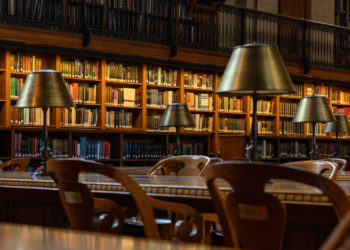
Did you know that you can cut a US #10 envelope in half, paste it onto the inside back cover of a book, and then use a 3×5 inch index card along with the handy date stamp you requested for your birthday to create due date cards for your own library? This insight is brought to you by my 9 year-old self. An illustrative example, but without the actual illustrations or the fuller insights of a host of books about the intensive ways that people connect with libraries, including their childhood experience of getting a library card, checking out books, reading, and repeating that joyful cycle of returning, renewing, checking out new books. Or of making a library at home. Over the last weeks the Washington Post declared this a new “Golden Age of Public Libraries” and the New York Times featured Reid Byer’s new book on The Private Library and the phenomenon of feeling “book-wrapt,” the “exhilarating comfort of a well-stocked library.”
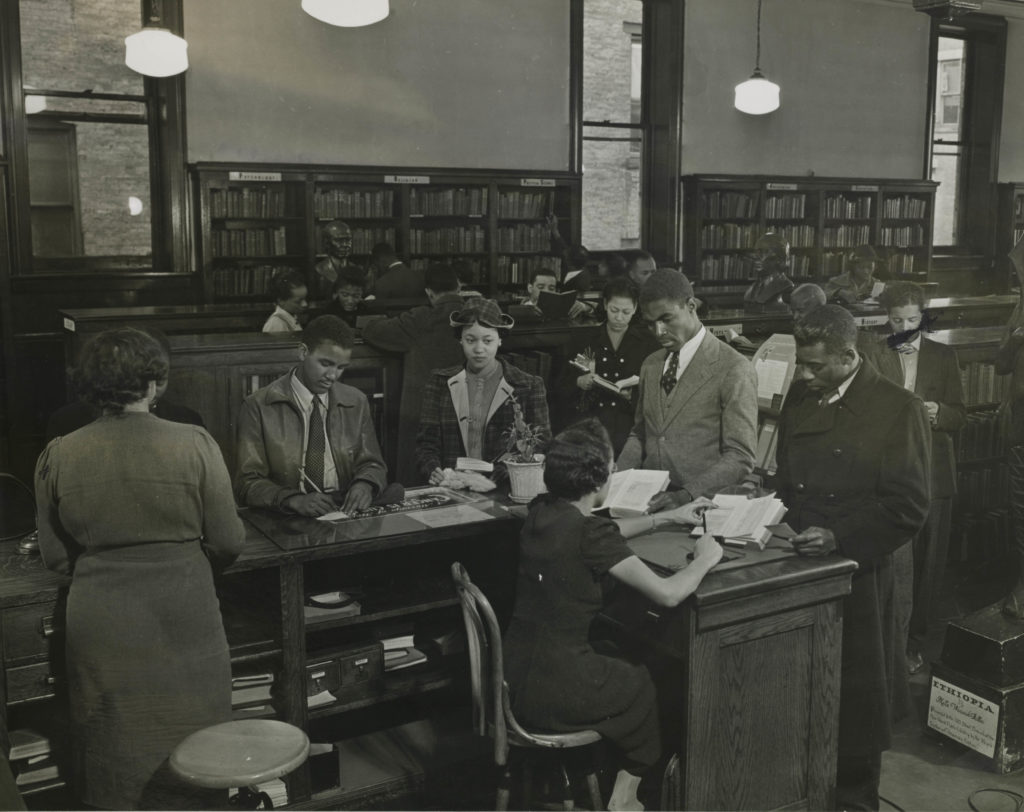
Last month I wrote about books about libraries and librarians, and asked for suggestions from readers. In the post’s comments and on social media folks responded generously and with enthusiasm for a subject that unites many of us. Wherever we work in scholarly communications, we are readers and we are conscious of how knowledge gets made and passed. Libraries and librarians have been, are, and will continue to be central to these core activities. If the original post was a crowdsourcing request, this post is a report back with a bit of reflection and a promise to keep compiling this list. (A cool thrill for me was having Rachel Kadish, author of one of my favorite novels The Weight of Ink – which I wrote about for The Scholarly Kitchen in 2017 – read the books being recommended in the post comments and then make her own recommendation!)
By their very nature libraries capture a sense of possibility, of humanity’s most ambitious and generous impulses to learn, to know, to share. Libraries have been the site of extraordinary aggregations of knowledge, and act as community centers for many kinds of communities. Libraries have weathered wars, and have been sites of resistance. Expectations for libraries and for librarians are high, and can come at enormous cost to both the institutions and the people when resources to support their work fail to match those expectations.
Libraries are also cultural and social institutions, made by and through economic and political systems. They will surely reflect the assumptions and biases of the context in which they are created and maintained. Whether public or private, general or research or special collections, a library is constituted, made, shaped, by an original founding and mission and then over time by generations of those who work in it and for it. Sometimes libraries expire or suffer destruction. The sharp politics of knowledge is nearly constant across history – what is knowledge, who makes it, who controls access to it – and so are the politics of books and libraries.
The books that were recommended reflect these dynamics of libraries and librarians’ work and they also may reflect what some of us working in scholarly communications are reading about one of the central institutions in our business — when we’re reading for pleasure. On all counts an interesting list.
I’ve compiled the full list here, within some themes that emerged in reading either individual books or pairing books. Yes, I either read the book or something about it for each of these titles! But to be clear about how very partial is this list, there is a wonderful literature in articles about libraries and librarians — in popular media and in academic scholarship — that isn’t included here, because we always need some specifically book-focused nerdiness in my view, though articles would also make for a great post. There is a dense and intense field of the history of the book that is missing here, and there is a history of libraries as reflected in library schools that’s also missing. But for those of us who work in scholarly communications in any of the many diverse professional positions in this industry, simply reading and thinking more about an institution that connects us all seems important.
The list only scratches the surface of the complex and fascinating world that is libraries, and is heavy on both the US and the early modern period so please keep sending your recommendations! I’ve also kept the list on a google doc which I’ll update.
Fiction
The world of fiction about authors, books, libraries, and librarians is exciting, even mesmerizing. Some of the books that folks recommended come near to fantasy, while others are historical fiction.
The Book of Form and Emptiness, by Ruth Ozeki.
Cloud Cuckoo Land, by Anthony Doerr.
The Personal Librarian, by Marie Benedict and Victoria Christopher Murray.
The Paris Library, by Janet Skeslien Charles.
The Starless Sea, by Erin Morgenstern.
The Strange Library, by Haruki Murakami.
Non–fiction
From biographies about librarians (including where I started with this, the life of the founding librarian of the Morgan Library, Belle da Costa Greene) to in depth looks at the development of specific libraries to the historical and political context for library work, non-fiction books about libraries and librarians is just as stunningly fascinating as fiction. This work also drives home the signal importance of libraries in so many specific moments and places and their role in the lives of individuals and communities.
The Archive Thief: The Man Who Salvaged French Jewish History in the Wake of the Holocaust by Lisa Moses Leff.
The Bookseller of Florence: The Story of the Manuscripts that Illuminated the Renaissance by Ross King.
Burning the Books: A History of the Deliberate Destruction of Knowledge, by Richard Oveden.
The Card Catalog: Books, Cards and Literary Treasures by Peter Devereaux.
The Catalogue of Shipwrecked Books: Christopher Columbus, His Son, and the Quest to Build the World’s Greatest Library by Edward Wilson-Lee.
The Country House Library by Mark Purcell.
Down Cut Shin Creek: The Pack Horse Librarians of Kentucky, by Kathi Appelt and Jeanne Schmitzer.
The Efficient, Inventive (Often Annoying) Melvil Dewey by Alexis O’Neill and Edwin Fotheringham.
Freedom Libraries: the Untold Story of Libraries for African Americans in the South by Mike Selby.
An Illuminated Life: Bell da Costa Greene’s Journey from Prejudice to Privilege by Heidi Ardizzone.
Irrepressible Reformer: A Biography of Melvil Dewey by Wayne A. Wiegand.
Library: A Fragile History by Andrew Pettegree and Arthur du Weduwen.
Library: An Unquiet History by Matthew Battles.
The Library Book, by Susan Orlean.
Libraries in the Ancient World by Lionel Casson.
Palaces for the People: How Social Infrastructure Can Help Fight Inequality, Polarization, and the Decline of Civic Life by Eric Klinenberg.
Presidential Libraries as Performance: Curating American Character from Herbert Hoover to George W. Bush by Jodi Kanter.
The Private Library: The History of the Architecture and Furnishing of the Domestic Bookroom by Reid Byers.
Reading behind Bars: A True Story of Literature, Law, and Life as a Prison Librarian by Jill Grunenwald.
Remote Access: Small Public Libraries in Arkansas by Sabine Schmidt and Don House.
Running the Books: The Adventures of an Accidental Prison Librarian by Avi Steinberg.
A Universal History of the Destruction of Book, From Ancient Sumer to Modern Iraq by Fernando Baez.

Discussion
14 Thoughts on "More on Checking out Library Books"

If you should want to include a movie then this is very nice Ex Libris: The New York Public Library https://www.imdb.com/title/tt6209282/

I’m trying to stick to books but I think the genre of films about libraries (and or library settings?!) would be amazing.

Add Alain Resnais’ “Toute la memoire du monde” short to that list too https://www.imdb.com/title/tt0049869/

Please add: BiblioTech : why libraries matter more than ever in the age of Google by John Palfrey
I’ll check it out, thank you!

One area that interests me a lot is the intersection of private collecting and university special collections. There must be lots of books that recount the histories of the formation of such collections, no? Here is just one example of what I have in mind.
DeGolyer Library began as a private collection in 1914 with the early and intelligent collecting interests of Everette L. DeGolyer, Sr., a major figure in the twentieth-century oil business. In addition to his pioneering work in petroleum geology and geophysics, Mr. DeGolyer was an extraordinary book collector and philanthropist. During his lifetime, he gave his collection of American and English literature to the University of Texas and his history of science collection to the University of Oklahoma. After Mr. DeGolyer’s death in 1956, the family library was maintained by the newly-incorporated DeGolyer Foundation and was aggressively expanded by the son of the founder, Everett L. DeGolyer, Jr. In 1973 the DeGolyer Foundation gave the library to SMU, where it is now housed in the original Fondren Library building.

I’m very interested in this subject, Sandy, from multiple vantage points. What does it mean for the collections we research, what can we learn about collecting as a practice and how it relates to socio-economic structures, and then also how do universities’ collections grow in specific ways relating to their alum and other connections.

I just finished and really enjoyed this novel: The Book of Speculation by Erika Swyler. The main character is a librarian and the town library is featured in the plot as is the importance—and magic!—of archival research/preservation.
Thank you, will check it out!

Thanks for your efforts! Another contribution is The Bad-Ass Librarians of Timbuktu by Joshua Hammer.
Thank you! Definitely on my mind as I wrote that first post.

Karen, here are a couple additional options in the fiction category: the entire “magic ex libris” series from Jim C. Hines – https://www.jimchines.com/project/magic-ex-libris/ and one I just started reading a few nights ago, Shadows of Eternity by Gregory Benford, about a librarian trainee working at a SETI library on the moon.
Fascinating, thank you!

I’m glad to know I wasn’t the only 9 year old who tried to turn my book collection at home into a library – I have such vivid memories of doing this as a child!