Social media has become an increasingly central feature of how scholarly communications organizations build visibility, share research, and connect with their communities. Yet as platforms multiply, fragment, and shift in character, organizations face mounting uncertainty about where to invest limited resources, how to set realistic expectations, and how to evaluate whether their efforts are working.
The June 2026 Scholarly Communications Pulse Check surveyed professionals across the ecosystem to take stock of current practice. The poll examined which platforms organizations are using and how often, the goals driving that use, how effectiveness is being assessed, and how social media activity has evolved in recent years. It also asked respondents to reflect more broadly on social media’s impact on scholarly communication itself. The results offer a community-wide snapshot of social media in scholarly publishing as it stands today.
This Pulse Check Poll was distributed to members of the Society for Scholarly Publishing, readers of The Scholarly Kitchen, and other professionals in the scholarly communications community. There were 179 respondents from a variety of organization types, sizes, and job levels.
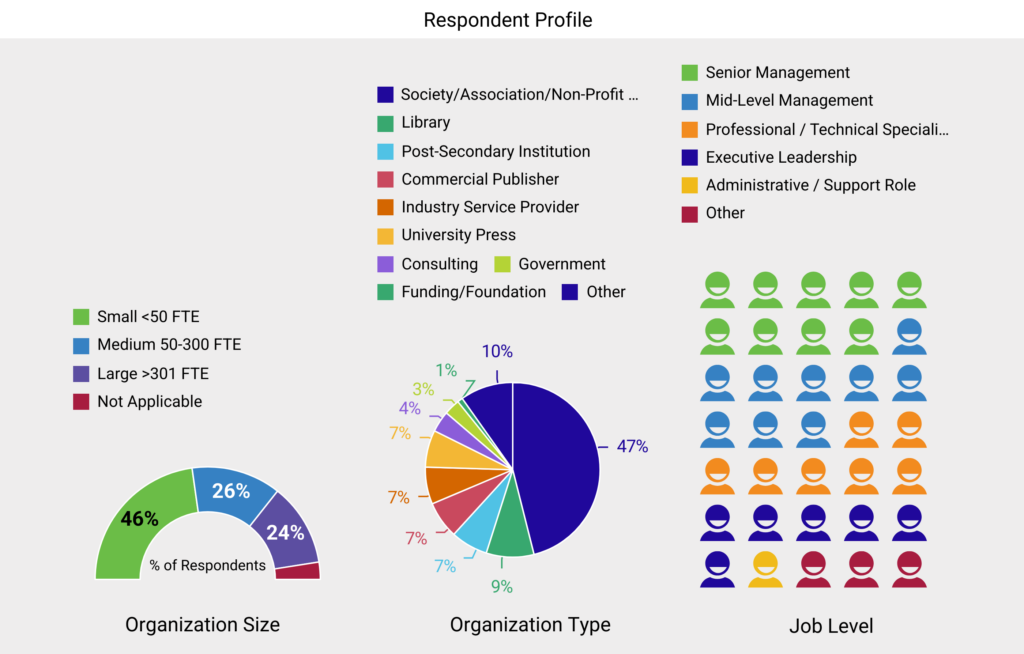
This post provides high-level aggregate results; the full report, available at no cost on SSP’s website (log-in or account creation required), provides additional detail and the ability to filter the data by organization size, type, and job level of respondents.
Key Takeaways
LinkedIn dominates, but the platform landscape is diversifying. LinkedIn is the clear professional default, followed by Facebook, Bluesky, and Instagram.
Visibility and dissemination are the dominant goals. Organizations primarily use social media for brand visibility, awareness, and dissemination of research.
Social media is seen as effective for reach, less so for results. Respondents rate social media highly for brand awareness and content dissemination, but confidence drops considerably for activities tied to tangible outcomes.
Measurement practices are uneven. Engagement metrics, including likes, shares, and comments, dominate evaluation tactics, while 21% of organizations report no formal measurement at all.
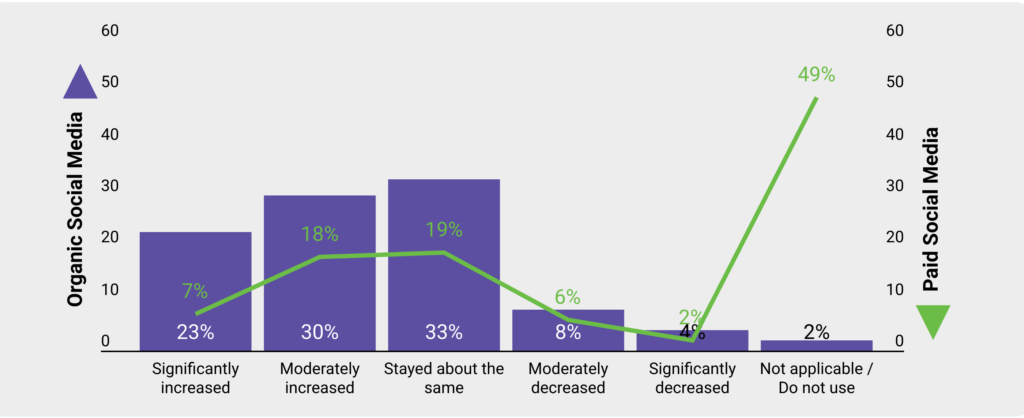
Organic social media is growing; paid remains a niche tactic. More than half of respondents report increased organic social media activity over the past two to three years.
The community sees social media as a double-edged tool. Respondents broadly credit social media with expanding the reach and visibility of research, supporting community building, and facilitating scholarly discourse. At the same time, significant majorities express concern about its contribution to misinformation, blurring of evidence and opinion, and increased exposure to harassment.
Platform Preferences
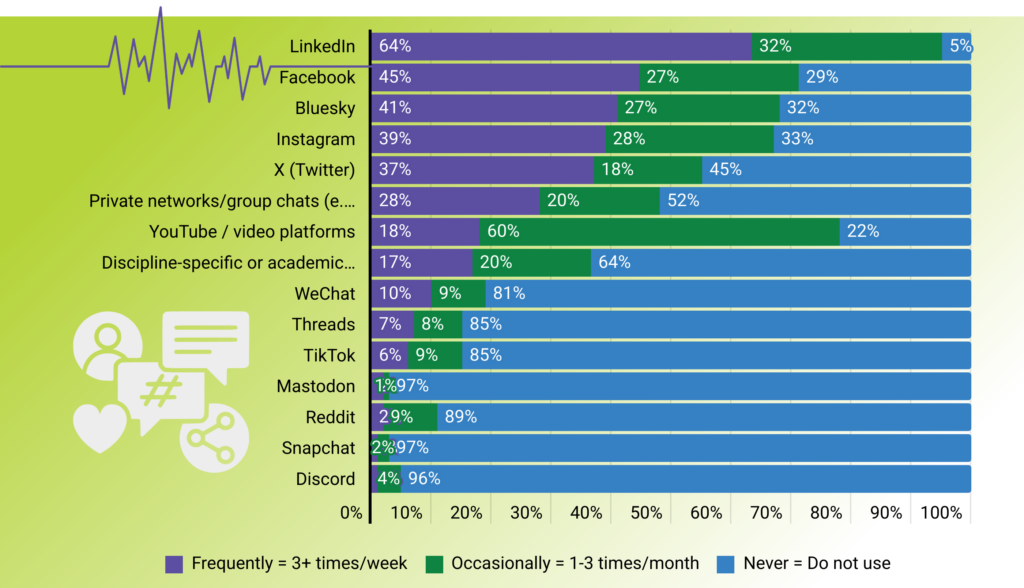
Scholarly communications organizations remain concentrated on a relatively small number of established platforms, but there does seem to be some experimentation with newer or niche channels. LinkedIn stands out as the clear leader across the board. Nearly two-thirds of respondents (64%) report using it frequently (three or more times per week), and only 5% report not using it at all. Its weighted average score (1.59) is substantially higher than any other platform, indicating that it has become the primary professional social media channel for scholarly publishing organizations.
Facebook (45% use frequently, 27% occasionally), Bluesky (41% use frequently, 27% occasionally), Instagram (39% use frequently, 28% occasionally), and X (37% use frequently, 18% occasionally) form a second tier with substantial but less universal adoption.
Bluesky’s rapid emergence is notable, with 68% of respondents reporting at least some use and a weighted average (1.09) edging out Instagram (1.06). X still remains widely used, though its 45% non-use rate signals it is losing ground to Bluesky.
YouTube and other video platforms are used less frequently (18%), but 60% report occasional use, bumping its weighted average above X. This suggests video platforms are likely used primarily for periodic longer-form content rather than for daily engagement.
Private networks such as Slack channels, association communities, and other member platforms show meaningful adoption, with 48% reporting at least occasional use. These community-based channels provide greater control over audience relationships and discussion spaces. Despite their scholarly focus, discipline-specific and academic networks such as ResearchGate show relatively modest adoption, with at least 37% using it occasionally.
Social Media Goals
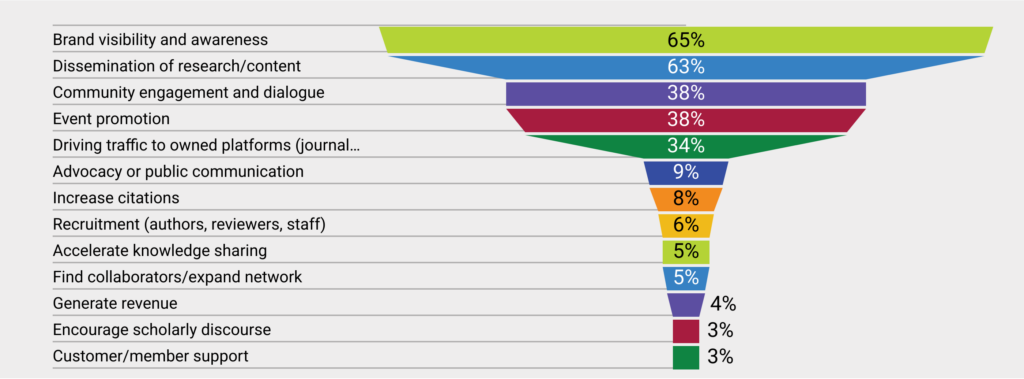
The poll results suggest that scholarly communications organizations primarily view social media as a tool for visibility, discovery, and content distribution rather than direct revenue generation or audience acquisition. The two dominant goals are brand visibility and awareness (65%) and dissemination of research and content (63%), indicating that organizations are focused on extending the reach of their publications, programs, and expertise while maintaining a visible presence within the scholarly community. A second tier of objectives centers on community engagement and dialogue (38%), event promotion (38%), and driving traffic to owned platforms such as journals and websites (34%), reflecting the continued importance of social media as a channel for audience engagement and directing users toward organizational resources.
Relatively few respondents identified goals related to advocacy, recruitment, citations, networking, revenue generation, or customer support, knowledge sharing, finding collaborators, encouraging scholarly discourse, customer/member support, or revenue generation. These results suggest that most organizations are using social media primarily as a communications and marketing channel.
Effectiveness
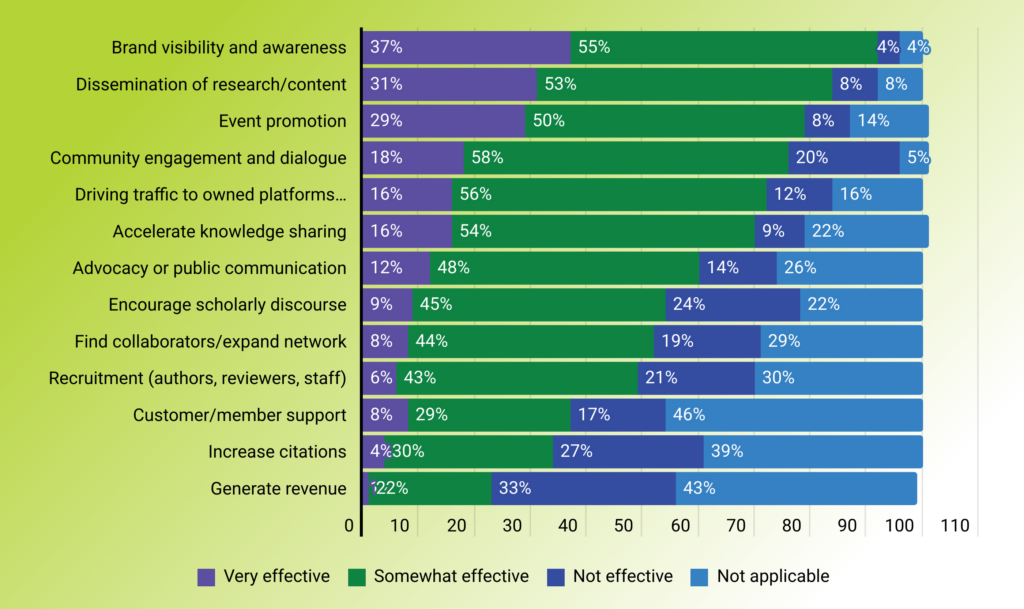
The results suggest that scholarly communications organizations see social media as most effective for brand visibility and awareness, as well as dissemination of research and content. More than 90% of respondents who use social media for brand awareness rate it as either very or somewhat effective, making it the highest-rated activity overall (weighted average 2.35). Dissemination of research and content is similarly well regarded, with roughly four in five respondents reporting positive results.
Social media is also viewed as reasonably effective for event promotion, driving traffic to owned platforms, and community engagement, although respondents are more likely to describe these outcomes as somewhat rather than very effective. More than 60% of respondents feel that social media is at least somewhat effective for accelerating knowledge sharing and advocacy or public communication as well, although to a lesser degree.
Perceptions become notably less positive for activities tied to deeper engagement or measurable organizational outcomes. Fewer than half of respondents consider social media effective for recruitment, customer/member support, increasing citations or generating revenue. Overall, the findings indicate that organizations see social media primarily as a successful tool for visibility, awareness, content distribution, and promotion, while its value for driving direct business outcomes, impact metrics, or sustained engagement appears considerably less certain.
Evaluation Methods
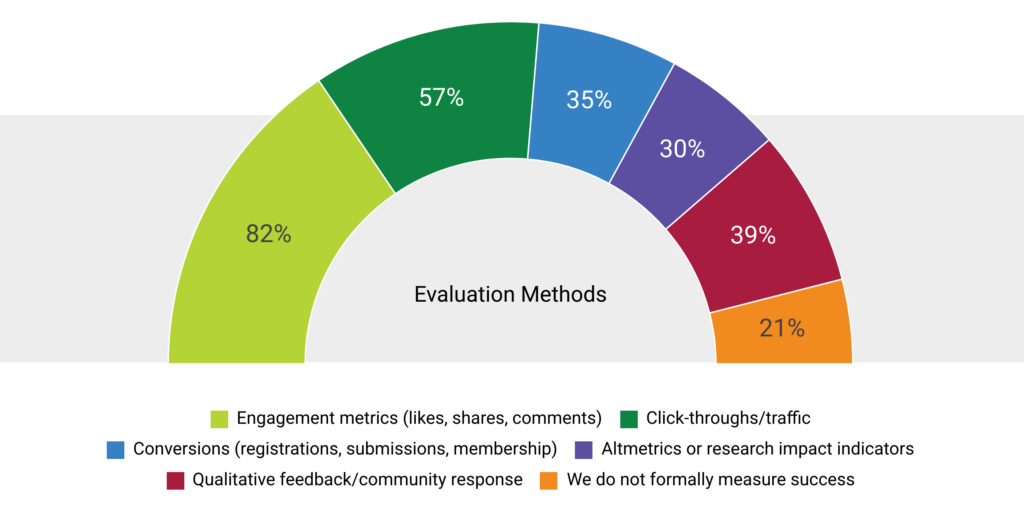
The findings suggest that most scholarly communications organizations rely heavily on engagement-based metrics to evaluate social media performance. More than four in five respondents (82%) report tracking likes, shares, comments, and similar engagement indicators, making this by far the most common measure of success. A second tier of evaluation methods focuses on actions that connect social media activity to organizational assets and outcomes, with 57% tracking click-throughs or website traffic and 35% measuring conversions such as event registrations, manuscript submissions, or memberships. These results indicate that while engagement remains the dominant metric, many organizations are also attempting to connect social media efforts to more tangible organizational goals.
At the same time, the data reveal a broader mix of formal and informal approaches to assessment. Nearly 39% of respondents consider qualitative feedback and community response when evaluating success, suggesting that relationship-building and audience sentiment remain important factors that may not be fully captured by analytics dashboards. Fewer organizations track altmetrics or research impact indicators (30%).
Notably, 21% report that they do not formally measure social media success at all, highlighting a significant segment of the community that either lacks established evaluation frameworks or views social media primarily as a communications function rather than a channel requiring performance measurement.
Evolving Practices
Organic social media remains widely used and continues to grow, with 54% of respondents reporting that usage has increased over the past 2–3 years (23% significantly and 30% moderately), while only 12% report a decline. Another 33% indicate that their organic social media activity has remained stable, suggesting that for most organizations, organic channels remain an established and increasingly important part of communications and engagement efforts.
In contrast, paid social media appears to play a much more limited role, with nearly half of respondents (49%) indicating that paid social media is not applicable or not used by their organization. Among those that do use paid social media, growth is more modest: 25% report increased usage, 19% report no change, and just 8% report a decrease. Taken together, the findings suggest that organizations are continuing to invest in and expand their organic social media presence, while paid social media remains a more specialized tactic used by a smaller subset of the community.
Social Media Impacts
Areas Viewed as Net Benefits
Respondents overwhelmingly see social media as beneficial for disseminating and increasing the visibility of research, with 84% reporting a moderate or significant net benefit and fewer than 3% perceiving harm. Similarly, expanding access to broader audiences (78% net benefit), supporting community building and collaboration (75%), and facilitating scholarly discourse (65%) are widely viewed as positive contributions. There is also moderate support for the idea that social media accelerates knowledge production or acquisition, although a majority characterize its impact as mixed rather than strongly positive.
Areas Viewed as Mixed or Neutral
Increasing citation rates is viewed largely as having no clear impact, with 65% selecting the mixed/no clear impact option and only 29% perceiving a net benefit. Likewise, accelerating knowledge production or acquisition generates a more divided response, with a small contingent viewing it positively but more than half reporting mixed or uncertain effects. Respondents are also divided on whether social media fragments scholarly discussion across platforms, with nearly 60% reporting no clear impact.
Areas Viewed as Net Harms
The strongest concerns center on information quality, trust, and scholarly rigor. Majorities perceive social media as contributing to misinformation and erosion of trust, oversimplification of research findings, rewarding attention-grabbing content over methodological rigor, blurring the distinction between evidence-based research and personal opinion, and increasing exposure to harassment, hostility, or unproductive interactions. In each of these areas, respondents are substantially more likely to report net harm than net benefit, with concerns about harassment (62% net harm), misinformation (51%), blurred distinctions between evidence and opinion (57%), and attention-driven incentives (56%) particularly pronounced.
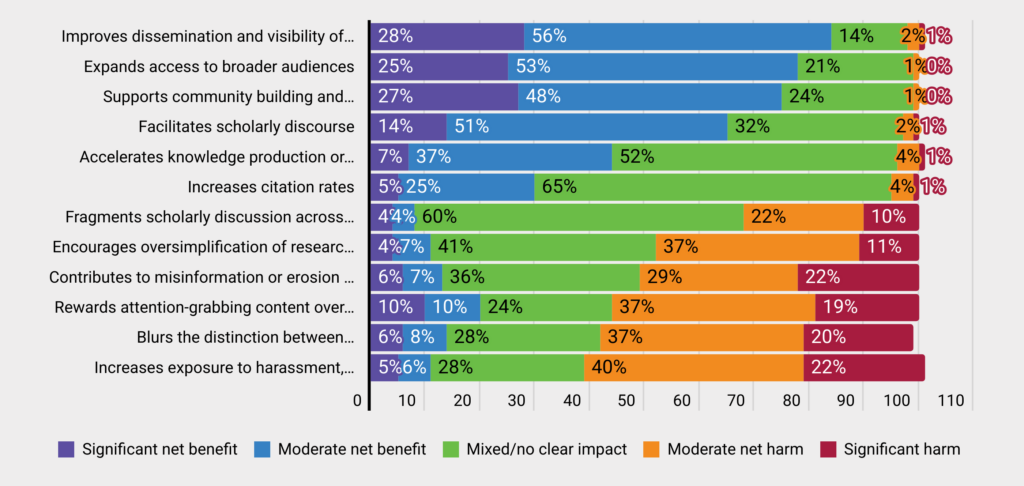
Taken together, the results suggest that the scholarly communications community views social media as a highly effective mechanism for discovery, visibility, reach, and connection, while simultaneously expressing concern about its influence on research integrity, public trust, scholarly nuance, and the quality of online discourse. The overall picture is not one of outright optimism or pessimism, but rather a recognition that social media has expanded access to scholarship while introducing challenges that can undermine the very goals of scholarly communication.
Conclusion
Organizations appear to be navigating a complex landscape in which social media remains an important vehicle for dissemination and engagement, while requiring thoughtful consideration of its limitations and unintended consequences for scholarly communication and the integrity of the scholarly record. Social media is working well for what it does most naturally: broadcasting content, building name recognition, and connecting organizations with their audiences. It is less trusted as a mechanism for driving deeper engagement, influencing scholarly impact, or supporting the kind of nuanced, evidence-based discourse that defines scholarly communication at its best. While platform preferences and measurement practices vary across organization types and sizes, there is broad agreement that social media delivers meaningful value as a communications and engagement tool. As platforms continue to shift and new ones gain traction, organizations will need to make increasingly deliberate choices about where to invest, what success looks like, and how to measure it.
The full report, available at no cost on SSP’s website (log-in or account creation required), provides additional detail and the ability to filter the data by organization size, type, and job level of respondents. If you have a suggestion for future Pulse Check Polls, send your ideas to info@sspnet.org.
Author’s note: Data collection was conducted June 1-15, 2026. AI applications were used to assist in the analysis and summarization of the data in this report.