Editor’s Note: Today’s post is by Maryam Sayab and Linhui Wang. Maryam is the Director of Communications at the Asian Council of Science Editors (ACSE) and Co-Chair of Peer Review Week. With a background rooted in research integrity and publication ethics, she actively works to advance regional conversations around responsible peer review, transparent editorial practices, and inclusive open science. Linhui is an Associate Professor at Fudan University Shanghai Cancer Center and Science Editor of China Oncology and Oncoradiology. Full disclosure, Linhui Wang is the author of several of the papers referenced in this post.
Open Access (OA) is often celebrated as a global success story, but behind the promise of openness lies a persistent issue: licensing and copyright confusion. Nowhere is this more apparent than in many regions of Asia, where OA adoption is accelerating, yet the legal and structural underpinnings of this openness remain fragile.
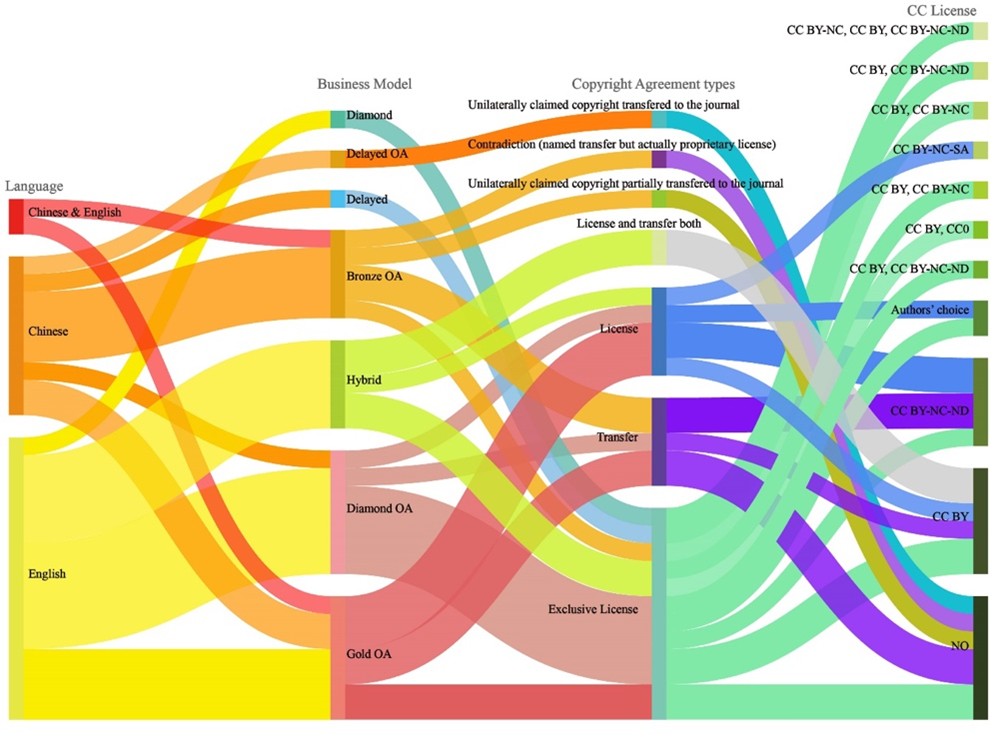
While much of the global conversation centers around transformative agreements, read-and-publish models, and Plan S compliance, journals in Asia face a more fundamental hurdle — clarifying what “open” actually means. Recent research, especially from China, reveals legal ambiguities that risk undermining the credibility and usability of OA content. While countries like Japan and Korea have made significant strides, many regions still struggle with foundational issues. Biomedical publishing, in particular, presents a mixed picture, vividly illustrated by recent research from Ming Ni and Linhui Wang (see Figure 1).
A Regional Challenge with National Variations
Across Asia, OA adoption is growing but often without harmonized policy or infrastructure. For instance, a 2023 study in Online Information Review found that many South Asian journals hosted by institutional repositories lack permanent licensing statements or clearly defined reusability rights. In Southeast Asia, the Asia OA Observatory reported that fewer than 30% of indexed OA journals used standard Creative Commons licenses as of 2024. Even in mature OA markets like Japan, inconsistencies remain in the application of derivative licenses. Korean medical journals indexed in PubMed Central often omit transparency about Article Processing Charges (APCs) or the scope of author reuse rights.
As far as Singapore is concerned, Jinjin Liu reported that the Directory of Open Access Journals (DOAJ) indexed 50 of Singapore’s OA journals by the end of 2024. Among them, 19 journals (38.0%) were also indexed by Web of Science (WoS), while 15 (78.0%) ranked in Q3 and Q4. Additionally, 76.0% of OA journals adopt CC BY licensing, and another 16.0% adopt CC BY-NC licensing. Liu also demonstrated that 78% of Singapore journals indexed in DOAJ agree that authors hold copyright without restrictions, and only 11 journals (22%) choose to retain copyright. But the details of the copyright transfer agreements were not analyzed.
This fragmentation undermines the principles of OA and complicates regional and global collaboration. The experience of Chinese biomedical OA journals offers a compelling case study.
The Bronze Mirage: When Open Isn’t Really Open
In the English-language article “The Development Status and Countermeasures of Biomedical OA Journals in China”, Linhui Wang and colleagues conducted a detailed statistical analysis of biomedical OA journals indexed in PubMed Central and the Directory of Open Access Journals (DOAJ). Their findings include:
- Limited use of standard licenses: Many journals do not adopt Creative Commons licenses, creating ambiguity in reusability rights.
- APCs lack transparency: Some journals charge APCs without clearly disclosing pricing models or fee waivers.
- Institutional concentration: A significant number of biomedical OA journals are affiliated with universities or government presses that may lack dedicated OA policy expertise.
These findings underscore a systemic disconnect between the aspirations of open science and the operational frameworks of OA publishing.
In a complementary study published in Chinese, “Current Status and Improvement Strategies of Copyright of Biomedical Open Access Journals in Shanghai“, Dr. Ni Ming and co-author Linhui Wang reviewed 112 biomedical OA journals in Shanghai. Although the article is in Chinese, its abstract (available in English) reveals key insights. A correction was later submitted: the proportion of Bronze OA journals was initially reported as 33.0% (37/112), but the correct figure is 27 out of 112 (approximately 24%).
Key recurring issues include:
- Bronze OA journals often lack clear OA declarations and licensing statements.
- Vague legal agreements: Copyright contracts frequently contain ambiguous or missing clauses, such as network dissemination rights, breach liability, and dispute resolution.
- License–contract conflicts: Discrepancies between Creative Commons licenses and journal contracts are common, especially regarding derivative works.
These gaps not only create confusion for authors and readers but also expose journals to legal risk and reputational damage.
Legal Ambiguities in Copyright Agreements
In China, Wang and Ni’s findings reveal a troubling pattern: even when journals claim to use Creative Commons (CC) licenses, their author agreements often omit provisions for digital dissemination or are signed only by the author and not by the publisher. Some contracts contradict stated CC licenses, granting journals exclusive rights despite a CC BY claim or failing to mention derivative use. Besides, some journals have both license agreements and transfer agreements, which are contradictory.
This issue is not unique to China. In Southeast Asia, some university journals still use traditional copyright transfer agreements for OA content, restricting authors from depositing preprints or sharing their work, undermining open dissemination goals.
The consequences are tangible. Journals with unclear copyright policies risk delisting from trusted indexes like DOAJ, PubMed Central, or Scopus. Authors may hesitate to submit, fearing loss of rights, while readers are uncertain about legitimate reuse, even for teaching or translation.
The Metadata Gap: Invisible OA
Another key issue is metadata accuracy. Many journals list articles as OA but fail to encode licensing metadata correctly. This hinders discovery and verification by aggregators such as Unpaywall and OpenAlex.
A recent study from the Initiative for Open Abstracts (I4OA) noted that Asian journals disproportionately lack standardized metadata for licensing, particularly those not published in English. This reduces visibility and impairs reusability.
Moving Toward Licensing Clarity: What Needs to Change
A multi-pronged approach is needed to close these gaps:
- National OA Policies Must Include Legal Standards: Governments and national academies promoting OA should go beyond access mandates. Policies should require CC licensing, author rights clarity, and enforceable reuse guidelines.
- Capacity Building for Editors and Publishers: OA training in Asia often prioritizes indexing and APC workflows while neglecting legal education. Programs by INASP and the Asian Council of Science Editors can offer regionally tailored training.
- Auditing and Transparency Tools: Third-party platforms, such as DOAJ’s evaluation process or Crossref’s License Metadata tool, can be integrated into national frameworks to ensure policy alignment. “Principles of Transparency and Best Practice in Scholarly Publishing” would be helpful for the improvement of the transparency of publishing behaviors and processes, and ensure the quality and credibility of academic research. Scholarly journals should increase the awareness of and participation in open science development, work on network security maintenance and website information transparency, clearly describe copyright and licensing information in journal policies to protect intellectual property rights, and safeguard editorial independence to ensure academic value.
- Global Indexes Must Recognize Context: While standardization is key, global platforms should support, rather than penalize, under-resourced journals that are taking steps toward openness.
- Establish OA policies and apply for OA database: Applying to DOAJ would be helpful for establishing OA policies for journals under the subscription business model, as well as raising the visibility of the journals. DOAJ is the world’s largest OA database, but it only indexed Gold OA and Diamond OA journals before 2024. Since early 2025, DOAJ has begun to index Subscribe-to-Open (S2O) journals. We could look forward to DOAJ indexing Hybrid journals someday.
Among the journals from different countries indexed in DOAJ, Indonesia has the largest number of indexed journals. At present, the proportion of China’s Gold OA and Diamond OA journals indexed in DOAJ is relatively small, and Bronze OA journals account for the highest proportion in China.
Conclusion: It’s Not Just About Being Open — It’s About Being Clear
Open access without clear legal scaffolding is like a bridge without guardrails: it may get you across, but it’s not safe. As Asia’s scholarly infrastructure expands, there is a growing need to invest not only in making research accessible but in ensuring its legal clarity and sustainability.
Wang’s findings highlight a larger truth: journals in the Global South are progressing toward openness but often lack the legal compass to stay on course. It’s time for funders, institutions, and infrastructure providers to prioritize not just how much content is open, but how reliably open it is.

Discussion
22 Thoughts on "Guest Post — Beyond Access: Untangling Copyright Confusion in Asian Open Access Journals"

To be very frank, open access journals means that the articles published in these journals are available to all since they charge APC from the author. At least I do not understand the legalities of the licenses. Whether it is license to publish the article or license to circulate the article is not clear. Authors blindly tick mark the options without any understanding. At least I do not have any knowledge regarding this.

Thank you for sharing this, Digambar, you’re definitely not alone in feeling confused about licenses. That’s exactly why I wrote this piece. If authors don’t clearly understand what they’re signing, “open” access becomes just another checkbox. We need simpler, clearer communication around rights, especially for researchers managing this on their own.

The topic is very much pertained to current trend of open access and its growing trend. There are no rational in open access charges by particular publication group. The monotony of deciding charges deprive many of the authors to publish good quality papers as majority of publishing houses force to go open access. Vice versa is also true that many of poorly written, irrelevant publications are appearing just for the shake of earning. There should be some ethical and rational mechanism of determining terms and conditions of open access.
Absolutely agree, Amit, the imbalance is a real concern. When publishing decisions are driven more by fees than by quality or equity, we all lose. Open access should be about accessibility and integrity, and that calls for fair, transparent, and ethical frameworks across the board.

The above article indeed a good initiative.

It is very informative and an excellent article for starting unifying rules, strategies, and OA publication operational guidelines and overall transparency to reach a day with unified OA publication applicable guidelines for all OA models, taking into consideration the specific nature of each model.
I appreciate your thoughtful direction. A unified yet flexible framework, one that respects the diversity of OA models while ensuring transparency, is exactly the kind of balance we need to work toward together.

Thank you for the article!
This piece really opened my eyes to the importance of clear copyright practices in open access publishing across Asia. Issues like unclear licenses and conflicting contracts are things we often see in local journals.
I agree that open access shouldn’t just mean “free to read,” but must also be legally clear so that authors, readers, and publishers feel safe and protected.
Hopefully, more journals in Asia will start paying attention to this aspect. A very insightful article!
Best regards,
Mamdukh Budiman
Universitas Muhammadiyah Semarang Central Java Indonesia
Thank you so much, Mamdukh! You’re right, clarity in copyright and licensing is just as essential as free access. When authors and editors understand their rights and responsibilities, it strengthens trust across the whole publishing ecosystem. I hope this conversation continues to grow in our region!

I have my own experience in respect of theft of my one article presented in a conference, abstract was published, but was latter published same paper by my colleague in his name in a reputed European Journal.. I approached University for the justice, but in-vain. I wrote to the Editor of concerned journal, but no response received. I approached High Court, but the court didn’t award the justice. Unfortunately, I am law degree holder along with other qualifications. I can imagine and understand what happened. I have firm opinion from my personnel experience that judiciary doent take it properly to awrd the justice. to my opinion, the copy right issues are neglected by our courts. I will write latter in a book, after retirement.
Thank you for sharing your experience, Dr. Chavan. It’s heartbreaking to hear how such a clear breach of academic and ethical integrity went unaddressed at so many levels. This also shows why stronger, enforceable copyright systems and greater institutional accountability are urgently needed. I hope your future writing brings visibility to these challenges and helps push for the change we all need.

For sure open access is very much needed for researchers and commons having inclination towards science and scientific facts. There are legalities involved in it but authors more often than seldom skip this because their focus is more towards publication rather than the legalities involved in it. However, hefty charge is a matter of concern. Many can not afford it especially in case of fund crunches. In my opinion this needs to be streamlined.
I also agree that streamlining processes and ensuring affordability, especially for underfunded researchers, is essential if we truly want equitable access and participation in science.

An excellent discussion is going on. I appreciate the author of this article and the contributors. Actually, “Open access” is a way (lock) for publishers to collect more money from authors who are helpless in this regard. This policy has been developed over the last decade. I will favor and highly appreciate if some rules are framed by the governments of various countries, which might be implemented when a license of publication is issued to any journal.
Open access has indeed become a double-edged sword. While it was meant to democratize knowledge, in many cases it has shifted the burden onto authors. I completely agree that stronger, government-backed frameworks and licensing rules could help bring more fairness and accountability to the system.

This article is worth reading, as it is insightful and states the importance of openness in Asian journal access. To ensure true openness, a focus should be put on proper and clear licensing rules, and this should be supported by solid frameworks.

The article has highlighted such a critical aspect of open access. The analogy of a bridge without guardrails is appropriate – access without legal clarity can indeed expose researchers, institutions, and publishers to unintended legal and intellectual property breach risks. As Asia’s scholarly infrastructure grows, we need to focus not just on making research available, but also making sure it has strong solid legal and ethical foundations and protection. Ultimately, it’s not just about how much content is open, but how securely and consistently it remains open.

This article highlights a crucial and often under-discussed challenge in the open access ecosystem—especially in the Asian research landscape. While open access aims to democratize knowledge, unclear or inconsistent copyright policies can unintentionally hinder both authors and readers from making full use of published work.
In my experience, many early-career researchers remain unsure about their rights post-publication, including whether they can share or reuse their own work. Clear, transparent, and standardized copyright frameworks across journals in the region are essential—not only for ethical publishing, but also for empowering researchers.
Thank you for shedding light on this important topic. It’s a conversation we urgently need to continue across institutions and editorial boards.
— Fayyaz Ahmad Siddiqui

The link to the Asia OA Observatory doesn’t resolve. Can you provide the correct link?
Thank you for pointing out, Sophie. Here is the link:
https://doi.org/10.1108/OIR-03-2019-0087
@The Scholarly Kitchen Editor: Please update the link to “Asia OA Observatory” in the article accordingly.

Updated.

Many thanks for this insightful article regarding the reality behind Open Access. I totally agree with a unified OA with a clear and flexible guideline, framework and copyright policies especially for teaching and translation, but still ensure transparency especially for both CC license agreements and transfer agreements.