Scholarly publishing thrives on community. The connection of ideas, of technologies, of people. The pandemic threw this need into stark relief, and our industry got creative about finding ways to connect outside of the usual conferences and seminars. The shift to virtual events not only provided a much-needed stop gap, but also opened up access to gatherings to a wider set of the population, both geographically and to stakeholders without the travel budgets required by IRL meetings.
Beyond those benefits, the drastic reduction in carbon emissions caused by the global halt in business travel highlighted the environmental impact of in-person events. As of now, most of the in-person events we were used to pre-COVID have returned (some with now-added virtual components). Combining these shifts with the industry’s commitment to the mission of the UN’s Sustainable Development Goals, event planners are now faced with the delicate balance between constructing spaces for deeper connection with the impact we’re having on our planet.
As someone who has organized industry events since 2018 (Silverchair’s Platform Strategies and adjacent client events) and was faced with this conundrum when bringing back an in-person format in 2022, here’s what I’ve learned about planning events that prioritize sustainability.

Tip #1: Don’t host an event
The Company of Biologists recently released an event carbon calculator designed to elucidate the carbon footprint generated by various aspects of an event, as well as highlight ways to mitigate emissions. The tool examines travel, catering, venue, and more. I completed this for our own event and was floored to see just how much of the event has nothing to do with the event itself, but rather the travel that your attendees have to do to get there. More than 90% of our event’s carbon footprint is from the predicted modes and distance of travel needed by our attendees.
So before you start thinking about compostable napkins, ask yourself: does your event fill a need unmet by other existing events? Could it be hosted effectively online instead? The proliferation of in-person events strains not only budgets, but also environmental health. For me, in shifting our event to virtual for two years, I found that the presentation of information translates perfectly well to a virtual format. What did not, however, was interactivity, engagement, networking, and collaborative problem solving.
And so, when we decided to bring back the in-person format, we kept the virtual series as well – allowing a wider reach of the high-value educational content while structuring the in-person day to facilitate exactly those qualities that are difficult to replicate online. There are almost no one-way presentations in the in-person agenda – instead we focus on interaction and building connections in ways that maximize the face-to-face experience.
Tip #2: Location, location, location
As highlighted above, travel is the biggest consideration in sustainability for an event. The more that attendees can walk, take public transport, or drive reduces carbon impact significantly. So first consider where most of your attendees are located in order to triangulate areas that minimize travel requirements.
This means not just the city you host it in, but also the venue’s proximity to other resources once they’ve arrived. Can they easily walk to restaurants, metros, and offsite activities? Help attendees choose mindful practices by encouraging and sharing information about carpooling, public transit, or cycling. For larger events, arrange shuttle services from transit hubs. Considering the macro and micro-influences of your event location will be the biggest factor in how sustainable your event ultimately is.
Tip #3: Partner consciously
From the event planner’s perspective, one of the most pressing considerations is always budget – the venue, the catering, the supplies. Where we spend our money should reflect our values by supporting the kinds of practices that contribute to an environmentally conscious event.
Partnering with companies and individuals who share your sustainability values and can demonstrate their own eco-friendly practices creates a ripple effect that amplifies your event’s positive impact. Opt for venues with existing sustainability certifications or green practices.
For us, The Eaton Workshop venue is a shining example of these values: the building is LEED Gold certified and supports a rigorous sustainability program to reduce waste and emissions, including recycling rainwater; they use sustainably sourced construction materials and furnishings; all workers are paid a living wage; and they support numerous local grassroots organizations working toward social justice.
Supporting local businesses also promotes sustainability by reducing food miles and transportation-related greenhouse gas emissions, decreasing packaging and food waste, and investing more directly in your host city.
Tip #4: Mind the details
We’ve covered the big things. But there are hundreds of tiny choices (so, so many) made when planning an event and keeping sustainability front of mind when making those decisions can add up to have an impact greater than the sum of its parts.
Here are some things to consider in the details:
- Digital materials. Lean on digital invitations and programs rather than printed versions. Today’s event apps have made this simple and also give attendees a space to network with one another asynchronously. This practice removes the need for paper materials that will just be tossed (or hopefully, recycled) at the end of the day.
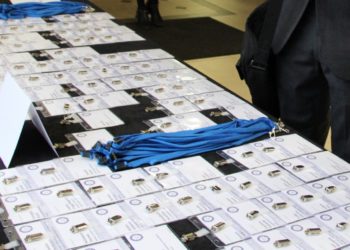
- Sustainable swag: If it’s got your company’s name on it, it should reflect your organizational values. Giveaways, branded supplies, and other collateral can be easily sourced responsibly thanks to our friend The Internet. I’m a fan of Ethical Swag, but most swag providers include sustainable and eco-friendly selections. Giving out swag like reusable bags and water bottles can go further by enabling eco-friendly practices long after the event has ended. My personal favorite eco-swag item: bamboo nametags made from materials harvested by hand in North Carolina from a sustainable forest and printed with a 100% plant-based dye. Bonus: we print the nametags with only name and organization so that they are more easily reusable after the event (see if you can spot them at the next industry meeting).
- Food and Beverages Source from local, organic suppliers to minimize transportation impact and support regional businesses. Offer plant-based menu options, which typically have a lower carbon footprint. Use reusable or compostable plates, cups, and utensils instead of single-use plastics. Plan portions carefully to minimize food waste, and if possible, arrange with the venue to donate leftover food to local shelters (or at least, to vendor employees so it doesn’t go to waste).
Tip #5: Give back where you can
Ultimately, hosting an in-person event will still affect the environment (see #1), so every effort you can make to alleviate that impact is still valuable. Though not a perfect solution, efforts like carbon offsetting of travel (such as via COTAP, Carbon Offsets To Alleviate Poverty) is one way to recognize that impact and make alleviation efforts. Organizations like Trees for the Future can plant trees equivalent to your number of attendees in areas affected by deforestation. Donate a portion of your ticket sales to environmental nonprofits working on climate change, wildlife conservation, ocean cleanup, or ecosystem protection (or consider including it as an add-on during the registration process).
The first time you try to implement these practices, it may take a little extra time and thought, so plan ahead. But once it becomes a standard part of your preparations, it can be a small shift that has a big influence on your event’s effect on our world.
Got additional tips for fellow planners? Let us know in the comments!

Discussion
6 Thoughts on "Five Tips for Hosting a Sustainable Event"

Thanks for bringing this to people’s attention, Stephanie. As a CSA-supporting, regenerative ag proponent, and home composter I have to shut off my brain at conferences. So much waste. I just returned from New Directions at the amazing AGU building but noticed people did not properly compost and recycle. Maybe we start adding a reminder about eco impact and do a little “housekeeping” at the beginning of events? I do recognize the hypocrisy of all this while we run around with our laptops and iPhones and talk about AI initiatives. And I do recognize that while compostable silverware and brown paper napkins might make us feel better…it’s not truly having an impact. Still I appreciate and see the tiny choices and deeply value posts like this that bring it to the forefront of people’s minds.

Ugh YES! We once hosted an event in Charlottesville where everything we used was compostable and yet I spent the entire day picking things out of the trash. 😑 So yes, I think education and clear signposting about sustainable options can be critical in making sure you’re not going through certain efforts for naught.

Very interesting article. I wrote something on the topic of events (academic conferences) on this platform a few years ago. It’s not specifically on the environment but some of the conclusions are very similar. https://scholarlykitchen.sspnet.org/2022/05/16/guest-post-hybrid-versus-in-person-what-will-be-the-future-of-academic-conferences/
Marco

Thanks for sharing–it was great to revisit this article and reflect on where we are now!

This was such an inspiring article! I’ve been part of the event management team in the hospitality industry for the past 10 years, and we also try to follow sustainable practices whenever we can. Not all the ones you mentioned, but we do our best to make small changes like using digital materials, reducing waste, and using eco-friendly decor, and yes, we also encourage cycling. Your article gave me even more ideas to make our future events greener. Thank you for sharing!
The small things add up! And fortunately, I feel like more and more vendors are prioritizing these practices, which is making it easier (and more affordable) to accomplish. Would love to hear how these things work for your next event!