For many years now, the dominant discourse around the future of scholarly communication has centered on two assumptions:
First, that charging people for access to scholarly products is morally unacceptable, and must be eradicated by means of a global transition to open access (OA).
Second, that this global transition from toll access to OA is inevitable (if not happening as quickly as it should be).
I’m going to push back on both of those assumptions. In the first part of this two-part essay, I’ll address the second; tomorrow, I’ll address the first, offering (in the form of a “modest manifesto”) a very different vision for the future of our global scholarly communication ecosystem.

As for the global transition to OA: it seems to have stalled out. As for its ultimate inevitability: I’m not seeing any evidence for it. On the contrary, what we seem to be seeing is ongoing and robust evidence of a very different transition, which has already happened and which I suspect will remain in place for the foreseeable future: a transition from a scholarly communication ecosystem overwhelmingly dominated by toll access to a much more diverse, hybrid ecosystem in which a variety of open and toll-access models coexist quite comfortably, each model contributing to the system a different set of strengths and weaknesses, none of them perfectly equitable, each solving some problems while creating or perpetuating others.
STM’s recent report on global uptake of open access provides some compelling evidence contrary to the pervasive “inevitability” discourse. Central to that report is this chart:
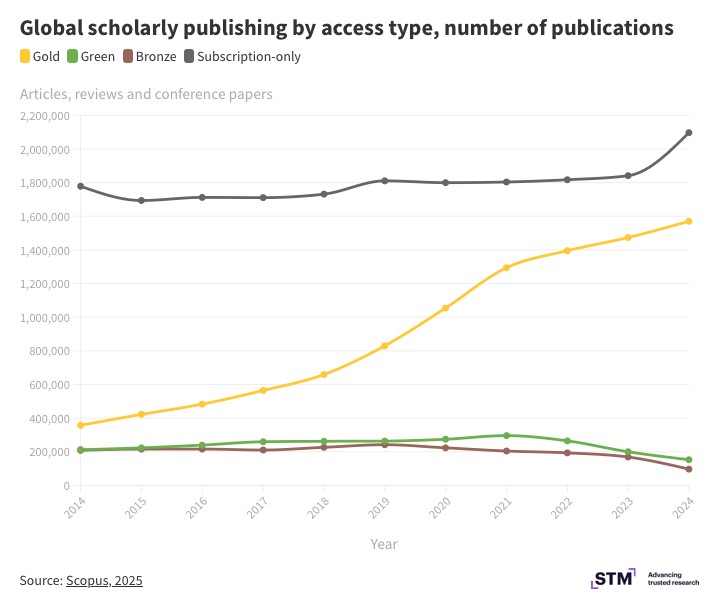
There are several interesting and revealing data points here. One is the continued rude good health of toll-access publishing, which, following a modest dip in the market share of articles, reviews, and conference papers between 2014 and 2015, has slowly grown its market share over the subsequent decade, growing much more quickly between 2023 and 2024. In 2024, two decades after the Berlin Declaration on Open Access, toll-access articles, reviews, and conference papers still represented the majority of output in these formats.
Another interesting data point is the growing (though perhaps slowing?) dominance of the article processing charge (APC) as the business model that supports production of open articles, reviews, and conference papers during the same period. While Green and Bronze OA publications puttered along for most of the decade at a low but steady simmer and in recent years have begun to fall off, Gold publications have increased strongly and now come close to rivaling the market share of toll-access publications – though again, recent data suggest that toll access may be pulling away. Given the increasingly controversial nature of the APC funding model (which, let’s be honest, is just another manifestation of toll-access publishing), this trend has caused real consternation in the OA advocacy community.
Now obviously, this is only one report based on only one set of data that focuses specifically on articles, reviews, and conference papers. But I’m not aware of any data suggesting that a global shift to OA is underway in any other sector of the publishing marketplace (if such data are out there, please share in the comments). Nor do global trends in publishing policy and practice offer much indication of an impending shift to universal OA. In the US, the only policy momentum is in the direction of public, rather than open, access, and despite a proliferation of institutional OA statements and policies, virtually no American academic institution actually requires its faculty to publish openly. In Europe, cOAlition S keeps retreating from its original, revolutionary goals. China, as yet, has shown little inclination to make open publishing a requirement for its researchers, and India’s recently instituted One Nation One Subscription scheme represents the national institutionalization not of open access, but of hybridity, with the national government both paying subscription fees and underwriting APCs in selected journals.
So does all of this evidence suggest failure on the part of the open access movement? Not if the movement’s goal is the growth and proliferation of open access – in that regard, it’s been a tremendous success. If, on the other hand, the movement’s goal is universal mandatory OA, then it’s hard to see success on the horizon.
But is mandatory and universal OA a goal we should embrace?
I’ll offer some thoughts on that in tomorrow’s post.

Discussion
17 Thoughts on "The Global Transition Has Already Happened – It’s Just Not the One You Expected (Part 1 of 2)"

A brave account, Rick.

Rick, I appreciate the reset on “inevitability.” The language of “transition” often smuggles in hubris—however well intentioned – promising a single end‑state when the world keeps refusing to be singular. Additive to your lists of complicating factors is the AI rights question: machine readability rights, agent access, and model licensing have opened a frontier that the OA movement didn’t anticipate and doesn’t yet have a coherent stance on. Publishers now face costs and risks that aren’t trivial even in the simple act of hosting OA. If openness includes machines, the economics and ethics change: models extract value differently than readers, and the safeguards aren’t free.

I don’t see why this should be framed as a problem that is unique to OA. Those who are concerned about unfettered access of LLMs to OA papers should be doubly disturbed about publishers licensing paywalled content to the AI companies.
https://sr.ithaka.org/our-work/generative-ai-licensing-agreement-tracker/

The dramatic increase in the number of subscription-only publications in 2024 compared to the previous years looks quite surprising. It would be interesting to know what is the reason for this. Is it possible that the cause is some kind of change in the indexing routines of Scopus? Or some other irregularity in the data?

We at Research Consulting help put the STM OA dashboard together each year, and while there were some changes to OA tags in Scopus in 2024, they don’t account for the increase in subscription-only publishing. It does seem to be a genuine increase, and the same significant uptick is also evident in the Dimensions database. A big part of the rise is down to rapid growth in outputs from China, which has lower levels of OA than the global average. Rick’s text on the ‘stalled out’ transition links to James Butcher’s article exploring this further. However, I think the other factor is that growth in the volume of outputs is increasingly outstripping the availability of funding for APCs or read-and-publish agreements.

I think Rob is right — recent decades have seen a huge explosion of research (which is a good thing), and many of the emerging models of open publishing simply can’t scale to meet that new demand for review, vetting, dissemination, and reliable archiving. The obvious exception is APC-funded OA publishing, which of course scales very, very well: revenue increases in direct proportion to publishing output. Unfortunately, Gold OA brings with it lots of negative externalities, as well as fundamentally challenging conflicts of interest for publishers.
Dear Rob,
Thanks for your answer. I quickly looked into the numbers in different databases and it seems there is a actually a large increase in toll-access articles from 2023 to 2024. It looks like a handful of non-OA journals, mainly in engineering/material science had extreme increase in the number of published articles (mainly from China). I will try to look more into this.

Dimensions shows a much different picture – Gold (articles published in 100% OA journals) surpassed Closed in 2019 and continues to rise. Note that Dimensions splits out Gold vs Hybrid curves separately, while the STM report combines those two access models into one curve. All OA (Gold + Hybrid + Green + Bronze) has been larger than Closed access every year since 2016.
Link to graph: https://ibb.co/S4b4sr0t
Dimensions also shows the jump in Closed access for the most recently completed year, but this is an artefact of the 12-month embargo period. Once 2025 ends, that 2024 data point will drop down to match all the others, just as it has every year. If you want a Journalology link, see James Butcher’s #107 for the same thing.
Thanks for this info, Eric. As far as I know both Scopus and Dimensions (and even Web of Science) mainly fetch OA info from Unpaywall. According my own previous experiences, Unpaywall systematically underestimates the number of OA articles (gold/diamond or hybrid). I can imagine that in reality the share of OA is still increasing each year. Although it is actually true that there are some toll access journals which have published copious amount of extra closed articles in 2024 compared to previous years. For example Chemical Engineering Journal or International Journal of Biological Macromolecules has published 3000-4000 extra articles in 2024 compared to 2023.
You make some good points Eric, Dimensions does capture a lot more gold articles than Scopus, being less selective, and the jump in closed access will definitely moderate as embargo periods elapse. However, we have snapshots of the historic Scopus data behind the STM OA dashboard and 2023 didn’t show the same ‘hockey stick’ pattern for Closed access articles that we now see in 2024.
From 2022-23, Closed access article volumes grew by 98,723, or just over 5%, as reported in last year’s dashboard. From 2023-24, Closed access articles volumes grew by 255,576, or nearly 14%, as reported in the current dashboard. See my (crude) side-by-side comparison here for a visual: https://ibb.co/t17xwXG. There’s definitely more to this than embargo periods.
And let’s not lose sight of the fundamental point here, which is that no matter how you define Gold OA, and no matter which journals you do and don’t count as OA titles, there is no data set right now that shows toll-access publishing to be going away, or even declining. The question at issue is whether we’re seeing evidence for an incipient global shift to OA publishing, and right now we aren’t — despite the dominant rhetoric.
Thanks Rob. I guess I don’t understand – the right-hand graph you included doesn’t show 2023?
What did 2023 Closed access look like in September 2024, and what does it look like now in late 2025? I predict 2023 showed a spike in 2024, which has now come down in 2025 once embargoes are over.
Sorry Eric, that’s a labelling error on my part – a corrected version with the right years is here: https://ibb.co/twWMktgz. You’re right that there was a spike in 2023 which has now come down, but 2024 shows a much bigger spike, which I don’t think will come down to the same extent.
Scopus data (used in the STM OA uptake analysis) shows about 2.1 million “subscription-only” publications in 2024—up from 1.85 million in 2023. That’s a jump of more than 10%. But based on my own checks, a significant portion of these are almost certainly misclassified.
I randomly sampled 91 Scopus-listed subscription-only publications from 2024 (I randomized DOIs with the help of OpenAlex sampling function: https://docs.openalex.org/how-to-use-the-api/get-lists-of-entities/sample-entity-lists). Seven of them (7.6%) were actually open at the DOI landing page: 1 hybrid OA, 5 bronze/free-to-read, and 1 with a manuscript version available. Even if the real misclassification rate were only around 5%, that would still mean roughly 100,000 articles per year incorrectly counted as subscription-only.
During OA monitoring at Stockholm University I see the same pattern: Unpaywall regularly misses correct OA status, and this flawed metadata is then propagated to Scopus, Web of Science, and Dimensions (which all use Unpaywall data for OA monitoring). The result is systematic under-counting of OA, especially hybrid OA.
The reliance solely on Unpaywall data can cause weird errors: the Elsevier-owned Scopus database sometimes marks Elsevier’s own hybrid OA articles as closed. For instance: https://doi.org/10.1016/j.cej.2024.156258 and https://doi.org/10.1016/j.cej.2024.157824 . The Chemical Engineering Journal, where these articles appeared, is also one of the major contributors to the rise in “subscription-only” output from 2023 to 2024.
Misclassification at this scale might matter: the year to year OA trends might be off, especially if the OA misclassification error is not constant in time.

I’ve seen similar things, hybrid journals labeled as fully OA for example, and don’t get me started on meeting abstracts tagged as research articles. I’m not sure if Unpaywall is to blame or the poor quality of publisher metadata that is being used to feed into Unpaywall’s classifications though.
Naturally this is a complex problem, and I really don’t want to blame Unpaywall. They are running a great service, which is especially useful in finding free/open versions of scholarly literature. The problem is that apparently all the major commercial providers are using Unpaywall as a source for their OA metadata. So basically, all analysis about OA which is based on data from Scopus/Web of Science/Dimensions will likely have the same errors inherited from Unpaywall. Of course, metadata quality can be one reason, but I have seen cases (like the examples above from the Chemical Engineering Journal) where the metadata is correct in Crossref (https://api.crossref.org/works?filter=doi:10.1016/j.cej.2024.156258&select=DOI,license), but it is still incorrect in Unpaywall, which is then just copied to the other databases like Scopus. And this is especially disturbing because presumably it was Elsevier who deposited the correct OA metadata in Crossref, but then it cannot be retrieved by their own service.
100% agree that over-reliance on a single source is problematic here. When Unpaywall revamped their classification scheme earlier this year, suddenly all the numbers changed https://blog.ourresearch.org/unpaywall-improvements-more-gold-better-green/