SSP’s polling initiative, Pulse Check, is a series of short, focused polls designed to track trends and challenges in real time. The second poll in the series, “Economic Outlook for Scholarly Communications in 2026,” set out to understand how professionals across the scholarly communications ecosystem are assessing the industry’s economic resilience in the year ahead, including sentiment on financial outlooks, key economic pressures, and where institutions expect to prioritize investment amid shifting funding, policy, and technology dynamics.
The poll was distributed to members of the Society for Scholarly Publishing, readers of The Scholarly Kitchen, and other professionals in the scholarly communications community. There were 286 respondents from a variety of organization types, sizes, and job levels.
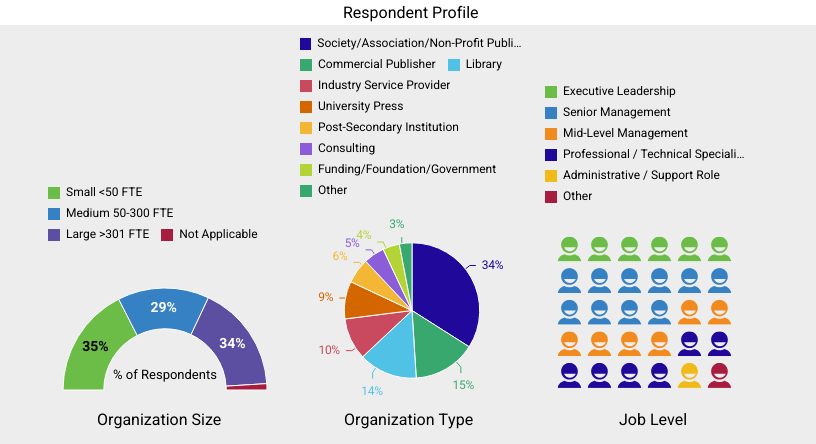
This post provides the high-level aggregate results. The full report, available at no cost on SSP’s website (log-in or account creation required), provides additional detail and the ability to filter the data by organization size, type, and job level of respondents.
Key Findings
- Economic sentiment is cautious and slightly negative, with concern about resilience in 2026 narrowly outweighing confidence and most organizations expecting flat or modest financial performance rather than growth.
- Institutional budget constraints and research funding volatility are the dominant economic pressures, reinforcing that financial sustainability challenges are structural and closely tied to public and institutional funding environments.
- Research integrity, public trust, and protection against predatory and fraudulent practices are viewed as existential priorities, consistently ranking as the most critical near-term challenges to long-term economic viability.
- AI is seen more as a governance and risk-management issue than a pure efficiency opportunity, with strong concern around intellectual property, ethical use, and disintermediation alongside continued investment in automation and infrastructure.
- Organizations are prioritizing defensive strategies such as cost containment and operational efficiency, while selectively investing in core publishing and technology, signaling a focus on durability and stability over expansion in a politically and economically volatile environment.
Economic Resilience for 2026
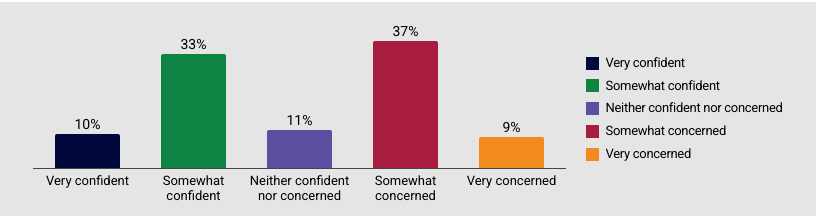
Confidence in the scholarly communications industry’s economic resilience for 2026 is notably mixed, with a slight tilt toward concern. Approximately 43% of respondents report being confident (10% very confident; 33% somewhat confident), while 46% express concern (37% somewhat concerned; 9% very concerned). About 11% feel neither confident nor concerned. The largest single segment is “somewhat concerned,” suggesting measured unease rather than acute alarm. Overall, the data reflect an industry navigating uncertainty.
Year/Year Change in Financial Position
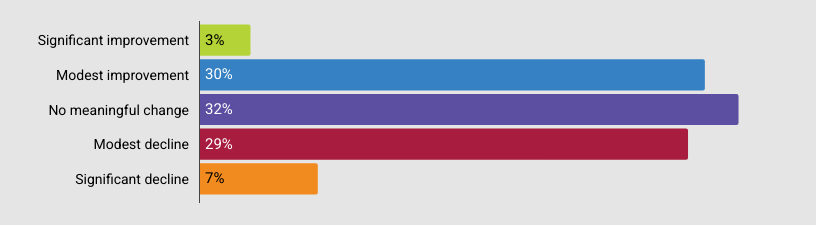
Expectations for 2026 are cautiously steady, with most respondents anticipating stability rather than growth or decline. A slight majority (32%) expect their organization’s financial position to remain about the same in 2025. The number of respondents who anticipate modest improvement is nearly equal to those who expect conditions to worsen modestly. Relatively few project a significant improvement or a significant decline. Organizations appear to be planning conservatively, signaling limited growth expectations amid persistent cost pressures, flat or uncertain revenues, and continued macroeconomic unpredictability.
Key Influencing Factors
Respondents were asked to provide additional details about the key factors influencing their expectations. Across the scholarly communications ecosystem, organizations are broadly navigating a landscape defined by fiscal constraint, structural uncertainty, and uneven adaptation to technological and policy shifts. Commercial publishers and service providers are grappling with AI-driven disruptions to traditional revenue streams — including traffic declines, margin pressures from research integrity screening, and shifting submission patterns — while simultaneously exploring AI-enabled tools and workflow services as potential growth levers. Libraries and institutions face the most acute austerity conditions, driven by federal and state funding cuts, grant instability, and rising journal and open access costs that outpace flat or declining budgets. Society and nonprofit publishers and university presses similarly contend with subscription erosion, softer ancillary revenues, and institutional funding reductions, with many turning to restructuring, cost controls, and strategic partnerships to stabilize their positions.
General growth opportunities reported include geographic expansion, AI commercialization, consortial efficiencies, and new product development. Organizations across the board appear to be in a holding pattern, managing risk conservatively while waiting for greater clarity on the political, technological, and economic forces reshaping the sector.
Leading Economic Impact Factors
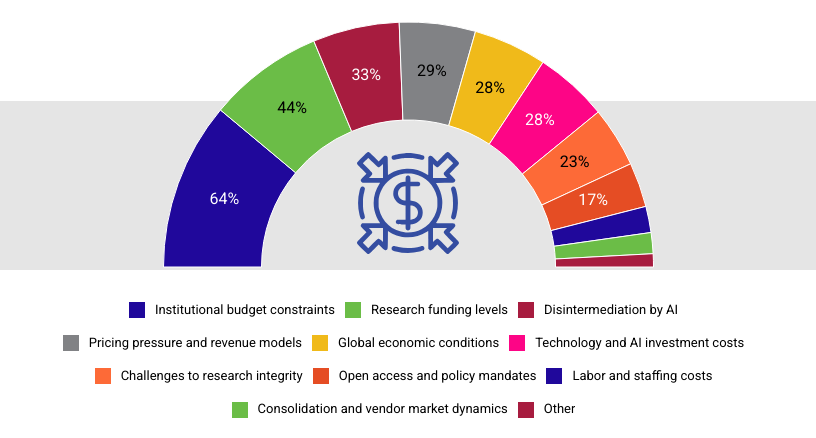
Institutional budget constraints emerge as the dominant factor expected to have the greatest impact on the economy of scholarly communications in 2026, cited by nearly two-thirds of respondents (64%), underscoring the central role of university and organizational spending pressures in shaping the industry’s outlook. Research funding levels follow at 44%, reinforcing the industry’s dependence on public and grant-based investment. Technology-related disruption is also prominent: 33% identify disintermediation by AI, while 28% cite AI investment costs, signaling both competitive and operational impacts. Pricing pressure and revenue models (29%) and global economic conditions (28%) reflect broader structural strain. Fewer respondents prioritize open access mandates (17%), labor costs (10%), or consolidation (8%), suggesting that immediate financial pressures outweigh longer-term structural shifts.
Investment Prioritization
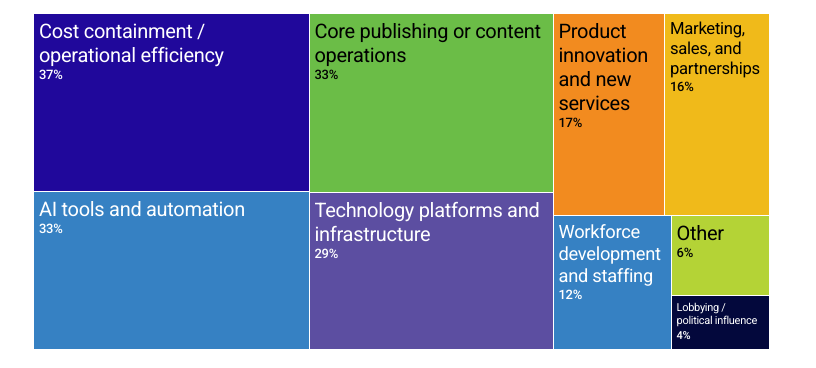
Spending priorities for 2026 reflect a defensive yet strategically targeted posture. The top selection, cost containment and operational efficiency (37%), signals a strong emphasis on managing margins and improving workflows amid fiscal pressure. At the same time, organizations are not retreating from mission-critical functions: core publishing/content operations (33%) and AI tools and automation (33%) rank equally high, followed by technology platforms and infrastructure (29%). These results suggest a dual strategy—tightening operations while investing in automation and digital capacity. Far fewer respondents prioritize growth-oriented areas such as product innovation (17%), marketing (16%), or workforce expansion (12%), indicating caution over an aggressive growth mindset.
Critical Challenges
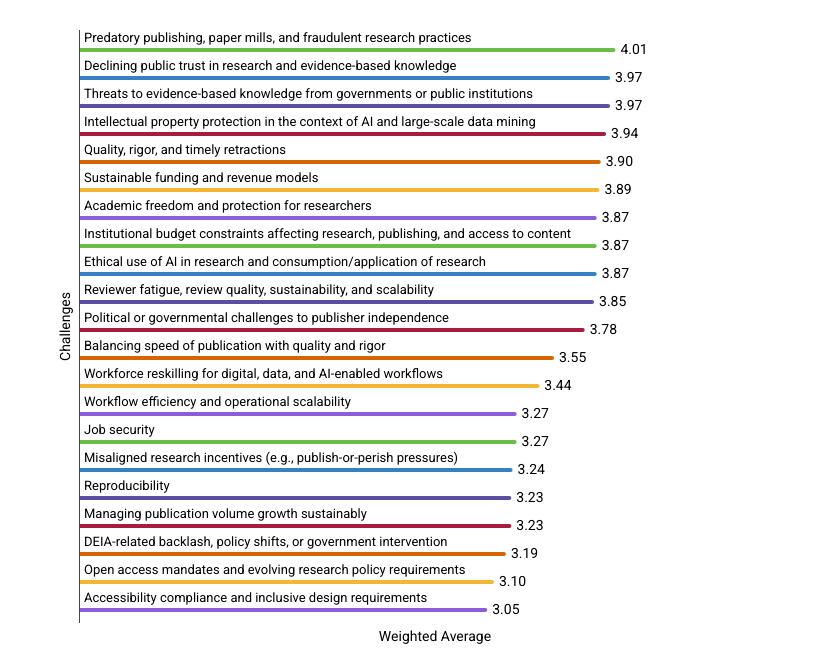
Respondents signal strong urgency across nearly all challenges presented, with most weighted averages clustering between 3.5 and 4.0 on a five-point scale. The highest-rated concerns center on research integrity and trust: predatory publishing and paper mills (4.01), declining public trust (3.97), threats to evidence-based knowledge (3.97), intellectual property protection in the AI era (3.94), and quality and rigor (3.90). Sustainable funding and revenue models (3.89), institutional budget constraints (3.87), academic freedom (3.87), and ethical AI use (3.87) also rank as very critical. Across these issues, a majority of respondents select “very” or “extremely critical,” underscoring systemic risk.
“Trust is now a financial metric. Research integrity is no longer just an editorial concern; it is viewed as a threat to economic viability.”
Conclusion
The data paints a picture of an industry in defensive mode — cautious, structurally stressed, but not in freefall. Scholarly communications faces a genuinely difficult 2026, driven less by any single shock than by the compounding of structural funding dependence, political volatility, AI-driven uncertainty, and integrity threats, all arriving simultaneously. Success in 2026 may depend on an organization’s ability to prove its value in an era of shrinking institutional budgets and rising digital fraud.
Anxious but not panicked. The 46% concerned vs. 43% confident split tells us the industry is navigating genuine uncertainty rather than crisis. The dominant response category being “somewhat concerned” is telling—this is measured unease, not alarm.
Funding challenges are the core structural concern. Institutional budget pressures (64%) and research funding levels (44%) dwarf everything else as economic impact factors. The industry’s dependence on university budgets and public grant funding makes it structurally vulnerable to government policy decisions that are largely outside its control.
AI is complicated. The sector isn’t thoughtlessly embracing AI as an efficiency windfall. The data show it’s being treated primarily as a governance and risk problem — intellectual property protection, ethical use, and disintermediation concerns all rank higher in collective anxiety than do productivity gains. Investment in AI tools is happening alongside real worry about what AI means for research integrity, traffic, and disintermediation.
Credibility is the foundation of everything. Predatory publishing, paper mills, and declining public trust top the criticality rankings — above even budget constraints or mandates. The poll reflects that if trust erodes, the entire value proposition of scholarly publishing collapses. The political climate around evidence-based knowledge likely amplifies this anxiety.
Survival over growth. Cost containment leads investment priorities, with marketing and workforce expansion near the bottom, confirming that most organizations are hunkering down. The dual emphasis on efficiency and core operations suggests a desire to protect what matters most while cutting what doesn’t — a rational response to an environment where revenues are flat or uncertain but costs keep rising.
The full report, available at no cost on SSP’s website (log-in or account creation required), provides additional detail and the ability to filter the data by organization size, type, and job level of respondents. If you have a suggestion for future Pulse Check Polls, send your ideas to info@sspnet.org.
Author’s note: Data was collected February 1–15, 2026. AI applications were used to assist in the analysis and summarization of the data in this report.

Discussion
1 Thought on "Economic Outlook for Scholarly Communications in 2026 — SSP Pulse Check Report"

Why would AI be an efficiency opportunity? Unless your business is publishing error-filled slop, in which case it would certainly help you do that more efficiently.