By now, you’re probably horribly familiar with the many ways that the Trump administration is attacking research, often in the form of direct or indirect censorship. Hundreds of billions of dollars of research funding have been cut or frozen. Tens of thousands of grants have been canceled. Hundreds of databases have been deleted or altered. Hundreds of words and phrases have been banned. And, and, and…
There are many more examples, and they’re all powerful illustrations of the damage being done to US research. However, it’s all too easy to write them off as a series of individual incidents rather than an intentional pattern. So – just in time for the US midterm elections – I’m delighted to say that the #DefendResearch team (of which I’m a member) has partnered with Research Consulting to develop what we believe is the first rigorous, clear, and citable baseline study of the aggregated impact of US government censorship, From Anecdote to Evidence: Mapping the Impact of US Government Action on Public Health Research.

We’ve focused first on censorship of public health and epidemiology because these are areas which have arguably borne the brunt of the administration’s attacks. And of course, nowhere are the costs clearer or more immediate – decisions made one day impact care and treatment the next, resulting in direct harm in the future. However, this piece of research has been designed to be reproducible and extendable to any domain, and the methodology and datasets used are, like the report itself, openly available from the link above.
There are numerous individual examples of how censorship in public health is playing out. For example, new analysis from the Association of American Medical Colleges found that the NIH has awarded 12% fewer grants in fiscal year 2026, despite the fact that Congress rejected the administration’s request to cut funding by 41% and instead approved its full budget. A recent NPR report found that the NIH is awarding and renewing grants more slowly than in previous years. And Trump is continuing to try and put political appointees in charge of federal health research grants – even though Congress has (temporarily) blocked this from happening. Each of these stories individually represents a major threat to public health research, but taken in aggregate the picture is even grimmer.
From Anecdote to Evidence is based on more than 4,200 extracts from over 240 sources, a mix of scholarly and news sources published between January 2025 and June 2026, and analyzed using AI with human review, including two rounds of expert peer review. It seeks to demonstrate what happens when the scientific process is politicized rather than being funded as a public good – as has been the case here in the US since the start of the second Trump presidency. Some of the impacts are measurable, such as terminated grants or censored websites. But many others are not, with anticipatory self-censorship – at both the individual and organizational levels – especially hard to track and especially insidious in terms of its short- and long-term effects.
The report examines US government censorship from three angles: constraining, defending, and protecting research; and at three levels: macro (systemic), meso (institutional), and micro (individual). The patterns it unearths are disturbing, to say the least.
At the macro level, the report finds a clear effort to dismantle the whole research system, through a mix of tampering with the record (173 quotes/pieces of evidence), ending observation (71 quotes), and eliminating the machinery (163 quotes). Did you know, for example, that in the year following Trump’s inauguration, the administration discontinued 562 federal information collection efforts? Or that in just the first two months, researchers found that potentially substantive textual changes had been made to nearly half of the 232 HHS, CDC, and VA datasets they reviewed? Just 15 (13%) of those changes were recorded in the datasets’ public change logs or otherwise publicly indicated.
The report also found over 300 quotes relating to the ways that authority in research institutions – the meso level – is shifting from scientific experts to political appointees, by over-riding those experts (37 quotes) and through terminating, freezing and conditioning funding (253 quotes), as well as by pressurizing publishers (11 quotes). Attacks on diversity, equity, and inclusion by the government are not new, but the scale is less well known. In fact, in the first four months of this presidency alone, most of the 2,000+ terminated grants were focused on health equity, particularly for Black, Indigenous and other people of color, and/or sexual and gender minority communities. In addition, researchers from those communities were nearly three times more likely to see their grant terminated than their White cisgender male colleagues.
And then there is the censorship of individuals – policing what researchers can say, chilling the discourse, and removing the dissenters. Of these, chilling the discourse, aka self-censorship, is for me, as mentioned above, perhaps the most worrying. For example, STAT reported that the National Academies of Science, Engineering, and Medicine was quietly removing words such as “health equity,” “marginalized populations,” and “restorative justice” from pending reports, and replacing them with terms deemed less “woke” in an effort to appease the Trump administration. And in their thesis, From the Legislature to the Laboratory: How Federal Funding Shapes U.S. Public Health Research, Ainsley Plesko reported that scientists were “removing key words from grant proposals, reframing research questions or avoiding topics perceived as politically sensitive”, and some worried that even describing unequal health outcomes could be interpreted as engaging in ideological or “woke” scholarship.
In case you’re wondering what this means in real terms, the report includes a handy table setting out the disruption observed or measured, the capacity lost, and outcomes modeled. As just one example, an article in The Lancet forecast that the cuts could result in a staggering 14 million additional deaths by 2030.
However, as the report notes: “The interventions described in Part I did not go unchallenged… Courts ordered about 100 HHS datasets restored and blocked a 15% cap on NIH indirect costs. A coalition of health and science funders, including most of the major US philanthropies, was reported to expect to spend close to $1 billion in 2025 to fund “archiving of data, develop alternative and fact based data systems at the state and regional level to support advocacy and governmental accountability, and fund antiracist and community connected research.” Journals and professional bodies committed not to retract articles on political requests.
The strategies used to defend research have been divided into three categories: reversal (undoing a specific action); replacement (building alternative capacity); and refusal (declining to alter, withdraw, or suppress research).
Of these, reversals are the easiest to quantify (with 86 quotes), as they typically leave a clear trail of evidence, often through court rulings. A good example is the temporary injunction won by 23 Democratic-led states and DC, restoring most of their CDC funding; Republican-led states that did not sue did not benefit from this ruling. Some reversals occurred without legal action. For example, following an announcement that funding for the Women’s Health Initiative would be terminated, public outcry led to its reinstatement a day later.
Replacement, for example of funding, databases, etc is also well-evidenced (76 quotes). Per the report, examples include “a near-$1 billion philanthropic pledge, civil-society archiving at scale, university bridge funding, states issuing their own vaccine guidance, and other countries and donors stepping in for US global health funding.” The report also notes that replacement carries its own risks, such as involvement by foreign actors whose priorities may differ; they may replace the money lost, but not the function. However, there have also been numerous efforts to replace information lost at all levels of the community, from grassroots archiving organizations mobilizing to preserve hundreds of thousands of government datasets to states issuing their own vaccine guidance, following the advice of experts rather than the government.
Much less evidence is available for refusal (just 18 quotes), but the examples are inspiring: resistance from journal editors (e.g., committing not to retract articles under political pressure); from professional bodies; from government officials; and from universities, most notably Harvard, whose legal fees as a result of their continued pushback against the administration led to an increase in their legal fees from $80 million in 2024 to $127 million in 2025. However, as the report notes: “What the evidence lacks is a test: we cannot say which commitments held, especially as a pledge binds only the individual or organization that makes it.”
The last section of the report focuses on protecting research, something that, as the authors point out, none of the defensive actions can do on their own. They’re not designed to change the underlying concentration of executive control over federal data, grants and agencies, and they haven’t done so: “Reversal restores assets but not control. Replacement preserves part of a function but not its scale or durability. Refusal is documented mainly as commitments, with few tested outcomes.”
The answer, suggest the authors, lies in a mix of actions:
- Legislate, don’t just litigate – make access to public health data a statutory duty
- Respond before the harm sets in – have lawyers and messaging ready in advance
- Treat alternatives as insurance, not the solution
- Protect the capacity to detect harm through independent auditing and monitoring of federal data
- Create support mechanisms to refuse improper interference, such as shared legal and financial backing for institutions
- Measure what is hard to see, in particular, self-censorship
- Preserve the records through persistent identifiers and long-term hosting plans (including outside the US)
- Set journal policies on government requests so that these can be dealt with consistently
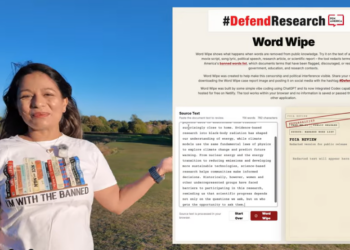
Censorship isn’t going away any time soon so, if it’s something you care about as deeply as I do, I hope you’ll take the time to read the full report and share it in your communities. The #DefendResearch team is putting together some toolkits you can use to help spread the word (available soon on our website). And if you’re looking for a fun way to introduce people to the dangers – and downright stupidity – of research censorship, please try out Word Wipe, which my #DefendResearch colleague Suze Kundu developed. It’s based on PEN America’s list of banned words and phrases (another great resource) and enables you to see which of those words get wiped from any piece of text of your choosing – from a poem to a research article.
Many thanks to Rob Johnson, Lisa Schiff, and Peter Suber for reviewing this post

Discussion
2 Thoughts on "From Anecdote to Evidence: How US Government Censorship is Impacting Public Health"

Hi Alice–Great work and thanks. FYI, I’ve been a fan of https://theimpactproject.org/ since it started right after the election. It has an actual map, linked to stories, showing the impacts across sectors (including health but others) and across the US and worldwide including in every district. It would be awesome if there were some even better coordination of efforts, too especially including societies that are, or at least were, also collecting stories from their members–have not seen many public sharing of those so making sure they are part of these larger efforts would be great. We’ve been trying to tell the story of the total ROI of science for decades, and here’s an opportunity to not let a crisis (it is) go to waste.

Thanks Brooks! The Impact Project is a great initiative — the map is included in the #DefendResearch list of tracking projects that are monitoring Trump administration actions that threaten research and higher education (https://theimpactproject.org/the-impact-map/). I agree that more coordination is needed and hopefully SSP’s new Advocacy Committee will be of some help there.