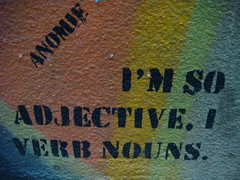
- Image by louisa_catlover via Flickr
I’ve felt this building up for months now. At first it seemed comical, but after seeing it a few too many times, I’m going to cut loose.
What’s up with editors dropping the “-al” endings off of words these days?
Now, I know when it counts. I know that “historic” is different from “historical” and “classic” is different from “classical.” I get that. But I recently saw a children’s book on a store shelf that promised a gallery of “mythologic creatures.” Oddly, it hurt my ears even to read it silently to myself in the bookstore because “mythologic” is so jarringly, teeth-grindingly inelegant. It should be “mythological.” The human mouth prefers to end words in neutral positions. It’s just a physiological reality. Speaking of that — hey, you medical editors, why is it suddenly “physiologic” instead of “physiological”? Since when is it “pharmacologic” instead of “pharmacological”?
Judging from some searches, it looks like a late-1990s change. I smell the vapors of something trendy. Ick.
Certainly, some -al endings naturally fall by the wayside. Who needs “academical”? Who needs “poetical”? But these should die natural deaths, not be picked off by editorial snipers in a purge fueled by some junta with no sense of language, rhythm, and poetry. The flow of language suffers when natural bridging sounds and rests are disrupted.
These two innocent letters are only trying to help us!
It certainly doesn’t make sense in economic terms. If you want to get rid of useless letters, try relaxing the “data are” rule so that you can reduce the seven letters to six by realizing we’ve moved to the “data is” era. Unless your agenda are about purity of Latin plurals. I can’t help you then.
According to the dictionary, the -al suffix means “of, relating to, characterized by.” So, historical relates to history, just as physiological relates to physiology. That said, I still don’t get why we’re dropping the -al suffixes when usage dictates they still thrive in key places, my editorial friends! Mythological relates to mythology, just as grammatical relates to grammar.
Adjective: grammatic
Of or pertaining to grammar
“the grammatic structure of a sentence“
There are actually people claiming we could be using the word “grammatic” out there? Give me a break! That’s almost illiterate (which may be entirely appropriate for grammatic sticklers). Luckily, Merriam-Webster has not lost their marbles:
The word you’ve entered isn’t in the dictionary. Click on a spelling suggestion below or try again using the search bar above.
My advice? Restore elegance and reason to scientific editing by restoring the -al to its proper place. If it truly dies in normal parlance, let it die, but don’t take it down to the river in a bag just because it annoys you or because someone popped you in the head with a crazy editing theory.
Your readers are wondering what kind of pathologic and nonsensic game you’re playing.
![Reblog this post [with Zemanta]](http://img.zemanta.com/reblog_e.png?x-id=cf1c2f2c-d98a-47d8-8df9-206cce1d4b0d)

Discussion
7 Thoughts on "I’m a Friend of “al” — A Rant"

Hello Kent,
This is my first time commenting, but I’ve been a reader for awhile.
It is refreshing to read that someone else considers the aesthetic value of words when writing. Abbreviation is a huge trend and, although I am guilty of it, it casts modern language as either too functionally driven or simply lazily formed. I am all for finding the most practical form of communication, but not at the loss of sufficient sophistication and flow. Your comment, “The human mouth prefers to end words in neutral positions,” is absolutely true and is one of the facts that so few people account for when writing.
However, the frustrating part of criticizing others’ writing is that they’ll be quick to hold a microscope to yours. I don’t think you meant to say: “I should be ‘mythological,’” since you’re surely not a unicorn. Further, your use of agenda: “Unless your agenda are about purity of Latin plurals” represents the older understanding of agenda as a plural. As dictionary.com clarifies: “Agenda, ‘things to be done,’ is the plural of the Latin gerund agendum and is used today in the sense ‘a plan or list of matters to be acted upon.’ In that sense it is treated as a singular noun; its plural is usually agendas: The agenda is ready for distribution. The agendas of last year’s meetings are printed in the official minutes. The singular agendum, meaning ‘an item on an agenda,’ is rare.”
From one grammar hound to another, maybe we should just let it go.

Thanks, Megan. Thanks for spotting the typo. In any rant, there’s bound to be one. I’ve fixed it now. And I’m sure you caught that my use of “agenda are” was tongue-in-cheek, a way of pointing out that “data are” is probably also similarly anachronistic. In any event, glad you enjoy reading, and a great first comment! Hope there are more in the future from you!

Anyone who has spent much time at University of Virginia will know that “academical” (as in Jefferson’s ‘academical village’) is alive and well:
http://www.virginia.edu/academicalvillage/
(A Google search will also turn up the Academical Village People…)
I haven’t been to UVa for years, and I wonder if there are debates about ‘academic’ vs. ‘academical’.

Hi John,
As an ex Wahoo, I can tell you that I was as charmed by the use of the word “academical” as I was by Jefferson’s serpentine brick walls and the honor code.
It is ironic then that I would one day end up working for a journal that lops off –al
with the enthusiasm of a 1920s G-Man…
Really enjoy the site– thanks to all who contribute!

does the demise of ‘academical’, render it possible that the noun-preceding adjective could then become ‘academicly’?
it’d take awhile, because english orthography’s pretty conservative, but still. geez. just thinking about it makes my teeth hurt.

Ah Kent – you heretical you!

Great post Kent – I was just starting to notice this trend this past week :S It’s good to hear that I’m not alone in thinking that it is awkward and unnecessary.
Alas, as with much else in life, ridiculous trends gain more traction than deserved. I for one will respond by ignoring this trend and retaining my “-al” unless forced to drop it for a good reason.
Pat