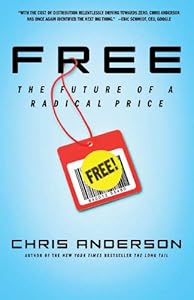
- Cover of Free: The Future of a Radical Price
A common bit of speculation, bolstered by Chris Anderson’s book, “Free: The Future of a Radical Price,” is that providing free copies of books drives awareness and redounds in a commercially beneficial way (Anderson didn’t pursue this approach himself, it’s worth noting). (Update: I was wrong. He did offer it for free. I just didn’t hear about it.)
Various publishers, some in the scholarly space, have had success with this approach — but arguably always as part of a carefully constructed business model in which “free” has a clear purpose. Even open access can be characterized as free output to spur paid input.
Aside from Anderson, one of the biggest mainstream proponents of “free” as a marketing tool is Cory Doctorow. He shamelessly recommends “free” as an unqualified benefit to authors, and feels he has benefited for years from the approach of giving away electronic copies of his science fiction books under a Creative Commons license. Doctorow is that rare author who has created for himself the vaunted “platform” currently in vogue in trade publishing circles — a personality, speaking engagements, writing in big venues (Boing Boing), and publishing books. Some revenue comes from each aspect, and the four aspects drive each other in a virtuous cycle.
(Doctorow should also consider that maybe his success is based on his skill as a writer. Surrendering success to a “free” strategy negates the role of skill as a writer, after all.)
Given this potential “fundamental error of attribution,” I wasn’t surprised to see Doctorow cheerleading a recent study about the effects the free e-books have on print sales:
A new study from two academics at BYU tracking the sales of printed books following free ebook releases found that generally, a free ebook release is correlated with increased sales. Interestingly, the exception is for a group of ebooks that were released for a week and then withdrawn — part of Tor.com’s launch strategy, and a success in getting large number of people signed up to the site. Very nice to see some crunchy data in the mix.
It would be nice to see some “crunchy data” in the mix, but the data in this study were largely uncrunched. In fact, they were just raw tables, barely masticated by the two Brigham Young University researchers.
There are many problems with the study published in the Journal of Electronic Publishing:
- Sales for only 70% of retail outlets were used as a basis of evaluating increased print sales, and these probably don’t even account for a majority of sales (Wal-Mart was left out, for instance).
- No data about e-book downloads were included to compare with print sales.
- “Correlation” is claimed, but there are no statistical tests of correlation in the study.
- No other factors are adjusted out — e.g., increased marketing, author name recognition, awards, etc.
- Only science fiction, tech non-fiction, and fantasy genres were included in the study.
- There isn’t a meaningful $ to be found in the study. Sales figures are provided, but the researchers didn’t push to find out if pricing changed on the print versions during the “free e-book” weeks studied, or if Tor in particular generated more revenues indirectly by creating leads using free content.
Why should the financial aspect been analyzed? One of the publishers covered by the study, Tor Books, took a risk making its e-books free, even for a week at a time. Doctorow and the authors of the JEP paper both speculate that Tor’s practice of only release e-books free for a week is what limited their upside of the “free” approach. But with only a week of free availability rolling through the 41 titles studied, Tor’s sales declined by 5,268 units. That’s $42,091 in lost gross revenues basing it on an average sales price of $7.99 per title (which seems to be Tor’s average paperback price — the actual revenue loss is probably greater). So, in the eight weeks studied, Tor potentially gave up more than $40,000 of revenues to offer e-books for free. Users had to register to get the free e-books, so Tor increased its email list. But at a cost of $40,000+, that had better be one well-monetized email list.
Had the authors thought this through even as superficially as I just did, they would have seen the size of the hill “free” can create for a publisher to surmount, and could have speculated on the likelihood of Tor’s email strategy overcoming that challenge.
One interesting element of the raw data counts presented by the researchers is that Random House and Tor titles sold much better overall than the other books. Is this because their marketing arms are that much better? Is it because the authors are more popular in general? Do these publishers just have better lists? Are the books generally more current or newer? (Many of the tech titles were older titles.) Again, the researchers didn’t measure these factors or adjust for them.
One author of Tor titles notes his own increased sales during the free e-book period, commenting on a confounding variable:
Were there other factors possibly relating to that increase? Sure; for example, in March of 2008 I was nominated for two Hugos, including Best Novel for The Last Colony. That might have had some influence, but I suspect if so it was tangential, since it wasn’t Old Man’s War up for the award.
While he may think the effect of being nominated for two Hugos is “tangential,” that’s a pretty powerful shot in the arm — to have two nominations for a genre’s crowning prize. Yes, I think that would drive strong sales across an author’s catalog.
Some books had significant sales declines with the offer of free e-books, if you accept e-book availability as the only driver. As an author or a book marketer, there is risk to be found in this study, and that’s enough to give one pause.
But, of course, one author of the study published in JEP gives himself away as a shameless advocate of free content:
I think there’s a huge benefit to society by making something available for free. Recently I’ve been involved with another study with my dissertation, and this studied just eight books, and over a few week time these books were downloaded over 100,000 times, and sales increased moderately. But the point wasn’t whether sales increased or decreased; here are 100,000 people who accessed works who otherwise wouldn’t have. So my hope would be that this study would relieve people’s fears that if they put books online for free their sales would tank, and they’d say, ‘let’s think about a more global benefit to having your works online for free.’
It’s nice to have this intellectual bias revealed in an interview after the study was published. It might have been better if he had stated in the paper itself his hope about which direction the results would point. Not that he didn’t leave intellectual clues aplenty — you can feel the authors working throughout the paper to make the “free content” argument appealing. This clear bias in their writing is what sent me to look for evidence that they held an intellectual bias.
Free access to content makes sense in some cases. But, it seems to make the most sense in the context of a business model that can make it work. Publishing studies like this — complete with lightweight data, flimsy analysis, and intellectual bias — doesn’t help.
![Reblog this post [with Zemanta]](http://img.zemanta.com/reblog_e.png?x-id=e9b8203c-3751-4388-8493-7b4615c251f2)

Discussion
15 Thoughts on "Do Free E-Books Drive Print Sales? Other Forces Seem More Powerful Than “Free”"

First, a correction–Anderson did indeed put his money where his mouth was, and offer his book for free through in a variety of forms.
Second, it looks like we’ve got a theme going this week, poorly conceived studies that are backed by a not-so-secret agenda.
You link to John Scalzi’s analysis of the study, and it should also be noted that he points out that the study included periods during December, the holiday sales season, which may have had some influence on the numbers. Sales generally go up around this time, so a better study would have looked to avoid seasonal sales influence.
Doctorow may also be a singular case. He’s gotten an inordinate amount of publicity for giving his books away for free. As a pioneer of this strategy, there’s a novelty factor, and that gives the press a hook to write about. The second author who does the same thing loses that novelty, and the 100th has no hope of standing out. Doctorow also benefited from the relative scarcity of author-sponsored free downloads when he launched his career. Now a new author is likely to be buried in the vast number of similar offerings.
Also, as a counterpoint, see the results this author reports. He went with the free-download-pay-what-you-want strategy made famous by the likes of Radiohead. The results were over 130,000 books downloaded, and a total revenue stream of around 500 pounds (UK). That works out to him earning less than 1/5 of a pence per book.

I take all of your points about Hilton’s work. There’s an elephant in the room, though: why aren’t publishers joining (and funding) studies like Hilton’s (or work that I am doing on the impact of piracy on paid content sales)?
To my eye, the story is less that Hilton or Doctorow have biases (they do; so do I). The story is that the book publishing business appears to actively avoid supporting or joining data-driven research efforts. I know that’s not your stance, but tackling Hilton this hard raises the broader point for me.

Publishers are conducting “studies” all the time around these questions — it’s called “running a business.” But companies aren’t academics, so they don’t have publish/perish pressures. But they do share them. The PSP session this year on the value of free was a striking example of how “free” integrates into business models. National Academies Press has shared their results in plenty of venues, as well. But because it’s unlikely there’s a general answer, publishers are probably wise to experiment with their own lists and practices, learn from those, and share with caveats and qualifiers. Even Hilton’s study quickly ran into a myriad of qualifiers he failed to deal with. There may be no general approach, which might be the real elephant in the room.
What makes you think that publishers aren’t deeply engaged in studying the effects of different types of marketing schemes for booksales? They may not release those results publicly, as they are likely seen as giving a publisher a competitive advantage over another publisher who lacks that same knowledge.
One group that studies these things in detail and is fairly open about their results is O’Reilly Media, who have proven to be a market leader in incorporating and understanding new technologies and marketing methods.
Here’s another vague and non-scientific case study on giving away a product for free, an interesting read if not terribly conclusive.
Kent, thanks for the links to PSP examples. In my post, I didn’t make it clear that I was talking about trade publishers, the segment that Hilton used for his research.
In that regard, I do think trade publishers have done little to support or join data-driven research efforts. That’s one of the reasons that Hilton’s data is general: he can’t get the specific feeds without publisher’s permission.
My sense is that you rightly see a number of holes in Hilton’s methodology. Given those holes, until we collate and evaluate a critical mass of experiments with free, we really can’t know if there is or is not a general approach (or even what approaches work).
I’ve proposed a segmented research approach to a range of trade publishers, offering shared results in exchange for data that would be disclosed only to the extent that the participating publisher approved. To date, one publisher contributed experiments with “free”, and two are participating in an effecort to establish the impact of piracy on paid content sales.
David, I agree with you about O’Reilly; they are one of the two participating publishers on the piracy study. They also are the publisher for the 2009 paper I wrote on the impact of free and pirated content on paid sales. I think you’d find O’Reilly both surprised and perhaps as frustrated as I am that other trade publishers are willing to spend tens of thousands of dollars annually on enforcement options like Attributor without doing work to establish the impact of piracy.
I agree with both of you that we could use better and more scientific research in this area. In my experience, small data sets limited to imprints and even larger publishers are not adequate to get those results. Well-planned, financed industry surveys would be a benefit.

The article by John Hilton and David Wiley is indeed very weak, which may explain why it was accepted and published in JEP in spite of being peer reviewed.
Little can be (or should be) concluded from their elementary analysis except as an example of how one ought to be more cautious with data. The fact that the authors are a professor and PhD student is inexcusable.

I’m the first to admit that this study is not perfect. Using historical data, comparison books, and also having stats on the number of downloads would have strengthened the study. I am remedying those design flaws in a current study.
The study cited in this post was an attempt to generate some “crunchy data” where we could look at actual sales figures for multiple books as opposed to just anecdotal stories. I hope that many other publishers and researchers will do more studies in this area.
As we stated in the article, “The results of the present study must be viewed with caution. Although the authors believe that free digital book distribution tends to increase print sales, this is not a universal law. The results we found cannot necessarily be generalized to other books, nor be construed to suggest causation. The timing of a free e-book’s release, the promotion it received and other factors cannot be fully accounted for.”
To the extent that this article stimulates discussion and action regarding the need for more and better research in this area, I am happy.
Of course all of this is subject to change if people’s reading habits shift to reading electronically, thus providing more reasons for future research.

who has studied the purchasing behavior of readers/book people? publishers, until recently, thought booksellers were their customers, so they weren’t that interested. have booksellers or associations of booksellers done surveys? librarians survey people all the time, but are less interested in purchasing behavior than in reading behavior, which is a different thing. nicholas basbanes has written several books about book people which are interesting, if somewhat extreme, anecdotal accounts. but it would be interesting to know ‘what people purchase’ vs. ‘what they actually read’ (book people buy more books than they can read in a lifetime, and still burn out their library cards); what motivates them to spend the money, and where the crossover may lie.
it seems to have been demonstrated in some measure that offering v. 1 of a series helps to draw new readers to v’s 2+. can offering 1 title free help non-series multiple-book authors? how about new authors offering their book for free in e-format for a few weeks, to get people to read and review it? or do certain special people have to read and review (e.g. nancy pearl). and: do we have a real idea of the effect of word-of-mouth? there are many possible models. doctorow’s model is unique, and perhaps not broadly applicable. taking myself as an example: i’ve downloaded most of his books for free, not yet read any, given a print copy of one to a relative, and then been commanded by a colleague to read that precise title. that colleague did not know that i had downloaded it for free, or that i had gifted it in print.
I responded to some of the criticisms raised in this post at:

This was a good read.
From my perspective (self publishing in PC maintenance and SEO), offering premium content for free made great sense with my first repair manual.
Back in 2008, at the very start of my publishing, I placed the entire material freely available on my blog, and it was free for months (mostly because I had no idea of ecommerce). But this ignorance on my part helped the page to rank very high for the title. Actually, it’s still among the top 3 ranks on searches. Now that I have an ecommerce site, this same material that was readily available on my blog is now selling for 18 months, and generates a good sum of money.
So, offering free content may be like a promotion, brand-building and so on.
Offering the entire book for free seems a shot in the foot. Having the content for a limited time (say a month or alike) for SEO reasons and for cranking the email list is a very good strategy, because later on you (I) should make a good use of the brand-awareness on the net, and all those email signups are potential customers.