Editor’s Note: Today’s post is by Martina Sollai and Eleonora Colangelo. Martina is an Institutional Partnerships Key Account Manager at Frontiers, working in the EMEA region. She engages and collaborates with academic libraries, consortia, and research funders who wish to support their researchers’ choice to publish open access by partnering with Frontiers. Eleonora is a Public Affairs Officer at Frontiers, where she provides strategic guidance on science, technology, and innovation (STI) policies, supporting the alignment of publishing operations with international regulatory frameworks.
Long before the digital age — before metadata, machine learning, and open access (OA) mandates — there was Alexandria. The ancient library, often mythologized as the cradle of human knowledge, was far more than a mere repository of scrolls. It functioned as the crucible of discourse, diplomacy, and public reasoning. Enabler of the Hellenistic ideal of universal learning (enkuklios paideia — literally, a “well-rounded education”), the library shaped not only the knowledge but also the political architecture of its time, to collect and connect: ideas, people, and power, beyond the materiality of papyri and pergamena.
Fast forward to 2025, and that foundational spirit is not only intact; it’s evolving with urgency.
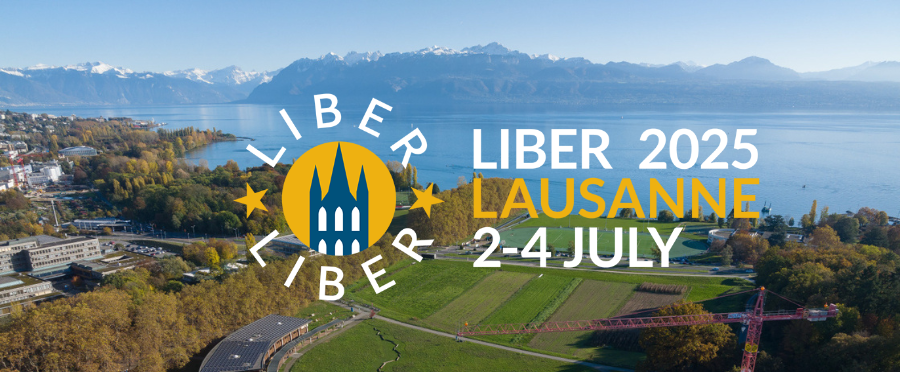
At the LIBER Annual Conference in Lausanne (July 2-4), this ancient legacy was reinterpreted through the lens of today’s research infrastructure, open science (OS) policy, and institutional strategy, in reflection of LIBER 2023-2027 Strategy on Copyright Reform, Digital Humanities, OA, and Research Data Management.
For those of us working at the intersection of publishing, partnerships, and policy, LIBER reaffirmed its position as a strategic nexus — a space where libraries are no longer merely curators of content, but active builders of infrastructure, architects of equitable access, and co-creators of knowledge governance frameworks. Inclusion beyond Europe appears to be the next frontier for the Association, as the upcoming 2026 presidency of Giannis Tsakonas (Director of Library & Information Center, University of Patras) predicts.
A post-conference reflection quickly leads back to five thematic pillars, the structural spine of this year’s LIBER agenda. The Libraries and open knowledge track reframed libraries not as passive policy implementers, but as active architects of OS, engaging in dynamic conversations about FAIR data, rights retention, and the collaborative infrastructures that sustain them. Digital transformation captured both the excitement and anxiety sparked by accelerating AI and automation, highlighting the urgent need to upskill professionals while grappling with perennial challenges like digital preservation.
The Research infrastructure and innovation stream shone a spotlight on metadata, CRIS systems, and repositories — no longer mere back-end tools but powerful engines shaping policy, grant reporting, and institutional strategy. Stakeholder engagement explored libraries’ evolving identity as brokers of equity, trust, and fairness in research assessment. Finally, Sustainability and future-readiness reminded us that OA cannot exist in a vacuum: to endure, it has to be financially viable, and to live up to its values, it should also minimize ecological cost; moreover, it depends on resilient infrastructures that can support it in the long run. All these pillars beautifully coexisted in Susan Reilly’s presentation (‘Acting Locally, Thinking Globally: Developing a National Monitor for Open Research’) on Ireland’s national OA monitoring framework (IReL). Reilly described how IReL has evolved into a UNESCO-aligned, stakeholder-driven infrastructure with a vision of 100% sustainable OA by 2030. Her insights emphasized modular monitoring, community trust-building, and policy alignment designed to avoid fragmentation and reinforce global OS standards.
Unsurprisingly, AI emerged as a dominant thread weaving through nearly every session. From enthusiasm about AI-enhanced workflows to serious concerns around misinformation and the opacity of training data, discussions were nuanced and pragmatic. This tension was vividly illustrated in the keynote by Frédéric Kaplan, Director of the Digital Humanities Institute at EPFL. In ‘The information potential of books’, Kaplan offered a bold critique of current AI training models that rely heavily on unstable and unverified web content. He defined pre-2020 printed books as more reliable and noted that today’s AI models are trained mainly on web-based texts, not on the wealth of knowledge preserved in books. This creates a gap, since much of the reliable and diverse scholarship that libraries safeguard is left out. He suggested that libraries could play a key role in closing this gap by helping to make book-based knowledge usable for AI training, ensuring that future systems rest on a stronger and more trustworthy foundation.
The workshops enriched the plenaries by focusing on real-world applications. Session 1.2, ‘Unlocking Libraries’ Potential: Initiatives, Methods and Tools to Monitor Open Science’, gathered voices from Croatia, Italy, Sweden, and Spain to highlight a cross-national push for transparent OS monitoring. From responsible metrics to APC-integrated workflows, speakers elaborated on the value of librarian-led expertise in building infrastructures that are both technically robust and socially equitable.
Taken together, all these examples crystallize an innovative status quo where libraries have transcended their traditional roles to act as data curators, metrics architects, strategic advisors, and policy co-creators. Whether through Reilly’s national infrastructure, Kaplan’s epistemological provocation, or the practical tips drawn from peer experiences in the OS space, LIBER 2025 made clear that libraries are indispensable players shaping how OA and OS policies are designed, governed, and sustained.
The Utrecht University’s (UU’s) approach, embedding its OA strategy within national policy dialogues, offers a glimpse of the new “agentification” of academic libraries. LIBER 2025 didn’t just capture this shift; it validated and accelerated it — which is why it is worth delving into the Utrecht’s case as an impactful one.
Utrecht’s case study
The presentation of the UU Library at LIBER 2025 sounded brave, starting from its title, “Beyond the Transformative Era: Courageous Decisions in Steering Towards Open Content.” Director Matthijs van Otegem and Deputy Director Mirte van der Zouwen focused on how the UU Library can better support its researchers’ choice of publishing OA in the near future — a topic that remains rightly the focus of many conference sessions, libraries’ strategies, and publishers’ interest.
UU has been known for pioneering OA support, awareness, and regulatory initiatives since 2005, when it launched an explicit OA policy, one of the first Dutch institutions to do so. The Library is a frontrunner within the Universities of the Netherlands (UNL) group, representing government-funded research universities across public, political, and academic domains, and ensuring the advancement of their collective interests both nationally and internationally. It is then useful to remember that UU has been a big player in the Dutch OS strategy, on which we will expand more towards the end of this section.
With this exciting premise, what else can be achieved? A lot, according to Drs. Van Otegem and van der Zouwen.
In line with the National Programme Open Science (NPOS) agenda, UU’s ambition is to reach 100% sustainable OA by 2030 – where sustainable refers to a combination of financial, systemic, and equitable feasibility, as emphasized in the UU institutional OA policy released in 2022. Coming from 20 years of OA activism, they seem well-positioned for success, with a 70% OA output achieved so far. However, here is where things slow down. Mirte van der Zouwen stated that they seem to have reached a tipping point in which OA struggles to fully replace closed content at UU — part of the research community still seems to perceive it as a nice-to-have commodity rather than the must-have new normal. Over the years, the library maintained the lead in driving the publishing strategy at UU, but in van der Zouwen and van Otegem’s analysis, this was proving to be a limitation. They argued that universities’ publication strategies must be led by academics to be fully embraced and thus successful. This implies taking the hard way of sometimes uncomfortable choices, having in mind the ultimate overarching goal of fulfilling the OA transition.
The UU Library prepared itself to pass on the comfortable driving seat to its researchers and moved to the navigator seat, represented by the library’s core duty as a highly skilled, essential supporting partner. To put it in van Otegem’s words: “At Utrecht (as in many other universities), faculties receive a collection budget for books and journals, whether print or digital. The library manages these budgets and reports on them annually. At most universities, this remains the standard approach, even with the rise of open access. Admittedly, part of the budget is now used to pay for read-and-publish deals, but the underlying way of working has not really changed. Traditionally, we had two separate processes: one for acquiring scholarly information to make it available to our community, and another for sharing our own academic output, preferably in open access. The key shift is that we no longer treat these as separate. Instead, we merge them into a single process, guided by the faculties’ impact strategies. It is now up to researchers to set the priorities – between reading and publishing, and between open and closed content.’
To general amazement, they returned its conspicuous 650K EURO OA-dedicated funds to the library board for eventual reallocation to other initiatives. The intentions of this counter-intuitive move include changing the perception of OA as an extra commodity and discontinuing the role of the library as facilitator based on handing out money for publications, which had proved to nurture a system they wanted to move away from. In our post-event conversations, van Otegem commented to us: “If we want to make publishing scholar-led, it means the research should be in the lead. For libraries, it means that we should give up the driving seat we took when we started working on open access and reposition ourselves as a partner in research to help them navigate”.
The transition towards researchers taking the lead in scholarly publishing was completed by stimulating the faculties to plan their own yearly publishing strategy based on their regular funds. “The library helps the faculties to develop a publication strategy and partners with them to compile their own portfolio from different OA options, taking into account that scholars in different career stages have different needs”, shared van Otegem with us. These words resonate even more if anchored to the national framework around OS.
As of mid-2025, the Netherlands continues to set the pace for OS policy across Europe, combining regulatory ambition with coordinated national investment. Under the leadership of the Dutch Research Council (NWO), the country’s OA policy has matured from target-setting into structured implementation: only Gold and Diamond OA routes are supported, with no embargoes permitted. National commitments unfold within the broader NPOS, where NWO, UNL, KNAW (i.e., the Royal Netherlands Academy of Arts and Sciences), and SURF (i.e., IT cooperative of Dutch education and research institutions) also coordinate structural reforms in researcher evaluation, data stewardship, and open infrastructure. In a significant policy development, the Netherlands will now formally recognize research datasets as scholarly publications, granting them equivalent academic weight and making them fully citable research outputs.
This shift affirms the country’s alignment with the FAIR data movement and reflects a broader commitment to inclusive, infrastructure-led science policy. As international frameworks increasingly look to the Dutch model, the Netherlands is thus reinforcing its role not only as an early adopter but as an active architect in setting a scalable, equitable, and future-ready model for scholarly communication. Libraries such as UU’s are leading the way in aligning institutional efforts with the national policy framework. Using the current faculty budget, understood in van Otegem’s terms as collection funds allocated to support faculty research ambitions, reinforces the shift from a ‘selection & acquisition’ perspective to one focused on ‘impact & needs’ of the research community. The priority has become supporting researchers at different career stages and across disciplines in using their faculty budgets to build their own OA portfolios. Sustainability is also pivotal as everything is done within the boundaries of the faculty’s current budget.
Conclusion
Giving up extra OA funds and giving back power to researchers, while aligning with the University strategy and providing technical support, are the key ingredients of UU Library’s recipe for a successful full transition to OA. That clearly positions UU Library not only as a successful case study in itself, but also as a scalable effort and an exemplum for all other libraries based in countries whose targets are no less ambitious.
In the fragmented international scenarios of approaches applied by university libraries to support the transition to OS, the UU Library’s OA strategy comes full circle back to one of the pillars of modern university libraries’ mission, or empowering and trusting their research communities. How this example may be adapted and actioned by other universities in Europe and beyond remains to be seen. Surely, the role of contemporary university librarians keeps evolving at the speed of light, by incorporating new skills and tools, while other core prerogatives remain solidly at the heart of the profession. Independent of future developments, the theme of empowering the researchers will be a game-changer, as stressed also in the post-presentation Q&A session. It was argued that the risk in having faculties decide on the OA publishing strategy is that custom wins and well-meant, bold moves end up perpetrating a system built around closed content and legacy prestige that can accelerate one’s career rather than fair, sustainable, open science. “We trust our researchers to take the best possible decision for themselves, and we are here to support them with our expertise,” was the simple and refreshing answer given by van der Zouwen and van Otegem to the audience.
Just as the Library of Alexandria once served as a crucible for knowledge, dialogue, and societal change, today’s academic libraries are reclaiming that agency — not by clinging to control, but by strategically relinquishing it. The UU Library’s bold shift signals a profound reimagining of the library’s role in scholarly communication. In doing so, it echoes the ancient ideal of the library not merely as a container of content, but as a dynamic force in shaping intellectual and institutional futures. LIBER 2025 reminded us that the most future-ready libraries are those willing to adapt their influence and not to retreat from responsibility, but to empower researchers as co-creators. The legacy of Alexandria lives on, not in the scrolls, but in the strategy.