Editor’s Note: Every year, as we enter the holiday season, we pause to look back on the best books, music, shows, and other cultural expressions we encountered in 2025. It’s not a “best of 2025″ list, but a list of the best media the Chefs consumed during 2025 — they might be classics, a few years old, or brand new. Here’s the second in the 2025 series of Chefs’ Selections.
Angela Cochran
 I finally watched Derry Girls and immediately regretted not watching it sooner. Derry Girls was written by Lisa McGee, whose work I now need to seek out, and was released in the UK and on Netflix in 2018. Derry Girls is a dark comedy that follows a group of 5 friends — 4 girls and a boy that becomes an honorary Derry girl — as they navigate high school in Northern Ireland during the Troubles (the non-stop fighting between the British Army and republican paramilitary groups).
Early in season one, the girls are on a bus heading to their Catholic school when they cross a checkpoint, and a soldier boards the bus, walking up and down the aisles with a long gun at his side. The girls didn’t miss a beat and continued their banter, signaling to the viewer that this was a perfectly normal occurrence in their reality.
A coming-of-age story full of wild capers, a sarcastic head nun, and ridiculous family dynamics brings non-stop laughs. The story, however, is intermittently pierced by the violence and turmoil surrounding them. Sometimes that turmoil was absurd (the Army blowing up a suitcase full of vodka bottles that the girls disowned on a bus to not get in trouble) and other times devastating — the juxtaposition of unbridled joy with the family’s response to news of a bombing nearby.
I am an emotional viewer — it doesn’t take much to make me laugh or make me cry, which is why this show hit me in all the right places. There are four distinct moments in the all-too-short three-season series that I bawled. These were all moments where hilarity was pierced by a crushing reality. Derry Girls features a soundtrack that speaks to my Gen X heart. The very first episode opens with The Cranberries. The Cranberries are practically a character in the show, with “Dreams” opening and closing the series. “Zombie,” “Ode to My Family,” and “I Can’t Be With You” round out some of the Cranberries soundtrack (note: The Cranberries recently released an album of their 1994 MTV Unplugged concert). Other Irish phenoms of the time also appear, including Dropkick Murphys, The Dubliners, and The Coors. Other ’90s bands round out the soundtrack. There is an entire episode dedicated to getting tickets to see Fatboy Slim (spoiler—this episode was one of my bawlers).
The last season encompasses more than one year in the timeline and feels a little rushed past some major storylines; however, when you get there, you understand why. These kids are now emerging into adulthood as they finish their last year of high school and turn 18. Their first adult decision is how they will vote in the Good Friday Agreement. Difficult discussions about the violence behind them and the hope that rises before them weigh on the shoulders of these girls (and one boy) seeking a future of peace.
While I may have momentarily regretted not watching this series sooner, I think the series means more to me watching it now. It was reassuring to see art reflecting back at me that there can be absurdity, normalcy, and humor at a time when violence and trouble pierce through against your will. I am going to need tissues from either the crying, laughter, or the gut-wrenching tears.
Note: Lisa McGee has a new show coming to Netflix in February called How to Get to Heaven from Belfast.
Lettie Conrad
Two favorites from me this year, one for your bookshelf and one for your favorite podcast app.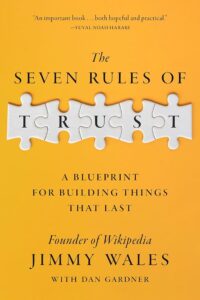
The Seven Rules of Trust by Jimmy Wales: With thanks to Hylke Koers at STM for mentioning this book at Charleston last month, I have been enjoying riding shotgun on Wales’s reflection on the evolution — and revolution — of Wikipedia’s 25 years. (Full disclosure: I’m about halfway through, so take my review for what it’s worth!)
Wales posits seven key principles that build trust among people, which are critical for every profession, every society, and every interaction. He draws on his own experiences developing Wikipedia as well as insights from across social science research and theory. (I do appreciate a well-cited work that is also very readable and accessible!)
From being rejected as either a joke or an existential risk, to being a “global utility” accessed 11 billion times per month, Wikipedia’s success story mirrors the overall trajectory of how information is consumed and monetized on the web. This saga, and Wales’ framework for understanding how trust operates, is very timely. I shivered when he asserted that “the sunny, pro-social view of human nature that inspired Wikipedia may be out of fashion… [but], for anyone who wants to bring people together, to foster trust and cooperation, and create wonderful things, understanding that nature and how to make the most of it is crucial.”
 Brene Brown’s Dare To Lead podcast: As a big fan of Dr. Brown’s research and books (like Daring Greatly, among others), I’ve been taking her podcast along on my daily walks.
She delivers every idea or theory with rich stories and anecdotes, from her Ask Me Anything series to her expert interviews. Dr Brown brings research data and insights to inform problem-solving, bringing a humanistic and pragmatic approach to her work. No matter the professional field, Dr. Brown’s insights into successful leadership can be transformative for any individual or organization.
In fact, like the Wales book above, Brown strikes that powerful balance of data-driven insights presented in plain, simple language that is very relatable and easy to understand. Both of these gems have been fantastic influences during my first 6 months as Deputy Editor of TSK — where I’m responsible for maintaining and fostering the type of internal trust and collaborative content development necessary for a successful free information resource. These resources will help me tackle those challenges in the new year ahead!
Jill O’Neill
This award-winning novel, The Tainted Cup by Robert Jackson Bennett, melds with surprising strength the genre of the traditional private-eye investigation with the type of imagined world-building usually found only in speculative fiction. I found it to be an entertaining and frankly immersive reading experience.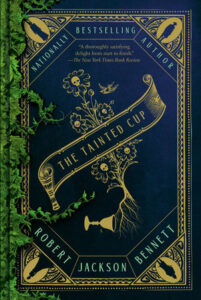
Our 20-year-old protagonist, Dinios Kol, is charged with gathering information about a murder for his somewhat eccentric and irascible superior, Ana Dolabra. Part of an exhausted Empire under siege from massive Leviathans, Din and Ana pursue the questionable deaths of an expanding collection of corpses. As an “engraver”, Din has (as did Archie Goodwin) something akin to a photographic memory. Using small whiffs of scent to trigger recall, he is able to capture critical information from interviews with suspects in a series of grotesque crime scenes. Just as with Nero Wolfe stories, however, it is Ana who has the real brains in this team while Din is busy with the legwork.
Bennett’s world-building is top-notch, and his writing skills create an immersive environment. In the opening chapter, the reader initially encounters only one or two unfamiliar terms (a mai-lantern as an object, Signum as a hierarchical rank), but the means of the private eye’s investigation seem entirely conventional (corral the household in a single room without allowing them to converse). The state of the corpse, the methodology of killing indicated – those are entirely unexpected. The vegetation of the world is unconventional and sometimes highly aggressive. The landscape is – to some extent – waterlogged. A stratified society puts Din at something of a disadvantage while Ana operates at a higher level of status. The investigation is sufficiently complex to satisfy even the most demanding mystery-lover.
Charlie Rapple
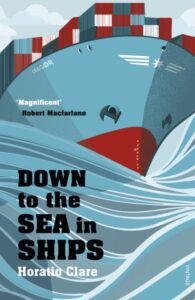 This year, I have a book and a piece of choral music for you.
My favorite read this year has been Down to the Sea in Ships by Horatio Clare, who spent several months living aboard two cargo ships. It is part travelogue, part portrait of a profession most of us only glimpse from a distance: the isolated world of merchant shipping. His prose is lyrical, but he doesn’t romanticize (“coming ashore from seafaring brings you up to the surface of a country as if through its basement” — a sobering but enlightening explanation of how hydrostatic pressure kills, and why we now use cradles to winch casualties horizontally when rescuing people from the water).
He captures the vastness and vulnerability of a world that tries to marry rigorous routine and unforgiving timetables with the unpredictable moods of the ocean. He brings to life very evocatively the other-worldliness of life at sea, where time stretches, landscapes shift slowly, and the world feels both unlimited and yet also very limited. It is a fascinating insight into the logistics of global trade, with the occasional set of facts and figures bringing real power and geopolitical unease — he describes collecting cargo from China destined for America: “Two thousand tonnes of knives, forks and other steel household goods … three thousand tonnes of tables and chairs .. twenty tons of patio furniture.. five hundred tonnes of kitchenware .. four hundred tonnes of lamps” and that is the briefest of snapshots, of the cargo of ONE ship.
Ultimately, this is a poignant portrait of the unsung people who keep our world provisioned. I loved the explanation of the symbolism behind seafarers’ tattoos: “You could read an old sailor’s whole life in his tattoos. A leatherback turtle for crossing the equator, a blue star for going round the Cape of Good Hope. A swallow is five thousand miles at sea.” And I loved that the whole time I was reading this book, and again now, I had playing in my head the rippling organ of Sumsion’s “They that go down to the sea in ships” (here sung by the Choir of Hereford Cathedral) — one of the most perfect settings of a psalm. The choral lines rise and fall like Atlantic swells; you feel the wind, the, light, the foam, the spray. And you feel chills up your spine when you come through the storm to the haven. Enjoy!


Discussion
3 Thoughts on "Chefs’ Selections: Best Media Enjoyed in 2025 (Part 2)"

Angela, the correct follow-up to Derry Girls is Reservation Dogs. A very different culture, but….

I am on it!
A bit more magic realism, but somewhat similar teen vibes.