Today’s post is by Isaac Wink, Research Data Librarian at the University of Kentucky. He would like to thank Mikala Narlock for reviewing multiple drafts of this piece and offering valuable feedback that greatly improved the final product. Reviewer credits to Chef Charlie Rapple.
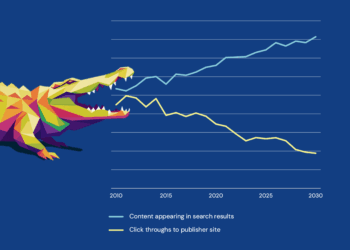
Recently, The Scholarly Kitchen Editor-in-Chief David Crotty shared a brief reflection on Google’s “Year in Search” video, asking if 2025 would be the last time that “search” refers to “a search engine sending the user to information on the internet,” rather than AI-generated answers from Google itself. That musing begs a separate question: What’s the problem with AI-driven information-seeking?
Generative AI text responses are smooth, self-contained objects, succinctly written with clear introductions, bodies, and conclusions. They do not, on their own, prompt further inquiry or search; they are crafted specifically to meet the exact query provided, and they often do so satisfyingly. By contrast, searching a library database or even conducting a traditional Google search can be a frustrating and iterative process. A user’s first query frequently doesn’t return the results they’re looking for, so they refine it, and in the process learn to articulate more clearly what they want to know. Along that path, they may stumble across tangentially related sources that send their line of inquiry in unexpected and creative directions.
These happy discoveries are a form of serendipity, the unintended but fortunate encounter with a source of information. Serendipity is not pure accident but rather a strategy that searchers can work to cultivate. Take, for example, the practice of shelf browsing, in which library patrons choose to read the titles in a given area of the stacks so that they might happen upon titles they wouldn’t encounter in a catalog search. This preference endures for many patrons even in the digital age. Products such as Virtual Shelf from ExLibris and SAGE Recommends attempt to recreate physical shelf browsing, suggesting that this method of discovery remains popular enough that major library vendors seek to emulate it digitally.
Beyond search, original scholarly research often leads to dead ends, frustrations, and unexpected discoveries. Learning to reckon with these challenges is an essential element of researchers’ training. The Nobel Prize-winning biologist Francois Jacob coined the term “night science” in his 1988 memoir to describe the haphazard and at times illogical connections researchers pursue to reach new discoveries. In contrast to “day science,” which “employs reasoning that meshes like gears and achieves results with the force of certainty,” night science is “[w]here thought proceeds along sinuous paths, torturous streets, most often blind alleys. At the mercy of chance, the mind frets in a labyrinth, deluged with messages, in quest of a sign, of a wink, of an unforeseen connection.” All research, Jacob argues, begins as night science, “[b]ut to get some work accepted and a new way of thinking adopted, it is necessary to purify the research of all affective or irrational dross,” a formalizing process equivalent to “describing a race horse with a snapshot.”

It should be noted that Jacob presents the ability to partake in night science as an innate quality of certain gifted scientists, great men (in Jacob’s formulation, it is always men) blessed with the “instinct” to draw seemingly spurious connections between disparate findings that lead to new discoveries. Subsequent scientists, however, suggest that night science is a practice that researchers can teach and a culture that communities can foster. While peer-reviewed articles typically purge researchers’ hopeless dead ends and random walks from the scientific narrative, some scientists seek to highlight the scholarly dividends of night science. Itai Yanai and Martin Lecher credit their confused and hypothesis-free discussions of gene expressions as a seed that led to six published papers. Others have pointed to the Institute for Advanced Study (which offers “facilities, tranquility, and time for fundamental inquiry”) and its dozens of Nobel laureates as the fruits of prioritizing creativity and exploration over immediate results.
While night science is hopefully not always as torturous as Jacob describes, it is frequently frustrating. Research is very rarely on a glide path to publishable results; instead, it encounters numerous moments of friction that researchers experience as frustrations and annoyances — but which might nevertheless lead to new discoveries. To frame things more positively, night science is about the serendipity of unanticipated linkages.
This is what we risk losing if we become overly reliant on AI tools in research and scholarship. If we take seriously what researchers say about night science, then frictionless research processes do not reflect the reality of academic inquiry and will not prepare the next generation of researchers to engage in it. Of course, information-seeking via generative AI tools is not yet a totally frustration-free experience, but it is worth seriously considering what will be lost as developers of those tools further reduce friction. While we can still point to examples of prominent AI chatbots hallucinating information, we should reckon with the fact that, for many people, much of the time, these responses feel good enough.
Rather than framing a lack of serendipity as a weakness of AI tools, I consider it more valuable to highlight it as a strength of what we may soon view as “analog” research processes. Given the numerous pressures facing researchers, it is tempting to offer resources that will make their jobs easier in the short term. I am aware of the irony of telling researchers they could benefit from frustration at a moment of widespread chaos for academia. But frustration and friction are inevitable, and learning to incorporate them into one’s process may ultimately reduce stress and improve outcomes. Cultivating serendipity and practicing night science pays off over the long run. Reducing friction and improving efficiency often saves time, but they may also prematurely trim branches of thought that could grow in productive directions.
Conference presentations, published articles, lectures, and other outputs of research present polished end products of research, hiding the messy and disorderly processes that often created them. What if training programs more explicitly introduced early career researchers to this messiness and demonstrated its importance in the research process?
This is easier said than done when many graduate programs are designed first and foremost to prepare students for the reward structure of academia rather than for the production of meaningful research. Scientific creativity courses offer a structure to prioritize curiosity over results and can be tailored to specific disciplines. One-shot workshops, assignments, and research consultations can similarly emphasize the moments where things go wrong as pivot points to transform a research question or head off in a new direction entirely. But justifying the time and other resources needed for these efforts is difficult in some contexts because they do not immediately produce results. More impactful advocacy for night science may come in individual interactions, as mentors explain their own journeys out of scientific labyrinths or librarians model changing a research question when searches turn up no results.
Becoming a good researcher is not only about learning how to get to the right answer, but also noticing what other questions to ask when the answer is not forthcoming. With information-seeking via generative AI, it is now almost always possible to get something shaped like an answer. Academia already knows how to value efficiency, but if we want good research, we should be wary of a path that’s deceptively smooth.

Discussion
3 Thoughts on "Guest Post — Cultivating Serendipity and Protecting Night Science"

“many graduate programs are designed first and foremost to prepare students for the reward structure of academia rather than for the production of meaningful research.” Oof—yes! In some ways AI is also a perfect solution for the publish or perish model of quantity over quality—but at a whole-Internet scale, and turns out its overapplication makes things unusable. It’s revealing the problems with our incentive structures. It also hides the gaps in knowledge, and finding one of those is often where original research starts! It makes it much harder in some ways to step back and see the shape of the existing body of work.
There’s also something to be said here about erasing other ways of knowing that don’t fit into neat paragraphs of extracted, synthesized information; there is evidence for links between creativity and neurodiversity, and Indigenous knowledge structures don’t function on the same model as western science.
It’s a fundamental weakness in a system to try and eliminate uncertainty, or to dismiss as ‘not worth it’ (or even ‘not real’) things that don’t fit into one model of understanding. That’s why reality is continually so interesting—any model of it is imperfect, and there’s always more to know! In some ways all of this seems designed to make things predictable and eliminate surprise, and I think adopting it wholesale would be a bigger loss than we can fully understand right now. But I should wrap this up or maybe go write my own piece if I want to keep talking. In any case, a really excellent and thought provoking column (and I love the concept of “night science” and am definitely going to add it to my vocabulary)—thank you for it!

First of all thank you for a thought provoking article highlighting such a great topic.
This has been something I’ve been pondering for some time, building on ideas of what was lost in the transition from print to digital, where browsing a journal was replaced by more direct entry into articles. While this was a win for those who wanted to immediately find what they were looking for, and a needed development given the volume of literature, it mean a loss in what you are describing, the ‘serendipity’ of finding an abstract or article tangential to your own space but fuels creative thought.
This builds on the concept that a creativity can often result from the marrying of two distinct fields and concepts. My favourite example of this is that off pistol shrimp and nuclear fusion described here: https://www.raconteur.net/design-innovation/the-story-of-shrimp-inspired-nuclear-fusion.
However, my view on the ability of AI to help with serendipity is much more bullish. The challenge with the print example I provide above and indeed your examples is that you are limited to the available corpus in front of you and what you can read. AI has no such limits, and can therefore, at least in theory, connect disparate concepts between fields, across vastly separate amounts of literature.
At Atypon, we’ve been toying with the idea of how to make this happen, phrased as the serendipity engine, seeing if we can use AI tools to help researchers connect concepts and papers they may otherwise not have.
It is early days, but I remain hopeful that AI has the power to greatly increase ‘serendipity’ if slightly ironically through planned means.
Thank you again for bringing this topic to the Scholarly Kitchen.

Thank you for bringing us the concept of “night science”! I love it. As someone who has moved almost all their searching to various LLMs, I have felt the loss of some serendipity, and also the loss of a lot of endless browsing through online fora trying to figure out which of the confident commenters knows what they’re talking about. Having that all boiled down into one chat response that you then have to wonder the provenance and wisdom of seems to me a worthwhile trade-off for most things. I think we’ll find serendipity through investigating the sources cited often enough, but I do share concerns that this is a missed learning opportunity. There will never be any good substitute for critical thinking!