Editors’ note: Today’s post is by Dr. Lisa Colledge, founder of Lisa Colledge Consulting. This is the second part of Monday’s post that builds on a 2024 argument by asking why the operating model around research has made these capabilities so difficult to sustain at scale.
The first post in this series argued that many of the fractures now appearing across research systems are not isolated research culture problems, but symptoms of a deeper mismatch between the demands of mission-led research and the operating models that evolved to support the research of an earlier era.
This final post turns to the question of how adaptation can happen in practice. Adaptation sits across a complex, multi-actor system — spanning funders, publishers, policymakers, professional services, institutions, and researchers themselves — in which expectations of leadership, collaboration, and contribution have evolved faster than the structures supporting them. The same pattern can appear at different levels: within a research team, across an organization, across national funding and assessment systems, or across the wider research ecosystem.
Across the research sector, many promising interventions already exist: leadership programs, narrative CVs, team science initiatives, research culture pilots, interdisciplinary institutes, mentoring schemes, and evolving approaches to assessment and collaboration. Most create meaningful local value. Yet few accumulate into coherent change.
This post explores what it would take for those interventions to become more than isolated pockets of progress: how they can generate evidence, build readiness, strengthen enabling conditions, and connect into a cumulative pathway for systemic change.

What Cumulative Change Requires
System renewal requires a different way of thinking about change: not as a collection of disconnected initiatives, but as a cumulative pathway in which each stage both creates local value and improves the conditions needed for subsequent stages of adaptation.
Narrative CVs offer one example. Used narrowly, they can become just another application requirement. Used developmentally, they can help researchers notice, name, and build the broader forms of contribution now expected of them. But their system-level value depends on whether assessment, development, review, and progression practices reinforce the same signals.
For local interventions to contribute to wider system renewal, they need to create value in their own right, generate evidence that informs subsequent decisions, and provide enabling conditions for the next stage of adaptation. Leadership programs, pilots, assessment reforms, capability initiatives, and coordination experiments only drive durable structural change when surrounding systems become progressively more ready to absorb and reinforce them.
From Isolated Interventions to Cumulative Pathways
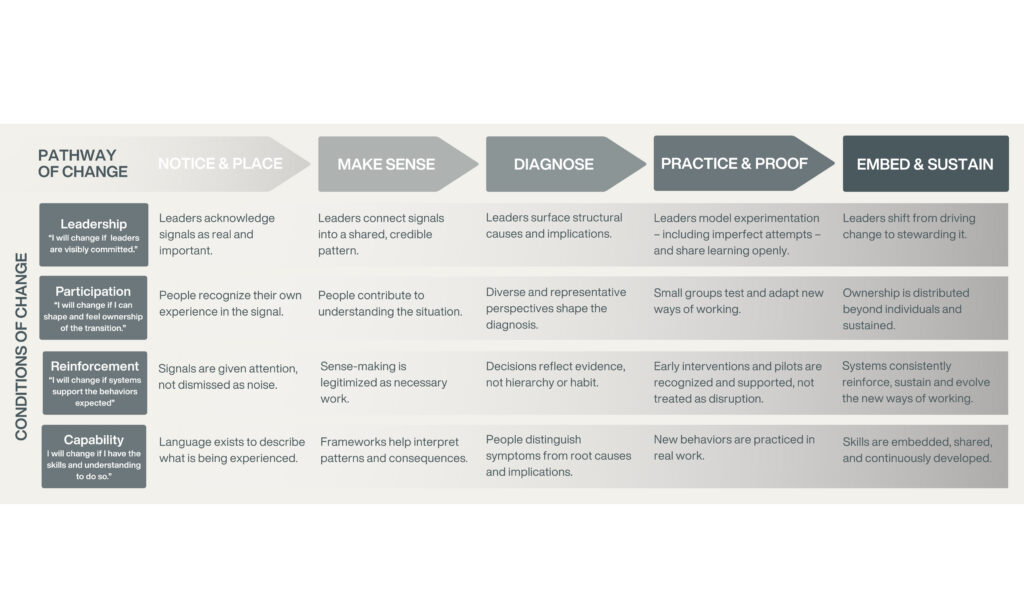
I find it useful to think about systemic adaptation through two connected dimensions: the pathway through which change unfolds over time, and the conditions required for change to sustain itself. These are illustrated in the figure below.
In practice, transformation rarely begins with large-scale redesign. More often, it begins when recurring forms of friction become too visible to ignore: coordination overload, leadership bottlenecks, interdisciplinary tensions, invisible “in-between” work, or growing disconnects between institutional ambition and operational reality.
The first dimension — represented horizontally in the figure — concerns the pathway of change itself.
At first, the challenge is simply to “Notice & Place” signals: to recognize and legitimize them as valid rather than as isolated frustrations or individual weaknesses. These frictions may first surface inside a single team, program, department, or professional services function, but they often reflect wider organizational or sector-level conditions.
Over time, practitioners can “Make Sense” of these signals by connecting them into shared patterns that reveal their scale, persistence, and organizational cost. Change-minded practitioners can then begin to “Diagnose” root causes, distinguish them from symptoms, and identify meaningful points of intervention.
Only then do meaningful interventions become possible. Small-scale operating experiments, pilots, leadership programs, capability-building initiatives, and new forms of collaboration form the “Practice & Proof” of testing alternative ways of operating while generating practical learning about what broader adaptation would require.
Over time, lessons from those interventions can begin shaping the systems governing how work is evaluated, rewarded, coordinated, developed, and reinforced. This “Embed & Sustain” phase ensures that new ways of working become less dependent on individual champions and increasingly embedded within organizational infrastructure.
The Conditions that Enable Change to Take Root
The second dimension — represented vertically in the figure above — concerns the conditions required for change to become sustainable once it begins.
Across a wide range of transformation efforts, four conditions consistently emerge as critical:
- Leadership — people are more likely to engage when leaders visibly signal commitment and model the transition themselves.
- Participation — people are more likely to change when they can shape, influence, and feel ownership of the process and outcome.
- Reinforcement — change becomes sustainable when organizational systems reinforce rather than undermine the expected behaviors.
- Capability — people need to be equipped with practical skills, shared language, and support to operate differently in the context of real work.
These conditions need to be revisited repeatedly across the pathway of change.
For example, leadership in the early “Notice & Place” stage may simply involve acknowledging structural friction as legitimate rather than dismissing it as individual weakness. Later, in “Practice & Proof,” leadership may involve protecting space for experimentation and learning. In “Embed & Sustain,” it increasingly involves redesigning systems, policies, evaluation mechanisms, and resource allocation so that new ways of working become structurally reinforced rather than individually dependent.
Making the Operating Logic Explicit
Underlying many of these shifts is the broader transition described in my previous post: from relatively autonomous models of research toward increasingly interconnected, mission-led forms of collaboration.
Complex problem-solving increasingly depends on integrating different forms of expertise, perspective, method, and cognition. Diversity supplies the raw material; inclusive behaviors and structures determine whether that diversity translates into outcomes.
In practice, cognitive diversity is almost certainly already deeply embedded within research environments, especially where interdisciplinary work is going on: across disciplines, methodologies, generations, professional backgrounds, and neurocognitive styles. The challenge is not introducing more diversity into the system – that is happening anyway. It is designing teams, professional services, and organizational systems capable of supporting, coordinating, and integrating those differences.
This is where many knowledge-intensive environments begin to struggle: expectations around collaboration and integration increase, while the operating systems needed to support those behaviors remain underdeveloped.
In an earlier Scholarly Kitchen article on cognitive inclusion, I argued that designing environments capable of integrating different neurocognitive styles improves problem-solving overall. The same principle applies here more generally: systems capable of supporting difference effectively are also better able to attract, coordinate, and retain the wider forms of disciplinary, professional, and cognitive diversity on which mission-led research increasingly depends.
This is not simply a question of values or wellbeing. It is operational infrastructure.
A Different Model of Progress
Recent sector discussions of strategic change have emphasized the pressure on higher education leaders to sustain transformation in challenging conditions. Across my discussions, several sector leaders described a pattern of reform fatigue: not resistance to change, but exhaustion from trying to sustain long-term direction while the sector appears to be “lurching from one crisis to the next.” The scale of change can feel overwhelming, particularly when progress depends on factors extending beyond any single role, organization, or stakeholder group.
Yet research systems are not immovable. They are designed systems. And systems that have been designed can also be redesigned – deliberately, cumulatively, and with visible progress.
System renewal does not begin by rewiring everything at once. It begins by sequencing interventions intentionally so that each stage creates greater coherence rather than greater fragmentation.
This responsibility extends beyond just institutions to the whole research ecosystem.
Funders help shape incentives, signal priorities, and seed new expectations across institutions. Publishers and related organizations influence what becomes visible, recognized, and rewarded. Policymakers and sector bodies can help align signals across the wider ecosystem. Institutions determine whether new behaviors are reinforced or constrained through everyday operating structures. Researchers themselves continue adapting in practice, often ahead of the systems surrounding them.
Progress therefore depends not on removing competition or institutional differentiation altogether, but on balancing them with stronger forms of coordination, shared learning, and collective intelligence across the wider research ecosystem.
If the challenge facing modern research is increasingly systemic, then one of the most important capabilities the sector may need to develop is the ability to coordinate, integrate learning, and adapt more effectively across the “in-between” spaces where modern research increasingly happens.