At this week’s Charleston Library Conference, The Scholarly Kitchen hosted a panel conversation with three of our leading guest bloggers, all of whom represent technology or service providers in scholarly communications:

As the panel moderator, I asked them what big changes they’ve seen from their vantage points since last year’s Charleston meeting. In keeping with the conference theme — “When the winds of change blow, some build walls and others build windmills” — I also asked what they advise organizations willing to experiment and innovate in response to the many challenges and opportunities our community faces.

Our 40-minute conversation covered a lot of ground, from the impact of AI, shifting user behavior, and evolving infrastructure within academic libraries, publishers, and platform providers. Here are my key takeaways.
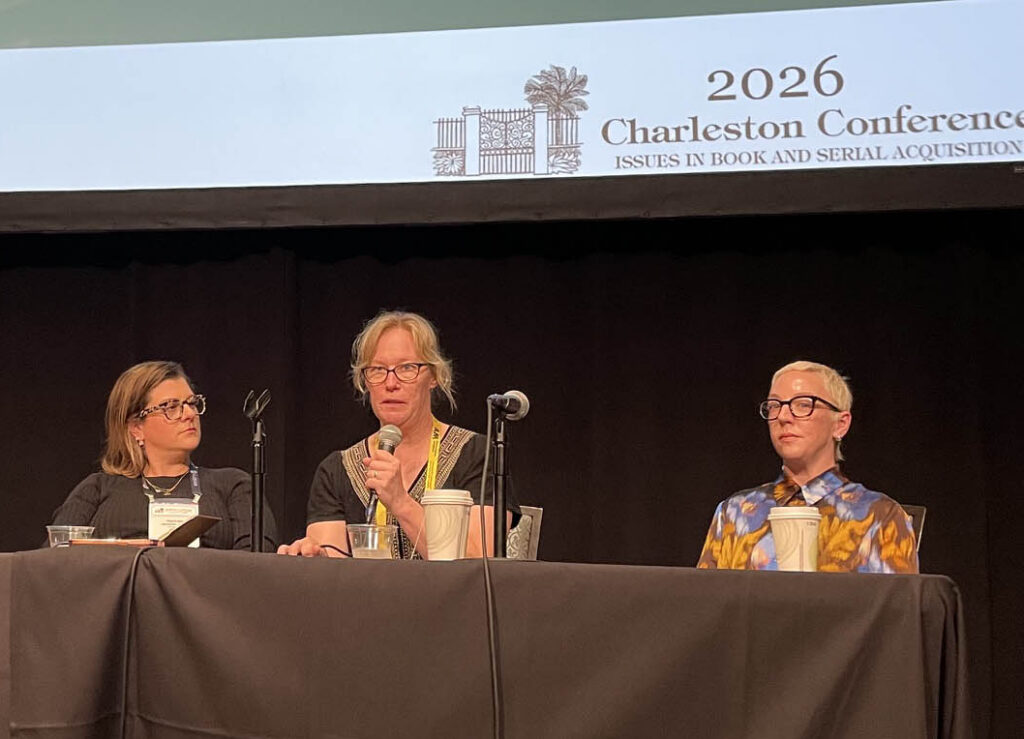
Photo of the Scholarly Kitchen panel at the Charleston meeting. From left to right: Hannah Heckner Swain, Michelle Urberg, and Amanda Ferrante.

“Windmills vs. Walls” (Collaboration and Experimentation)

All three panelists emphasized the value of libraries and publishers embracing change and choosing experimentation (“building windmills”) over resistance (“building walls”) in response to rapid technological shifts. The panelists agreed that aggressively blocking bots forfeits valuable intelligence and potential usage metrics stored in server logs. Hannah recommended publishers define their risk tolerance and measurable benchmarks — such as working with Silverchair to temporarily allow AI crawlers or bots through firewalls (e.g., Cloudflare) to observe their behavior, rather than immediately blocking them entirely. Michelle shared how LibLynx is innovating with new tools like the Bot Filter, designed for scholarly content providers to manage the robotic activity flooding their platforms. Amanda called for deeper collaboration among publishers, platform providers, university IT departments, federations, librarians, and end users to solve shared technological challenges such as the new initiative from SeamlessAccess to promote wider uptake of federated identity management.

The Shift in Identity, Authentication, and Access Management

It didn’t take long for the panel to dive into the decline of pure IP-based access in libraries of all kinds, which is failing more frequently due to security configurations and growing agentic activity. Amanda noted that a dual-access model (IP + SSO) is an ideal balance for many institutions, because IP authentication remains vital for walk-in users and alumni who lack university single sign-on (SSO) credentials. But, pairing it with SSO as a fallback substantially increases successful access, which EBSCO has observed resulting in a 23% median usage increase across 1,400 institutions. While libraries are accountable for providing access, central university IT departments own the authentication infrastructure. Michelle and Hannah both stressed the importance of cross-sector collaboration around identity standards bodies (e.g., InCommon), so campus SSO policies do not inadvertently lock out patrons and institutions have a bridge to decrease reliance on IP authentication.

AI Agents, Bot Usage, and Evolving Standards

Michelle reflected on a recent observation that libraries are grappling with the idea of “bot as a patron,” recognizing that the boundary between human and machine access is blurring (from purely automated bots to humans directing bots and autonomous agentic workflows). Panelists discussed treating bots analogously to physical library patrons — where libraries can define acceptable behaviors, gray areas, and outright misuse. Amanda suggested that the community needs standards for AI agents to self-identify via pseudonymous IDs or metadata headers. If a bot refuses to identify itself, platforms face the challenge of deciding whether to throttle, block, or permit it.

Hannah felt publishers and libraries alike need new metrics for this brave new world, metrics that reflect today’s realities and let go of methods that lag behind agentic retrieval. While COUNTER is working hard to lead the way on these new benchmarks, Michelle noted how we are all struggling to keep pace with new web crawlers and scraping behavior — which leads to uncaptured platform usage. From their vantage points, working with both libraries and publishers, the panelists discussed how we are all in need of clear, predictable community frameworks (via organizations like NISO, COUNTER, and STM) rather than reactive, arbitrary platform shutdowns.

Audience questions sparked a conversation about the differences between US and EU approaches to greater regulation. While European frameworks move toward mandatory watermarking and traceability for AI interactions, the US landscape relies largely on industry norms, commercial incentives, or platform-level enforcement (“carrots vs. sticks”). Michelle noted that we’re facing an asymmetry of influence, where large tech companies (e.g., OpenAI, Anthropic, Google) operate at a scale where academic publishing represents a small fraction of their focus, making voluntary adherence to library standards difficult to enforce unless large university-level license deals create commercial leverage.

Our 40 minutes together flew by, but I really appreciated some fantastic audience questions and rich dialogue in such a short time. Post your questions for these bloggers in the comments below, or let us know you have ideas for future panels with the movers and shakers that share their expertise in The Kitchen.

AI disclosure: Credit is due to Google’s Gemini, which helped the author synthesize the panel transcript.


Lettie Y. Conrad

Lettie Y. Conrad

Lettie Y. Conrad, Ph.D., is an independent researcher and consultant, leveraging a variety of methods to drive human-centric product strategy and evidence-based decisions. Lettie also serves as the Deputy Editor for The Scholarly Kitchen and an active volunteer with the Society for Scholarly Publishing and the Association for Information Science and Technology.

Discussion

Leave a Comment