Editor’s Note: Today’s post is by Scholarly Kitchen Chef Ashutosh Ghildiyal and Gregory Simmons. Gregory is is Vice President of Global Business Development at Integra Software Services, where he leads growth initiatives across scholarly publishing, education, and technology services.
AI has spread through scholarly publishing faster than most publishers can govern it. Editors, integrity teams, marketers, authors, and reviewers use it every day, often on material that should never leave the organization. The Society for Scholarly Publishing’s (SSP) 2026 AI in Scholarly Publishing Pulse Check found that most organizations have at least one active AI use case. Only 3% feel fully prepared, and ethics, legal exposure, privacy, security, and staff capacity remain the main barriers. Readiness carries particular weight in scholarly publishing, where confidential material moves across a distributed workflow and publishers answer for the integrity of the scholarly record.
How can a publisher make AI useful across the organization while keeping control of confidential information, editorial decisions, and accountability? Gregory Simmons took up that question in a recent presentation to the KUWAI and Tools group of SSP’s AI in Scholarly Publishing Community of Interest (CoIN). His talk, AI in Scholarly Publishing: Balancing Innovation, Trust, and Content Protection, covered adoption, governance, trust, and content protection. I sat down with Greg to talk through the ideas behind it. One theme came up repeatedly: a publisher’s AI maturity shows in whether it can identify worthwhile uses, control the risks, keep people accountable, and learn as it goes.
From choosing AI tools to managing AI use
Ashutosh: Greg, when you talk with publishers about AI these days, what’s on their minds?
Greg: Two pressures at once. On one side, there’s more work than ever: higher submission volumes, reviewer fatigue, research integrity concerns, tight resources, and growing pressure to have an AI strategy. AI looks like an obvious help with all of that.
On the other side, publishers hold information that has to be protected: unpublished manuscripts, reviewer reports, editorial correspondence, proprietary content, and institutional knowledge. So you need AI to help with the work, and you need to protect the information and processes that scholarly publishing depends on. Doing both at once is the hard part.
Ashutosh: You can see that tension in the guidance coming out across the industry. The International Committee of Medical Journal Editors (ICMJE) recommendations on artificial intelligence, for example, address confidentiality, transparency, human accountability, and AI use by authors, editors, and reviewers. They caution against uploading manuscripts to AI systems where confidentiality can’t be assured. The Committee on Publication Ethics (COPE) position on authorship and AI tools and the International Association of Scientific, Technical & Medical Publishers (STM) recommended classification of AI use in manuscript preparation reinforce the emphasis on human accountability and transparency. So is the answer just better policies?
Greg: Policies are where you start. A policy tells people what to avoid. On its own, it doesn’t help anyone finish their work.
Say an organization tells staff not to upload confidential material to a public AI service. That addresses one risk. It still leaves people without an approved way to get the task done. People need boundaries and practical options: which AI systems are approved, what information can be used, who has access, and when a human needs to review the output.
That’s what I mean by moving from AI policy to AI practice.
Where should human judgment remain?
Ashutosh: You spent a lot of the talk on trust. Where do you draw the line between what AI can do and what a person has to decide?
Greg: Trust underpins scholarly publishing. Editorial oversight, peer review, and quality control are how we help establish the reliability of the scholarly record. AI changes how some of that work gets done. Responsibility for the result stays with us.
AI can summarize content, classify submissions, support language improvement, spot patterns, and assist with screening. People still make the calls on significance, ethics, quality, and publication. In the presentation I called this appropriate automation: deciding where automation adds value and where human judgment is essential.
In practice, it helps to separate three things: tasks where AI can assist, outputs a person has to review, and decisions for which a named person stays accountable. An integrity screening tool might flag unusual citation patterns in a submission, for example. An editor then looks at the context and decides what, if anything, to do about it.
Ashutosh: Peer review is where this gets tricky. Reviewers may use AI for language help or summarization, while publishers have to protect confidential manuscripts. The issue extends past the publisher’s own staff to authors, reviewers, editors, vendors, and everyone else in the process.
Greg: Yes, governance has to follow the workflow.
We’re already seeing AI-generated manuscripts, paper mills, fabricated or hallucinated references, inappropriate AI use by reviewers, and image manipulation. AI can also help catch some of these problems through integrity screening, such as the shared tools in the STM Integrity Hub, citation analysis, and other checks. The same technology creates some of these risks and helps manage them. Governance decides how it gets used.
Governance has to become part of the working environment
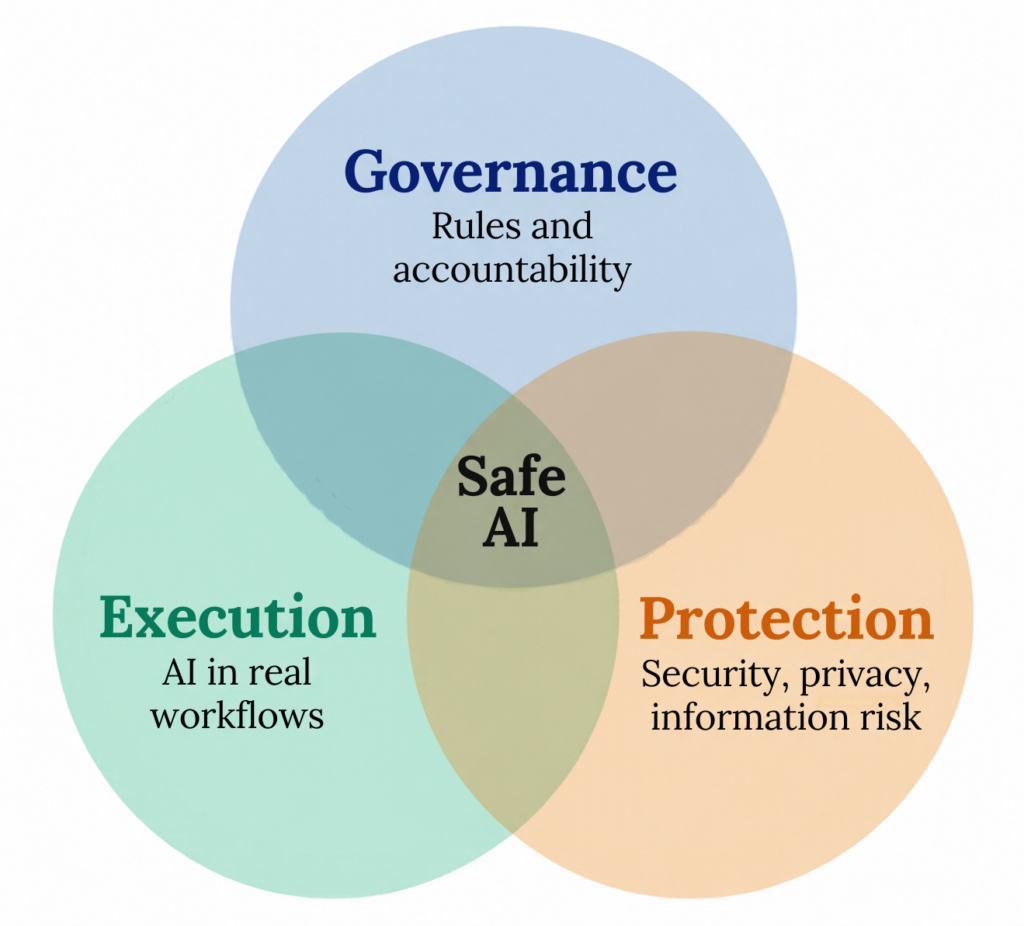
Ashutosh: Your talk sets out three elements of a safe AI approach: governance, execution, and protection. If a publisher were building this from scratch, where would you tell them to start?
Greg: With purpose, then strategy, governance, and technology, in that order. Identify the problem. Decide whether AI is an appropriate way to address it. Put the right controls in place for that use case, and only then choose the technology.
Organizations often do it in reverse. They find a new tool and then go looking for a reason to use it.
Ashutosh: I made a similar argument in my earlier Scholarly Kitchen piece, “Before the Guardrails: Why AI Governance in Research Must Start with Purpose.” There I argued that governance depends on coordination across the research ecosystem. Your talk brings that idea inside the organization. So once the purpose is clear, what does governance actually look like on a Tuesday afternoon?
Greg: It has to become operational. That means approved AI systems, appropriate permissions, information controls, security and privacy measures, monitoring, audit trails, and clear accountability. It also means knowing what information each system can reach and how its outputs may be used.
The three elements work together. Governance sets the rules and accountability. Execution puts AI into real workflows. Protection covers security, privacy, and information risk. (See Figure 1.)
Ashutosh: That sounds like a shift from picking tools to building an environment. Is that fair?
Greg: Yes. If every employee picks their own tools, the organization may have little visibility into what’s in use or what information is going into it. A governed environment restores that visibility. Staff can use several AI models, with controls on permissions, agents, and information. Someone who needs to summarize a set of internal documents can do it inside the approved environment. The goal is to make AI useful while keeping organizational information under organizational control.
AI readiness is an organizational capability
Ashutosh: Most AI discussion in our industry focuses on editorial workflows. Your talk also covered marketing, community engagement, knowledge management, and event preparation. Why look beyond editorial?
Greg: Because that’s where many publishers can learn fastest with the least risk. Preparing for an event, drafting marketing material, or helping staff find information across internal documents rarely involves confidential manuscripts or editorial decisions. Those projects show you which uses create real value, what controls they need, and where people must stay involved. You can then apply those lessons to higher-stakes editorial work.
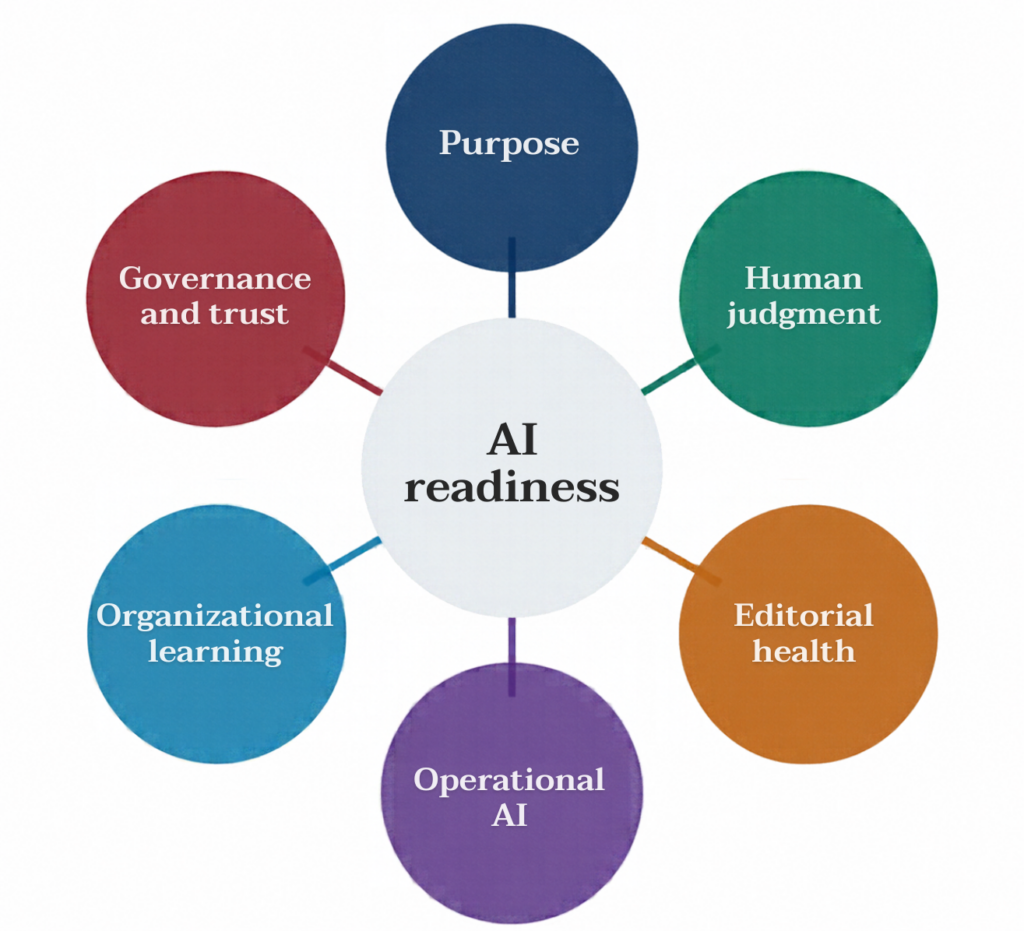
Ashutosh: You also have a second model: six dimensions of AI readiness, namely purpose, human judgment, editorial health, operational AI, organizational learning, and governance and trust. How does that fit with governance, execution, and protection?
Greg: The first model is about having the right controls in place. Readiness is about whether the organization has the skills, processes, and habits of learning to use AI well within those controls. An organization can have access to very sophisticated AI and still be poorly prepared. People may not know how to use it, governance may be unclear, and there may be no process for evaluating results or learning from failures.
That’s why AI literacy and organizational learning matter as much as the technology. People need room to experiment within clear boundaries, and ways to share what they learn. (See Figure 2.)
Ashutosh: Say I run a mid-sized society publisher. We’ve done a few pilots, nothing joined up. What would you tell me to do on Monday morning?
Greg: Start with the work. Look for repetitive tasks, bottlenecks, information-heavy processes, and places where staff need better access to knowledge. Ask where AI could improve efficiency, research integrity, or service to authors, reviewers, members, and readers.
Then assess the risk. A use case involving public information is very different from one involving an unpublished manuscript or personal data. From there, set up the governance model and give people approved ways to use AI. Build human review in wherever judgment matters. Then measure results and adjust as you learn.
Organizations that do this well build a repeatable way to identify opportunities, assess risks, protect information, train people, evaluate results, and adapt as the technology changes.
Ashutosh: You ended the talk by saying publishers will be distinguished by how intentionally they adopt and govern AI. What does “intentional” look like?
Greg: AI will become part of ordinary publishing work, and many individual uses will start to feel routine. The important questions will be organizational. Where is AI being used? What information can it reach? What decisions does it support? Who is accountable for the outcome? What controls are in place?
Publishers who can answer those questions clearly will be better placed to use AI at scale while protecting the trust that scholarly communication relies on.
Ashutosh: So the real work is building the conditions for people to use AI responsibly.
Greg: Right. And the technology will keep changing, so publishers need an approach that can change with it.
Where to start: practical takeaways
The conversation suggests five steps for publishers moving from experimentation to practice:
- Identify the problem and the value you want. Look for tasks where AI could save time, ease a bottleneck, or improve service.
- Assess the sensitivity of the information and the risks. Unpublished manuscripts, reviewer reports, and personal data call for stricter controls than public content.
- Provide approved tools, access controls, and clear rules for use. Pair every restriction with a sanctioned alternative, and make sure the rules reach authors, reviewers, editors, and vendors as well as staff.
- Define human review, decision rights, and accountability. Be clear about where AI assists, where a person must review, and who is accountable at each point in the workflow, including steps handled by partners.
- Measure outcomes, learn, and update controls. Use early projects to learn what creates value and what controls it needs.
How is your organization moving from AI policy to AI practice? We would welcome hearing about your experience in the comments.
Author’s note: The authors used Claude to help review and organize the source material, including themes from Greg’s presentation, and to edit the text of this post. The authors reviewed all changes, verified the cited sources, and take full responsibility for the final text.