AI governance is not primarily a technology challenge. It is a coordination challenge. Governance is the process through which the research community decides where AI should assist, where human judgment must remain central, and how accountability is maintained. No single organization can do this alone. It requires coordination across the institutions that collectively shape how research is conducted, evaluated, disseminated, and preserved.
Today, however, those institutions are moving at different speeds. Publishers are making independent decisions about AI-enabled workflows. Institutions and libraries are developing their own policies and guidance. Researchers are experimenting with new capabilities while navigating inconsistent expectations. Technology providers are deploying increasingly powerful systems faster than the community can evaluate their implications. The result is a growing risk of fragmentation, with AI becoming embedded in critical research processes before there is broad agreement on how it should be used, where its boundaries should lie, and who remains accountable for the decisions it influences.
As artificial intelligence becomes increasingly embedded across the research lifecycle—from discovery and writing to peer review, editorial assessment, and dissemination—the challenge is no longer simply adopting new tools. It is ensuring that those tools remain aligned with the purpose of research and the trust on which the research enterprise depends.
Scholarly publishing has rarely rushed to embrace new technologies. Its culture of caution, skepticism, and rigorous evaluation reflects its responsibility as a steward of the scholarly record. In the age of AI, those instincts are not obstacles to innovation; they are among the community’s greatest strengths.
The High-Speed Train and Why Track Comes First
What does effective AI governance actually look like in practice? A useful starting point is a metaphor.
Think of AI as a high-speed train carrying the research enterprise (researchers, editors, reviewers, students, and the reading public) toward knowledge faster than ever before. But power without track is not an asset; it is a hazard. Governance is the track: it does not slow the train; it is what makes speed safe and direction reliable.
Track is not built by the operator alone. It requires planners, engineers, maintainers, and regulators working toward a shared purpose. The same is true for AI governance in research. Effective governance depends on bringing together researchers, institutions, libraries, funders, technology providers, and publishers, along with a convener who can help the community reach shared understanding.
The same principle can be seen in other complex ecosystems. China’s manufacturing ecosystem offers a useful lesson in coordination. The location of a factory is often explained in terms of labor costs, but in reality it reflects the strength of an entire ecosystem: transportation infrastructure, suppliers, talent, logistics networks, capital, research capability, and long-term planning.
AI governance operates in much the same way. A publisher’s policy, an institution’s guidelines, or a technology provider’s safeguards are important, but they are only individual components of a broader governance ecosystem. Responsible AI adoption ultimately depends not on any single organization, but on how effectively the ecosystem as a whole coordinates around shared goals, standards, and accountability.
The Question Before the Questions
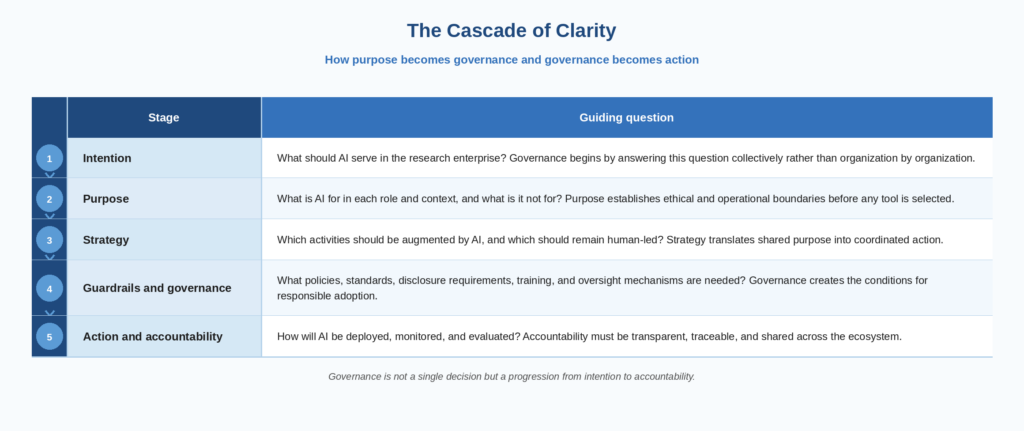
Conversations about AI governance often focus on guardrails, policies, standards, and risk management. These matter, but they cannot be the starting point. Before any tool is procured or policy drafted, there must be clarity about what the effort is meant to serve. Without that clarity, organizations risk strategic drift, where a series of individually reasonable decisions gradually carries them away from their original purpose.
Much of the anxiety surrounding AI stems less from the technology itself than from the uncertainty that accompanies significant change. Organizations often respond by either rushing toward adoption or delaying action while waiting for certainty that never arrives. Neither response addresses the fundamental question. Before asking what AI can do, organizations must first decide what they are trying to achieve. Applied to governance, the starting point is intention-setting.
Defining intention is not purely an analytical exercise. It is shaped by an organization’s values, culture, and mission as much as by its strategy. It becomes the foundation for strategy, the guide for governance, and the basis for the decisions and actions that follow. Intention-setting establishes the context that makes every subsequent stage coherent: it tells an organization not just what AI should do, but what it is ultimately in service of. Without that context, strategy becomes optimization without direction, governance becomes compliance without meaning, and accountability becomes process without purpose. This helps organizations navigate uncertainty, resist competing pressures, and remain aligned as AI capabilities continue to evolve.
An Additional Mind, Not a Replacement for Judgment
One practical way to think about AI governance is to distinguish between two kinds of cognitive work: mechanical-cognitive work and judgment-cognitive work. A substantial portion of the cognitive work performed by researchers, reviewers, and editors is repetitive and trainable, including formatting references, checking submission compliance, screening for plagiarism, triaging scope, matching reviewers, and flagging statistical inconsistencies. AI can absorb much of this overhead, freeing researchers and editors to focus on work that requires deeper human attention.
Judgment-cognitive work is different in kind, not just degree. A senior editor’s sense that a manuscript’s framing is subtly misleading, or a reviewer’s recognition that a methodology is technically sound but contextually inappropriate, depends on discernment, contextual understanding, sensitivity to nuance, and the ability to apply values in specific situations. Much of this judgment is rooted in tacit knowledge, developed through deep engagement with a field rather than through explicit rules.
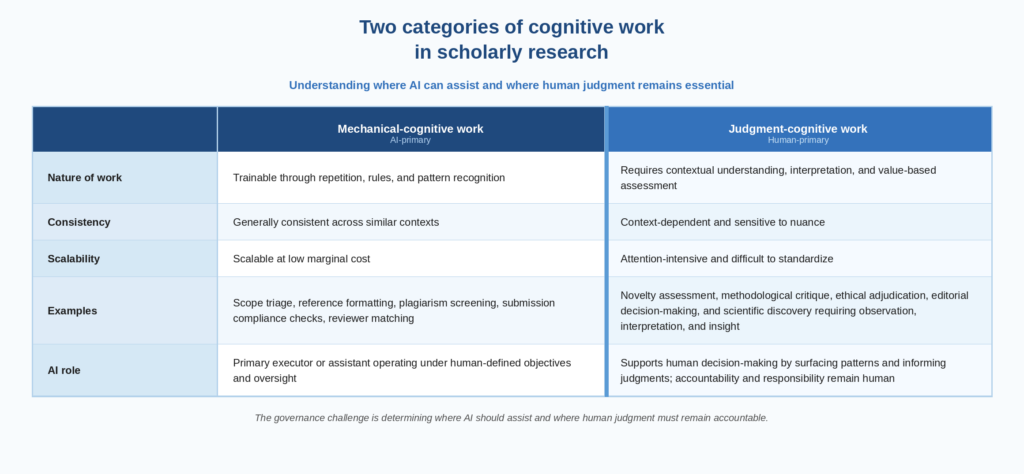
A related concern is cognitive outsourcing: the risk that AI may gradually erode the human judgment on which scholarly quality depends. The danger lies less in the technology itself than in how it is used. AI can effectively support mechanical-cognitive work, but when convenience leads researchers and editors to delegate judgment-cognitive work as well, the quality and accountability of scholarly decision-making will suffer.
Drawing the Line Between Assistance and Judgment
Publishers are already using AI to screen submissions, detect image manipulation, identify potential reviewers, and assist authors with language refinement. The governance challenge is no longer whether AI will enter scholarly workflows, but how far it should be allowed to go.
Policies still vary, but a common principle is taking shape: AI can support human decision-making by surfacing information, identifying patterns, and reducing cognitive overhead, but it should not substitute for human thinking and accountability on consequential decisions. Consider the difference: an AI system that flags a potential conflict of interest assists the editor; one that resolves that conflict replaces the editor. An AI system that surfaces methodological inconsistencies supports the reviewer; one that evaluates those inconsistencies and renders a verdict displaces the reviewer entirely.
These distinctions should be made explicit in governance frameworks. The test, in every case, is whether the task requires human judgment, accountability, and responsibility, not simply whether AI is capable of performing it.
Why Publishers, Societies, and Libraries Must Convene the Conversation
Scholarly publishers, learned societies, and academic libraries sit at critical intersections within the research enterprise. Publishers and societies receive the work of researchers, apply disciplinary standards, draw on the expertise of reviewers, satisfy the requirements of funders, and steward the scholarly record. Libraries, meanwhile, operate at the point where researchers, students, institutions, information resources, and emerging technologies meet.
Their most important contribution may not be selecting AI tools, but helping the research community reach agreement on how those tools should be used. This requires convening researchers, institutions, libraries, funders, technology providers, and publishers around shared frameworks that ensure AI serves the goals of research while preserving accountability, trust, and integrity.
Organizations such as STM have already begun developing principles and guidance for the responsible use of AI in scholarly publishing, providing an important foundation for broader community discussions.
The organizations that earn the greatest trust in the years ahead will be those that govern AI thoughtfully and transparently while helping the broader research community build shared norms, expectations, and accountability frameworks for its use.
From Experimentation to Ecosystem Governance
If governance is about coordination, then organizations must first develop the internal capability to coordinate before they can contribute meaningfully to governance across the wider research ecosystem.
If publishers and societies are to play a meaningful convening role, their own governance practices must first move beyond isolated experiments and departmental initiatives. As AI becomes more deeply embedded in workflows, governance must become more formal, more cross-functional, and more outward-facing.
Building on established organizational maturity models, the figure below presents a four-stage AI governance maturity framework for scholarly publishing. It moves from isolated experimentation through organization-wide coordination and, at its most advanced stage, to shared standards across the research ecosystem.
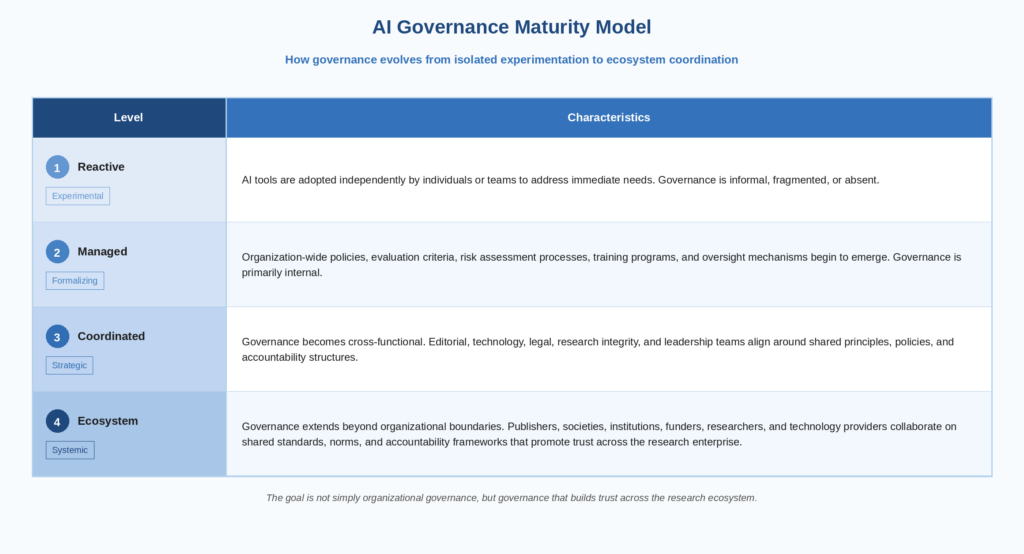
The next step is the Coordinated stage, where governance becomes a shared organizational responsibility rather than the concern of individual departments. This is where governance begins to move beyond compliance and becomes a genuine strategic capability, shaping how the organization positions itself as AI reshapes the wider research landscape.
For publishers, societies, and libraries, the long-term opportunity extends beyond achieving coordination within their own organizations. The highest level of maturity is ecosystem governance, where standards, norms, and accountability are established collaboratively across the research enterprise rather than within any single organization’s boundaries. Reaching this level requires sustained cross-stakeholder convening and consensus-building. Publishers, societies, and libraries are uniquely positioned to provide that leadership.
What Coordinated AI Governance Could Look Like
If governance is ultimately a shared responsibility, then every stakeholder has a role that is both distinct and complementary. The goal is alignment: a shared understanding of where AI creates value, where human judgment must remain central, and how accountability is maintained across the research enterprise.
For publishers, learned societies, and libraries, governance extends beyond selecting or implementing AI tools. Their greatest contribution lies in their ability to convene the research community around shared principles, expectations, and accountability. Through that convening role, they can develop common principles that reduce fragmentation. Within their own organizations, this means defining where human judgment is essential, establishing transparent AI policies, and reviewing governance as technology and community expectations evolve.
Researchers remain the ultimate stewards of scholarly judgment. While AI can reduce routine cognitive work and improve efficiency, they remain accountable for the quality, originality, and integrity of scholarship.
Institutions and libraries bridge researchers and the broader scholarly communication ecosystem. Their governance efforts should be grounded in the realities of research practice while remaining aligned with publisher, society, and funder expectations. Beyond developing institutional policies, they can help researchers navigate an increasingly complex landscape by providing AI literacy, guidance on responsible use, and support that balances efficiency with research quality.
Funders influence research behavior through the expectations attached to grants and funding programs. Clear expectations for AI transparency and researcher accountability can help establish common expectations across the research ecosystem. Equally important, funders should work to harmonize those expectations with the standards emerging from publishers, institutions, and scholarly societies, reducing unnecessary complexity for researchers operating across multiple funding environments.
Technology providers also share responsibility for governance. Their role extends beyond building increasingly capable systems to designing technologies that support transparency, human oversight, and meaningful accountability.
No single stakeholder can govern AI alone. Effective governance depends on sustained collaboration and a shared commitment to ensuring that AI strengthens the integrity, trust, and purpose of the research enterprise.
Keeping Purpose at the Center
Governance frameworks, policies, and standards matter, but they are only as effective as the purpose that guides them. A practical place to begin is a cross-functional AI governance working group that brings together publishing, editorial, technology, research integrity, legal, library, and research support perspectives. The goal is not simply to draft policies, but to establish an ongoing process for determining what AI should and should not do in service of the organization’s mission.
The high-speed train is already in the station. The challenge is not simply to lay the track, but to ensure the destination remains clear before the train departs.
AI capabilities will continue to evolve. Human responsibility will not. The future of scholarly communication will not be determined by how powerful AI becomes, but by whether the research community remains clear about the purpose those capabilities are meant to serve and whether it can govern them together.

Discussion
2 Thoughts on "Before the Guardrails: Why AI Governance in Research Must Start with Purpose"

Where do you think the recent initiative for a standardized AI disclosure statement (object of the Focus Track at this year’s World Conference on Research Integrity) sits within this ecosystem? Is it possible to clearly label and distinguish work that was AI-assisted from that which was AI-produced?

Hi Maria, I don’t think disclosure requirements will be particularly helpful, nor do I believe they will remain a meaningful practice for very long. We should probably assume that, in the future, most scientific articles will be written with extensive AI assistance, and many may be almost entirely AI-generated from a writing perspective. I don’t see that as inherently problematic, provided the authors remain responsible for the underlying ideas, claims, interpretations, and conclusions. The thinking, context-setting, critical review, and final editorial pass should remain the responsibility of the authors.
I also worry that AI disclosures may unintentionally introduce bias in how a manuscript is received. Knowing that AI was used could predispose readers—including editors, reviewers, and the wider scientific community—to judge the work differently or dismiss its ideas prematurely, regardless of the actual quality of the research. The focus should remain on the originality, rigor, and significance of the work itself, not on the tool used to express it.
To me, the more important question is not whether AI was used, but whether the work contains genuinely original ideas, novel insights, or meaningful scientific contributions. That is what editorial assessment and peer review should be focused on establishing. In this regard, the emerging trust markers and integrity indicators may prove far more valuable than AI disclosures, as they can help distinguish genuine, high-quality scientific work from AI-generated slop or fabricated articles.