Editor’s Note: Today’s post is by Laura Harvey and Chris Reid. Laura is a consultant working with publishers & vendors on authority-building content. Chris is Senior Director of Product Management at Wiley. Their newsletter “Near Missives” explores what scholarly publishers can learn from other industries. This article reflect their personal views.
There are two ways to learn about a topic: from deep inside, and from the outside. When it comes to learning about the scholarly communications industry, there are plentiful examples of the former, including this very blog. Just over 12 months ago we started thinking more and more about the latter route. Our newsletter started with that one question — what can scholarly publishers learn from other industries?
This question has coincided with a time of significant technological change — change with at least echoes of the beginnings of the internet, and arguably even on the scale of technologies like steam power, electricity, or even the printing press. As scholarly publishing moves through its second digital transformation, the need to look at broader trends and other industries has never been more important. No one has the right answers, and many wrong turns will be taken, but taking a broad view allows us to see the wood for the trees, focusing on direction rather than detail.

In our writing over the last year, 4 clear trends have emerged that we think everyone in scholarly publishing should pay attention to:
Business Model Evolution
One major theme has been how business models have adapted, or in some cases doubled down.
While the days when content businesses could spring lucrative data businesses overnight may be passing (see Reddit’s recent fortunes), the landscape is rich with examples of publishers — especially news publishers — transforming into data businesses via AI licensing deals. Newscorp signed with Meta in early 2026, and Le Monde late last year.
The trend also extends beyond licensing deals with AI companies. Look at Bloomberg’s recent diversification into an enterprise data provider as an example. Bloomberg Terminal – the company’s core subscription product still produces the bulk of the revenue, with the publishing arm of the business reinforcing the brand, but enterprise data now generates an estimated $2-3Bn and, crucially, brings Bloomberg into customers’ AI workflows.
Food for thought, for scholarly publishers, especially as “live feed” deals start to emerge and the internet becomes a soup of LLM-tinged content that drives up the value of original, curated, high-quality outputs.
That said, a “data provider to LLMs” model is not without concerns for scholarly publishers, as evidenced by much discussion on this blog (this post also). Perhaps then, it’s worth taking a deeper look at how content businesses are transforming, specifically focusing on trust-based content businesses: that trust is being productized into in-workflow solutions.
Perhaps then, it’s worth taking a deeper look at how content businesses are transforming, specifically focusing on trust-based content businesses: that trust is being productized into in-workflow solutions.
With CoCounsel, Thomson Reuters has built out “AI that thinks like a lawyer” on top of the Westlaw legal database, which, crucially, is designed for in-workflow deployment. Salesforce announced a similar approach at their recent earnings call with their increasingly deep relationship with Claude, launching a new plugin and 37 pre-built sales skills. Moody’s, the credit ratings agency, is another example, having recently announced the release of a set of AI Skills which encode their proprietary ratings, research, and risk intelligence. This quote from their press release points towards the increasing focus on bringing expertise to places of execution, a trend coming to the finance and banking industry at large.
“AI platforms are becoming the interface for financial decision-making, and the next phase of adoption will be defined by execution. Skills are how we encode Moody’s expertise into that execution layer.” – Cristina Pieretti, Head of Digital Content and Innovation at Moody’s
Medical and standards publishing are rich in examples here too. Decision support tools powered by proprietary content like Wolters Kluwer’s UpToDate and Elsevier’s ClinicalKey have had AI interfaces and upgrades recently, and standards organisations like the NFPA are transforming their archives of technical content from reference tools to interactive “career companions.
In-workflow delivery of trusted advice is a rich seam for scholarly publishers, but in itself also presents a challenge. Those user workflows are now where discovery happens.
Discovery, Disrupted
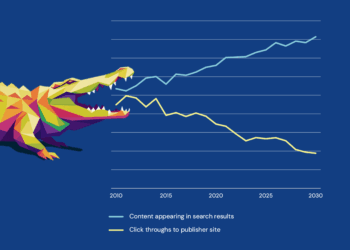
Rapid changes to reader behavior have been a dominant theme over the last year, and it’s something publishers of all stripes are dealing with, from the likes of news media and Wikipedia to newsletter channels. Human readership is falling, and the evolution of AEO (the artist formerly known as GEO) is top of mind.
We should all remember that researchers are humans first, bringing discovery habits from their personal lives into their professional lives. If (and it is a BIG if) you ordered your coffee via ChatGPT and read your news via Claude, then it is a small jump to beginning your research journey through these same channels. The data shows AI has truly entered the research discovery workflow.
Wiley’s 2025 ExplanAItions survey shows 84% of researchers actively use AI in their work, with 62% using it for research- or publication-related work. Kudos’ latest report shows a third of researchers are starting their information seeking with AI.
To add to the growing evidence of changing behavior — the last few years have seen a flurry of offerings that sit between scholarly content and AI to facilitate discovery, and they’re growing at an exponential rate. Consensus has grown to 2.5 million monthly users since launching in late 2022 (and has their sights set on being the “AI OS for researchers”). Both Elicit and Scite have total user numbers in the multiple millions.
Differentiation and Community … In an Increasingly Content-Heavy World
So, your content business is now a data business. Your readers are machines, and you no longer own the front door.
Where next? You need a moat.
Differentiation and community are the emerging answers, and they’re coming from news media and the creator economy.
In late 2025, The Economist announced their “3 Ds” strategy: Differentiation, Direct relationships with customers, and Discoverability. As a leading media brand, quality and editorial choices do much of the “differentiation” work. The direct relationships piece is interesting — think new newsletters and apps launched in ChatGPT to reach readers where they are. They’re also investing in social media as part of their discovery strategy.
Challenger Italian Media brand Bewater takes the social media trend further. It has eschewed having a platform entirely — they reach audiences entirely in high-engagement channels like social media, podcasts, and live events. And their model of person-to-person engagement is mirrored in the broader “creatorification” of new publishers.
Wired provides another case study. They’ve transformed their journalists into the product, with an exclusive forum where subscribers can interact with the team, plus events, new newsletters, and more. Scholarly publishers should take note: your expert teams & editorial boards are the perfect analog to Wired’s staff of journalists. And there are already industry trends pointing in this direction: from the transition to personality-focused marketing, to the ever-expanding publisher partnerships that facilitate researcher interactions (ResearchGate, Cassyni, etc.) and the growing discourse around fully connecting conferences and publications.
In an increasingly content-heavy world, curation is king. And audiences want to hear directly from the experts doing the curating.
Curation is King. Trust is King.
What drives curation that gets attention (and revenue)? Trust.
Trust is perhaps the dominant theme to emerge in our year of external trends, and it’s a topic which has been a through-line for our industry long before generative AI.
AI and authorship have been the biggest publishing trust story of the last year in our own niche and beyond. In trade publishing, what started with Shy Girl moved quickly to the Granta literary prize controversy, Jerry Falade’s Call me, I’ll Hide the Body, and then on to Substack’s partnership with Pangram. The uproar around each has told us a lot about what readers want from content, and it’s not just quality. They’re looking for a blend of value, including craft, connection, and integrity. How much this translates to scholarly readers and between different subject verticals is to be debated, and the exact mix will certainly differ, but it’s a helpful lesson on what readers really value coming at a time when readership is transforming.
These AI authorship scandals have also shone a light on organizational practices, or more definitively the lack thereof. They’ve shown gaps in quality control processes and author treatment and highlight how challenging it can be for businesses to adapt to rapidly advancing, widely available technology (or fill in process gaps that arguably should have been there all along).
It shouldn’t be ignored that the AI/authorship conversation is happening against a background of underlying industry tensions. In this way, the authorship scandals have acted as something of a lightning rod (see the comment threads on this post or this one for a flavor).
Any scholarly publisher who has weathered a research integrity scandal (AI-related or not) will recognize a lot here. As publisher AI authorship policies continue to evolve in our sector, and research integrity challenges mount, no doubt we will see more of this play out in our own industry.
Reflections
For most of us attempting to stay even vaguely up-to-date, the last 12 months have felt like drinking from a fire hose, while riding a rollercoaster. There’s so much going on, everywhere, all at once. All of it feels like change. Some of it exciting, some of it unsettling. All of it challenging. But (and with apologies to Nate Silver) what is just noise and what is signal?
With this in mind, we thought we’d put our necks out and suggest some predictions about where we as an industry will stand this time next year. What principles will remain tried and true, and where will we have adapted, or been forced to adapt?
What Stays the Same
- Technological advancement will continue to outpace the ability for culture, legal frameworks and infrastructure to keep up.
- Consumer-as-a machine will become a dominant topic…
- …alongside Trust
- Users will continue to choose convenience above all else – including above official tools, policies, and guidance
- SaaSpocolypse predictions will not come true. Stories like this one about DocuSign are a reminder that core competencies are key and technology is not the only moat a SaaS business has to offer.
What Changes?
- Competition will intensify. We’ll see more exciting products and services coming from academic publishers, translating their content to expert advisory-type offerings. The competitive landscape will evolve.
- Community will take center stage. The conversation about cultivating direct audience relationships in an AI-era has been strong for 18+ months now, and the news media trends are clear. We’ll see progressive society publishers looking to blend their events and publications offerings, and a whole new host of audience-engagement formats will likely come from commercial publishers.
- AI will create novel, quality work. Publishers won’t just have to grapple with AI-generated manuscripts, but with AI use across different parts of the research publishing process, that will likely necessitate and update in best practices. Readership data will get more nuanced. Academic reading behavior has transformed. It is still transforming. People will still read – but what and why (and how) will tell us something different than it did a few years ago.
What do you think? Jump into the comment section!
Addendum: This post was updated at the authors’ request as of 3:20PM, September 4, 2026.

Discussion
7 Thoughts on "Guest Post – A Year of Trends Beyond Scholarly Comms: What You Need to Know"

@Chris and @Laura,
Thanks for sharing your wisdom.
From the standpoint of scholarly content amplification, I totally agree that new host of audience-engagement formats will likely come. However, they may not merely come from commercial publishers.
Indeed, on the STM innovation stage, multiple companies are attempting to support publishers in cultivating direct audience relationships. Some of these solutions will be presented at STM Innovation Day in December in London.
What has changed is that with AI the cost of creating prototype has dwindled. The magit bullet is to work with tech partners who understand content the way people in publishing do. Watch this space, as we are planning to introduce a novel solution (initially aimed at clinical researcher and consultants), helping them to stay current on latest trends with our personalised and curated newsfeed, called ScioWire. Launch is in Q4 2026….

Thanks Sabine – I think the most interesting audience engagement examples will come from the society space…

I have read so many recent SK posts and been driven into deep thought. I want to reply, then Outlook dings and I am off to my next meeting or deadline. I also do not know how to organize the myriad thoughts and am loath to write anything so unorganized. It would be pages and not a comment.
So, today I will share one thought, maybe two.
Most of what I hear about AI today is about writing. I find it is reasonably good at writing, at least some of the models.
Then in today’s post I read, “The uproar around each has told us a lot about what readers want from content, and it’s not just quality. They’re looking for a blend of value, including craft, connection, and integrity.” I turn to the devil on my other shoulder, and I am told there will be no human readers of your scholarly content. Put it all on a MCP server, optimized for AI with all the necessary metadata. I do not understand what any server does, but among the things I am told is that the MCP server will break my content into 300 word chunks. I am on some level horrified. So, the function of the MCP server is to shred my content. Is this thing evil itself? Then I wonder if my grandchildren will understand what is happening just as easily as they drink from a firehose.
I also wonder at the same time if reading isn’t such a fundamental human endeavor that we will never give it over entirely to machines. Which of course means that I have to pay for the legacy PDF server as well as the new MCP server. Oh, and that is on top of the papermill detector, fake citation detector and I forgot what else. Sorry, drifted off into a third thought there.
I am not anti AI. I use it every day. At the same time, I feel blessed that I trained in journalism and have 38 years in the industry. I can detect, at least I like to think I can detect, when AI has gone off the rails.
Ding. Sorry, Outlook calls.
Haha I know the feeling Tim, many fascinating SK comments have died in my brain before ever being typed out…
> I also wonder at the same time if reading isn’t such a fundamental human endeavor that we will never give it over entirely to machines
^ 100% this is what I was trying to get at with “Readership data will get more nuanced”. I believe people will still directly read content. I’m fascinated to see what they still read and why (and how it varies by discipline, role, career stage etc)

Some find this new world overwhelming. I see it as an opportunity to reconnect with the audiences that matter, as the article mentions, and to push creativity and innovation to levels I haven’t been able to before. It’s refreshing to be able to build something new, but it needs to be useful. Of course, that must be done with diligence, discipline, discernment, and critical thinking, grounded in practical business models and use cases.
You’re right about the opportunity here – I think it’s the pace of change above all else which can be overwhelming, particularly for larger organisations (or those with very lean resources)
It depends.