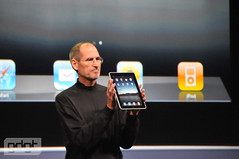
- Image by marketingfacts via Flickr
Unless you live in a cave (and a cave without a wireless connection at that), you’re probably aware that Apple announced their long-awaited, much-hyped tablet computer yesterday, officially dubbed the “iPad.” Full technical specs and details are available from Apple, and ArsTechnica has a good summary.
Some initial impressions are below, and I’m hoping this post will serve as a conversation space for our readers to post their thoughts in the comments.
First, I think that the vast majority of the tech press and online commenters seem to be completely missing the point. There’s persistent lamentation about this or that laptop feature that the iPad is missing. If you need the full features of a laptop, the iPad is not for you. This is a different product, meant to fill a different niche. The question Jobs asked during his presentation was, “Is there room for a third category of device in the middle? Something that’s between a laptop and smartphone.”
Right now that category is being filled by netbooks, which, as Jobs notes, are just really cheap, crappy notebooks. They aren’t specialized for this niche — they just do the same things as notebooks, only more slowly and not as well. There are certainly people who need notebooks and instead buy netbooks because they cost less and this makes up for the drawbacks of cheap tech. But there’s a huge market buying netbooks because they just want an inexpensive device to do simple tasks like answer e-mail, browse the internet, update their Facebook pages, and watch video.
That’s the target audience for the iPad.
For about the minimum price for a decent laptop, you can soon (the iPad should be selling in March) get a device that’s designed for those needs and provides an allegedly better user experience. It’s not meant to replace laptops — it’s meant to create a new level somewhere below a laptop for those with lesser needs.
That said, I can’t justify buying one. I’m one of those people mentioned above who needs the power of a full-fledged laptop. If I’m in a situation where the laptop isn’t usable, then my iPhone will suffice until I can get to a more powerful machine, and because my iPhone’s so small, I always have it with me for my real basic computing activities. Essentially, my needs are either too advanced or too primitive for this device.
Since this is a publishing blog, the real big news may actually be Apple’s new iBookstore. Details on the store are sparse so far, which makes it hard to comment. What’s the DRM situation? What’s the actual file format (Jobs did say it uses ePub, but is it some modified version)? How easy will it be to convert XML, PDF, or Quark files? What is the business arrangement? How much control over pricing do publishers have? Will the iBookstore and products be available for iPhones and iPod Touch’s as well (77 million of these in the wild, by the way)? Will there be a Google Books app? These questions need to be answered before we can discuss much further.
But this does seem to be a nail in Kindle’s coffin. Why spend $489 on a Kindle DX when you can spend $10 more and get so much more functionality in an iPad? And what of Amazon’s Kindle app? Assuming it will translate to the iPad, Amazon then becomes just another bookstore selling e-books for a variety of devices, and this certainly takes a lot of the wind out of their sails as far as dictating terms to publishers (particularly because the Kindle app is so far behind many other e-reader apps).
Take note that even though Amazon sells the same music downloads as Apple, and usually offers them at a better price, they still only make up about 8% of the market to Apple’s 70%. This shows the power of having the content store built-in to your device, and the reason Amazon tried so hard to create their own lock-in for the Kindle.
As an editor for a niche publisher of scientific manuals, textbooks, and monographs, we’re likely to be better served by an e-book store that doesn’t penalize us for having to price our books higher than $9.99. We sell to a small market, and our books require heavy editing. There’s no way we could survive at that price point because our audience simply isn’t big enough to make up for it with increased sales. If Amazon is going to keep the vast majority of the revenue on books that sell for more than $9.99, then there’s no point offering our books through the Kindle Store. If Apple’s iBookstore works the same way their App Store does, they’ll be price agnostic, offering the same terms regardless, which makes it a much more attractive prospect.
One other potential loser here is Microsoft Office. Between the free Google Docs and Apple’s new version of iWorks priced at $10 per app, how many people are going to need an expensive, full-fledged Office suite? Okay, probably a lot, but there’s also a large number of people who buy it because it’s the market standard and don’t use 95% of its functionality. As these simpler, cheaper alternatives see more use, Microsoft stands to see one of their main economic pillars begin to erode away.
More as more details become available, please share your thoughts below.
![Reblog this post [with Zemanta]](http://img.zemanta.com/reblog_e.png?x-id=55f8b9c1-8524-4a64-9864-644662ba5233)

Discussion
44 Thoughts on "The iPad: First Impressions of Its Importance to Publishers"

It’s difficult to react without knowing so many of the details (most of which you’ve covered above), but I will say that the prototype app showed off by The New York Times seems to hit the mark in creating a new, better reading experience for digital news and magazine content. I can see the major weekly professional and scholarly journals (Nature, Science, NEJM, etc.), which are becoming more magazine-like every day, taking advantage of iPad in a similar way and being very successful in doing so, and it’s only a matter of time before the smaller, less-frequent professional and scholarly journals make similar moves.
The price point is an absolute killer, and the real winners from this will be textbook publishers like McGraw-Hill. Steve Jobs was careful to mention the budding digital textbook market in his keynote, and McGraw-Hill CEO Terry McGraw was the first to publicly acknowledge the presence of the tablet, and its potential importance to his company’s higher education business, on Tuesday evening. All of a student’s textbooks and course packs on a slim, connected device–that’s something everyone I went to university with only dreamed of.
Kevin Cohn
Atypon

McGraw-Hill was apparently dropped out of Jobs’ presentation yesterday after their CEO blabbed. Don’t mess with Steve.
More on iPad and textbooks here.

My first thought was whether academic libraries — especially those who participated in the Google book scanning project — will be able to benefit from all the content they provided.

So maybe it’s really intended to be a Kindle killer? These are both interesting devices, but neither of them has hit the right price point in my opinion. When someone does, that’s when publishing will change.
I don’t think it was designed to be a Kindle killer, but that a minor part of its functionality will end up killing the single-purpose, single-store-only eReader. While I think it will kill the Kindle, I don’t think it will kill the Kindle Store.

But apparently Steve Jobs has decided that people do read, after all. (That’s why he dismissed the Kindle originally.)
No, actually Jobs has been remarkably consistent on this subject. He originally said there aren’t enough readers to support a stand-alone eReading device. He has instead created several multi-use devices that do more thing which will attract audiences much larger than stand-alone eReading devices, allowing for the positive effects of scale on manufacturing costs. You should also note how much time yesterday’s demo spent on movies and videogames compared to books to get a sense of how important they are toward Apple’s market.

Initial details (unsubstantiated rumors?) about book pricing suggest that to put a book in the Apple bookstore means not having a price higher than $14.95. I am seeking clarification of this point, but if it is true, then it is unlikely that there will be native versions of academic or professional books for the iPad.
That is an important question. I’ve seen a lot of speculation based merely on the prices seen on the screen shots from Jobs’ talk yesterday. Will the iBookstore mandate prices like the iTunes store, or will it be an open market like the App Store?

Even if they do mandate a price no higher than $14.95 does that matter? Couldn’t one just sell one’s book as a stand-alone app for whatever price one wanted? Or perhaps someone (GiantChair for example) will build an online bookstore app for academic and professional books.

“Why spend $489 on a Kindle DX when you can spend $10 more and get so much more functionality in an iPad?”
Eye strain avoidance?
Is that worth nearly $500 for a separate and limited device? If so, for how many people. I do think there will be hardcore niche readers who want e-ink devices and will stick to them. But that’s going to be an increasingly small group as other technologies improve. Factor in all the limitations of those devices and you have to put a pretty high priority on eyestrain, particularly when most people spend most of their days reading off a computer screen.
Yes, the health of my eyes is worth $500 to me, and (since that’s mid-range compensation for, what, about 10 hours of work) it’s worth that much to my employer.
And then there’s aesthetic considerations. I gladly pay $25 for an Everyman’s edition instead of $5 for a mass market paperback, so why would I balk at paying for an e-reader that frees me from staring at glowing LCDs?
Judging from online commentary, you are not alone in this. The question is whether there are enough people who share this desire to make the manufacture and sale of the Kindle a profitable and sustainable venture. One assumes the iPad will steal away a certain percentage of current Kindle users. Will there be enough left over to keep the hardware platform afloat?

I regularly read ebooks on the iTouch without eyestrain, and I’d take a iPad over a Kindle any day even if it were only a dedicated reader. Of course, then I’d want books that took full advantage of the iPad screen and its other capabilities. I’d gladly forgo being able to choose the font and type size for the pleasure of reading pages professionally designed for a 10-inch, high-resolution, full color screen.
More on the iPad vs. the Kindle here.

eyestrain avoidance, and circadian rhythm disruption avoidance. unless the young people today have evolved into something other than diurnal mammals.

I think this is ultimately all about Rich Media. Until now, we’ve pretty much kept our print publications separate from “supplementary material” like videos, audio, animations, etc. Those are now becoming much more _integral_ to published content, and less “supplementary.” Obviously, Apple always targets the broad consumer market; note that most of the magazine prototypes that have been proliferating recently have emphasized the link between the textual content and rich media (and also plain old linking). But this will become increasingly important to scholarly publishers too. Look at all the rich media employed by NEJM, for example. True, you can access all that on a laptop. What the iPad offers, in my view, is a very appealing combination of form factor and functionality (including the touch screen, including the ability to handle “books as apps”) that provides that kind of rich user experience. I don’t think anybody will see it as replacing either their laptop or their smartphone. But I think it — and its descendants — are going to be an attractive “media consumption” device in the long run (even for plain old novels).
One other technical point I’m interested in is interactivity, annotation, etc. Certainly in academia those would be huge plusses.
— Bill Kasdorf
Bill, I completely agree. When iPad was being announced I was on my way to the airport, and then on a plane. I saw bits and pieces, and one of the bits that caught my attention was Steve Jobs saying, “It’s a better web browsing experience than using a notebook.” No way, I thought–how can that be? Then I watched the keynote and I could immediately see what he meant. Tactile interaction with iPad is why it will become the gold standard for consuming content.
Kevin Cohn
Atypon

I’ve been waiting for an ebook reader solution that will work with technical material – color, clear presentation of tables and charts, etc. I’m hoping this is the answer.
Gizmodo hits the nail squarely on the head with this essay:
Generally speaking, the iPad’s goal is not to replace your netbook, assuming you own and love one. It’s not about replacing your Kindle either, assuming you cashed in for that as well. We have reviewed plenty of both, and know there’s plenty to like. If you derive pleasure out of using either, then Apple might have a hard time convincing you to switch to the iPad. But for the millions of people who aren’t on either bandwagon, yet have the money and interest in a “third” device between the phone and the computer, the iPad will have greater appeal.
Stephen Fry weighs in here:
iPad 1.0 is still fantastic enough in its own right to be classed as a stunningly exciting object, one that you will want NOW and one that will not be matched this year by any company. In the future, when it has two cameras for fully featured video conferencing, GPS and who knows what else built in (1080 HD TV reception and recording and nano projection, for example) and when the iBook store has recorded its 100 millionth download and the thousands of accessories and peripherals that have invented uses for iPad that we simply can’t now imagine – when that has happened it will all have seemed so natural and inevitable that today’s nay-sayers and sceptics will have forgotten that they ever doubted its potential.

When I sit on my couch with my laptop, it’s too big, too bulky, the keyboard is in the way most of the time, the screen creaks and groans as I readjust myself, it is jsut not a comfortable experience. When I sit on my couch with my iPhone, I struggle with the size of the text, the need to scroll to see the entire picture adequately, and with typing on the tiny little keyboard. I think the iPad is EXACTLY what I need. Not too big, not too small.
The iPad fits a niche that has yet to fully emerge. I can see my teenage son using this for all of his social networking, YouTube and video viewing, and eBook reading. I can see having one of these laying around the house for anyone to pick up read the local news, or check out a blog, or catch the weather, or to look up a location on the map. There is no keyboard in the way, but you can pull one up when you need it. You don’t have to drag everyone over to the computer, but rather you can hand the computer around for everyone to take a look.
For reading books – For those who like to look up words, validate an author’s statement, explore a reference, or take a quick break to catch sports scores or check their Twitter feed, this sort of reader is great.

I think one of the most important aspects of the iPad release will be that aesthetics will matter for the first time in e-reader experiences. While the devices have been moderately cool (the Kindle 2), the experience has suffered from a lack of color, fonts, integrated online content, video, etc.
With the iPad, aesthetics will matter a TON! Maps, fonts, colors, video integration, etc. — how good something looks will again gain value. Instead of being stripped out, the value added by layout artists, illustrators, designers, and others will be integral.
And, the size is sufficient to make it pay off. It seems like music went from album-cover artwork to the much less impressive CD artwork to the “might as well not exist” thumbnail artwork. Books, journals, magazines, and others seem destined to retain that great human factors size, and now the aesthetics will be even richer.

iLounge has a very detailed, technical editorial of photos and videos in their Apple iPad First Look:
http://www.ilounge.com/index.php/reviews/entry/apple-ipad-16gb-32gb-64gb/
Regarding publishing: “But the iBooks app falls short of really bringing books forward into the 21st Century—they are basically the same black and white things you see on an Amazon Kindle or Barnes and Noble Nook, only presented on Apple’s nicer color screen with little bits of extra shading. Nothing was said or shown about magazines or newspapers within the iBooks app; Apple instead demonstrated access to these publications via the Safari web browser and publication-developed apps (such as the New York Times app). Thus, Apple appears set to let individual publishers evolve their products through apps rather than ePub-format eBooks, and isn’t providing a special newspaper or magazine reader, or subscriptions, to push this forward. At least, yet.”
So it seems that publishers will have either an economy option, to convert to ePub-format eBooks that will be a one-size-fits most, and simply populate titles available in the iBook store, which is quite fine for text heavy content, and perhaps embedded images and video, but will be a fairly static experience. Or the custom option, to create dedicated Apps with rich media and greater functionality and interactivity, such as note taking, voice annotation, advanced indexing, filtering, interactive demos, score keeping polling, sharing etc. Following on from what other’s have commented here, I think the real breakthroughs will come not only from better ways to consume content, but better ways to interact with it and contribute to it. I’d like to see a next wave of user generated content and social media with content Apps supporting virtual bookclubs where readers can highlight, comment, and interact with other readers (and the authors) and share their own relevant experiences, photos, videos, etc. The iPad, which will still need some clunky accessories or workarounds for camera, video, file sharing, is coming closer to a ubiquitous (always with you, always on), multi-function interactive media input-output tool. And there is room for many different players, including not so proprietary and restrictive ones, open source, open standards. But the more user-friendly and budget friendly the device, the more non-tech savvy, non-laptop wielding users will be able to consume and contribute. Digital has brought down the cost of publishing production and distribution, and also brought down the costs and friction of interactivity and discovery.
I’m not sure the “book” needs to be reinvented, it does what it’s supposed to do quite well. I don’t mind the fairly staid form for eBooks, provided, as Kent notes above, that it allows for design, typography, etc. I do think we should all be interested in inventing new forms of expression (not “reinventing” anything) that incorporate audio, video, interaction, connectivity and more, but I’m not sure if that thing is still a “book” or if it’s something new entirely, requiring a new name and new ways of generating content (wrote some about that here). I’m betting there’s room for both sorts of things on the market.
And you’re right in that the App Store seems the place to be to do this sort of experimentation.

Y’know everybody laughed at the WII, until you couldn’t buy one for the demand. This is the same isn’t it. The first computing device where natural gestures are what you use to control it. Files, formats, storing things, the staples of the OS have been removed, leaving a device designed for the business of doing things. Instinctively.
For me, the barrier to owning an iPhone was the contract for the voice. I don’t use a mobile phone much. The data bit interested me, but the lock-in for 18 months and then the lack of portability to another supplier? Nope no thanks. This machine is free of those restrictions. Priced aggresively enough that after 2 – 3 years you’ll just go get the latest version with whatever toys are on it. Plug it into iTunes and bang, all your older stuff is straight on there. No fiddling around with OS installations and backups and all that stuff that just gets in the way of the doing.
For publishers – what opportunities! 3D protein models, videos for the tricky bits of the lab protocols animations, cutaways. layers. Kent is right, aesthetics are back and you can charge for them too. We can learn to do this stuff, we did it before. There’s a whole bunch of reference books from my molecular biology days, that would be so awesome on this machine.
Steve Jobs understands that mobile devices are not about the contract, they’re about the mobility. No bootup wait for an iPhone OS based device is there… In fact what’s a bootup?(Ok yes it’s a second or two if you turn it off.) He also gets (about the time the iPhone was jailbroken I reckon) that the street finds uses for things, uses unintended by the manufacturer… This is the Gibson device, a machine conceived to allow the street to do things with it. Apple are the suppliers of the entire infrastructure for that process.
John Gruber at Daring Fireball has a very thorough commentary on the iPad, making the analogy that the iPad is to the laptop as automatic transmission is to manual transmission in a car. He gives some details on iBooks, typography and why this isn’t such a bad deal for Amazon:
Typography and iBooks
The iPad’s version of iPhone OS contains more fonts than iPhone OS 3.1, including my beloved Gill Sans. The iBooks app lets you switch the text face, but only from a choice of five fonts.
iBooks uses full-justified layout for books, with no apparent option to switch to ragged right. It doesn’t do hyphenation, so you wind up with very unsightly word-spacing gaps. No e-reader I’m aware of does justice to proper book typography, but I was hoping for better from Apple. It’s decent web-caliber typography, not print-caliber typography.
As for Amazon, they might wind up delighted with this thing. Apple’s in the business of selling devices first, content second. I think Amazon is in the content business first, the device business second. A world where Kindle hardware sales pale in comparison to the iPad but where there’s a very popular Kindle app for iPad that competes against iBooks is not a bad situation for Amazon. Apple is only selling e-books for use on their own devices; Amazon is willing to sell e-books anywhere they can.

I have little doubt that the iPad (at price points that drew gasps from the audience) will be a pretty successful product. I’m looking forward to having something lighter and more portable than my laptop for watching movies and surfing the web in many places, like trains, planes and my bed.
But a lot of the Kindle killing commentary is off-base or factually inaccurate. Adobe has already said that Apple is using an incompatible, proprietary DRM with its ePub implementation (See http://blogs.adobe.com/flashplatform/2010/01/apples_ipad_–_a_broken_link.html). And there has been significant reporting on the business model for the iBooks store — higher prices for consumers, lower royalties for publishers and more money for Apple (See for example http://online.wsj.com/article/SB10001424052748703906204575027503731077976.html)
The price comparison is a little too cute, as well. Most people buy a regular-sized Kindle, which for $259 includes lifetime free wireless and costs considerably less than the cheapest iPad and LESS THAN HALF what the cheapest iPad with a cellular connection costs (before counting the required monthly plan for mobile service, minimum $180/year).
There’s also been extensive confusion about Amazon’s recent royalty hike, which applies only to self-published ebooks priced under $10. Big publishers still get paid based on their own specific deals, generally half or more of the print hard cover list price.
While Steve Jobs unveiled an amazing piece of hardware with cool software and a great price point, he did not announce any innovations to the business of selling content online. The iBook store is just like other ebook stores only with higher prices and a little more control for publishers (in fact, it seems just like the unpopular Scrollmotion app’s exact model, really, with a smidge more concession to consumers on pricing). There was no video subscription plan, no new way to pay for digital versions of print products, no iTunes for magazines, no micropayments scheme, no game-changing price cuts on TV clips, no cloud-based sharing of media files across all a person’s devices, no iTunes.com etc.
It’s quite possible that these are to come, that negotiations will be finished before the iPad actually arrives. I don’t know. But without some creativity and innovation on the business side, I don’t think the iPad can save anyone.
There’s an extra parenthesis in your link, should be:
http://blogs.adobe.com/flashplatform/2010/01/apples_ipad_–_a_broken_link.html
I’m not sure if that blog entry is actual knowledge or just speculation–Apple hasn’t released any info on the subject. But I don’t think Apple using incompatible DRM on their iBooks gives Amazon any advantage, they use just as incompatible DRM on their Kindle Books. The difference will be that the iPad can read iBooks, Kindle Books, Nook Books, and books from any other store that wants to build an App. The Kindle will only read books from the Kindle Store.
I’m waiting for full information before commenting on actual pricing in the new store. But if I’m a bookseller, I might selectively put some items in Apple’s store where I could set the price rather than putting them in with Amazon where I have to follow their more restrictive rules.
Neither really matters so much to Apple though–their real money is in hardware, not content as John Gruber stated in the quoted article above:
As for Amazon, they might wind up delighted with this thing. Apple’s in the business of selling devices first, content second. I think Amazon is in the content business first, the device business second. A world where Kindle hardware sales pale in comparison to the iPad but where there’s a very popular Kindle app for iPad that competes against iBooks is not a bad situation for Amazon. Apple is only selling e-books for use on their own devices; Amazon is willing to sell e-books anywhere they can.
The iPad does not require a 3G subscription, it’s optional on some models. You can also pay to turn it on and off when needed (less and less important in an age of widespread Wifi). Even at half the price, you’re still talking about a niche product at best. Highest estimates of total Kindle sales so far are around 2.5 million. Compare that with the 250 million iPods sold to date, or the 77 million iPod Touch/iPhones. Death may be too strong a word, but banishment to a backwater might be more apt. I’d also bet that Apple will improve and advance their device a lot faster than Amazon will, which has shown only minimal progress since the Kindle’s inception.
What’s nice about the iPhone/iPod/iPad platform is that it is open to the types of innovation you mention (as Sinae above notes, the real action is going to be in the App Store, not the Bookstore). But will it save anybody? That’s a tough call, but at the very least, I think publishers will be happy with a shot at new ways to sell their products.
Also amusing to see Adobe’s knickers in a twist over flash being left out. Perhaps if they could get their software to actually work well on a Mac it might be less of a problem.
All that said, there’s far too much hyperbole in the tech press, and far too much assumption that every market is a zero sum game, with one winner and everyone else losing out. There’s likely room in the market for more than one product.
STRONGLY agree!
And for publishers and consumers, a rich and varied marketplace is a much better situation than having a monopoly gatekeeper, whether that’s Amazon or Apple or Google or anyone else.
This winner-loser type of reporting has been polluting every aspect of mass media journalism for a couple of decades, and impairing our public discourse in myriad ways. Look at the latest outcome of a Massachusetts Senate seat and how the reporting turned it into the Super Bowl of politics.
So, it’s no surprise that the tech press has adopted the same style.
Don’t forget the cycle that this is part of:
1) Create a huge level of hype and speculation, raising expectations far beyond reality.
2) Start an immediate backlash when the product is released but before you’ve actually tried to use one.
3) Actually get to use one and write about how you knew all along what a great device it was.
Same thing happened with the iPhone. Plus ça change, plus c’est la même chose.
And, just to get this on the record for you David, Bezos is being just a tiny bit less vague with his Kindle boasts today, saying so far in January they are selling 6 ebooks for every 10 print books when titles are available in both formats and excluding all free ebooks. Also “millions” of people have bought Kindles, he says…See http://finance.yahoo.com/news/Amazoncom-Announces-Fourth-bw-319363362.html?x=0&.v=1
Glad he’s getting more specific. I just wish they’d offer up concrete numbers rather than oddly convoluted generalities.
For what it’s worth, TechCrunch is speculating that 3 million Kindles have been sold, though they don’t have any concrete evidence (and I always assume anything TechCrunch says is an attempt to help the sites owner’s portfolio).
The entertaining (but oft-profane) Angry Drunk has a good analysis and presents an interesting case for owning one:
In my opinion, an overall good first outing. The key thing to take away from the design and specs of the iPad is that it isn’t intended to be a netbook. It’s Apple’s answer to the use-cases that spawned netbooks. Nor should the iPad be looked at as a laptop replacement. Instead, I think that the iPad should be viewed as a laptop alternative.
More on the pricing deal Apple has struck with its partner publishers here. How will this translate into the store for all publishers? Can an STM publisher for a small technical market survive at $14.99 a book?
Couldn’t a 3rd party (Safari Books, Ingram, Baker and Taylor, Barnes and Noble, Smashwords, etc.) simply build an online bookstore with an iPad/iPhone app that would deliver electronic books to the iPad/iPhone at whatever price point publishers want to charge for them? I’m unclear on why everyone cares what the iBook pricing policy is. If it isn’t favorable to publishers, someone else will just build an app for that and publishers will go where they are able to get favorable pricing.
I assume we’ll see something like that, or at least a separate policy for textbooks and the like. The problem with having a separate store is the layer of separation it creates for the user. You can buy mp3’s from Amazon often for better prices than you can from iTunes. Despite Amazon’s better deals, 70% of download buyers go to iTunes, presumably because it’s more convenient.
There’s also the issue of whether one allows for “in-App” purchases, where you’d have to tithe Apple 30% of your revenue, or you do like the Kindle App does and switch the reader over to Safari to buy from your website. It’s clumsy and likely results in some lost sales, but it’s unclear if those losses exceed the 30% Apple tax.

I am excited in ways I haven’t been for a while about the potential for multimedia rich ebooks. I’m particularly interested in scholarly editions of classic texts, with audio, glosses, annotations, images maps, and yes, video. Waiting to see what sort of content creation tools will work, though if I have to integrate things by hand with ePub via XML/XHTML, I will.