As I sit at my desk here at the American Mathematical Society (AMS) offices in Providence, RI, I am having a slow moment. I see the urgent calls to the Government to stop destroying science in the USA. I see the rush to hop on new business model bandwagons in a bid to be the coolest on the block. I see the hype and reality of AI invade our publishing thoughts from sunrise to dusk. Just yesterday for example, we were trying to devise suitable author guidelines that encourage book and journal authors to disclose how they are using generative AI in manuscript preparation, but struggling to understand how to respond when they disclose that content is in part generated by AI. And then I reflected on how little our guidelines are likely to affect authors’ actions, in any case.
Slumping in my chair, and feeling mildly ornery, I wonder why the word copyright has become almost a dirty word for some.
And then, serendipitously, I discovered a new magazine to distract me. The magazine is titled Delayed Gratification: The Slow Journalism Magazine — and I love it.
“Like the other Slow movements such as Slow Food and Slow Travel, we take time to do things properly. Instead of desperately trying to beat social media to breaking news stories, we focus on the values we all expect from quality journalism – accuracy, depth, context, analysis and expert opinion.”
And so, in my slightly ornery and disinhibited way, I realize that this idea is the core of why society publishing is so important. In my publishing world it is not necessary to be first – aware of trends and innovations yes – but not first.
For us, in math publishing, it is about understanding our environment and interpreting the rush of the world for our community culture and innovating accordingly.
Admittedly, mathematics culture and mathematics publishing are perhaps unique environments. Mathematicians do not run large labs, funding levels are low, blackboards are vital, there are fewer co-authors, a published proof may run over 70 pages long, we coexist happily with the preprint server arXiv, and peer review just takes time as a reviewer has to run through a complete proof.
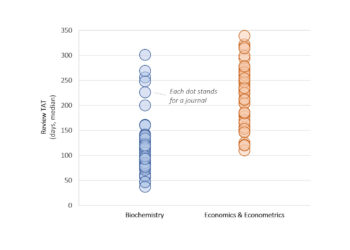
At the AMS, we still have our own print shop – a remarkable thing to behold. If you were to visit our print shop you will see that we have moved on from offset printers to digital printers – a heady innovation – and we have guillotines, laminating machines, binders – and it takes time – a beautiful example of slow, quality publishing. But we are not alone. While much of what we write and read when discussing scholarly publishing is dominated by science and medicine, let’s reflect on the humanities and fields such as economics where there is not such an emphasis on speed, be it in publishing content or reaching for the latest publishing trends.
Here is a wonderful YouTube Short called Hot off the Press, that takes you through the printing of a new book we just published called The Floer Jungle: Charting the Development of a Theory by Siobhan Roberts, acclaimed science writer and Executive Editor of Narrative Projects at the AMS) and the mathematician, Helmut Hofer, a founder of the field of symplectic topology and a member of the National Academy of Sciences.
In an open access world, we have resolutely eschewed article processing charges preferring to stick to Green and Diamond models, with perhaps rather too reasonably priced subscriptions. While this does not work for all communities, it works for us as mathematicians; institutions understand who we are as a community, how we are funded, and how books, journals, and indeed preprint servers such as arXiv, complete our ecosystem. And as we took our foot off the gas, we have seen many models come and go and fall back to clear notions of community inclusive and equitable publishing.
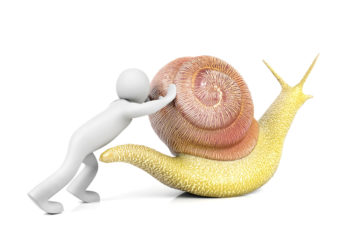
This is slow publishing.
I must admit that AI, while omnipresent in all parts of our lives, vague in its promise and omnivorous in its threatening tone, does not rule our publishing life. Indeed, it is perhaps best to think of AI as another set of tools and ideas that authors, publishers, and readers are incorporating into their workflows, but it does not define us.
It takes time to write a book, curate content, produce a book, and see a physical object claim its place in the world – one that will last and hopefully influence future generations of thinkers.
This is slow publishing.
What I would like to leave you with is the notion that there is beauty and business sense in being slow. I am not advocating burying our collective heads in the sand but just waiting and translating and watching on behalf of the cultures we serve.
This is the idea behind slow food – and now, slow journalism – and so it is for slow publishing.

Discussion
2 Thoughts on "Slow Food, Slow Publishing: The Beauty of Not Being First"

As my father used to say, being first can sometimes get you run over. Took me a long time to appreciate those words.
Thanks for this column.

I bought my brother a subscription to Delayed Gratification as a present. He’s still talking to me.