Editor’s Note: Today’s post is by Scholarly Kitchen Chef Ashutosh Ghildiyal, Maria Machado, and Gareth Dyke. Maria is a physiologist turned consultant, helping scientists transmit the core message uncovered from their data and disseminate new knowledge quickly. Gareth is a consultant specializing in scholarly markets and researcher networks in China and Central Asia, and is a co-founder of Sci-Train.
Research is more open today than at any point in history: free to read, widely distributed, and increasingly global in scope. But open was never the ultimate goal. The goal was discovery, understanding, application, and progress. In an AI-mediated information environment, where research is increasingly accessed through synthesized answers rather than direct engagement with the scholarly record, achieving those outcomes requires more than openness alone. Therefore, Open Science 2.0 must focus not only on access, but also on trust, interpretation, learning, and effective communication. The challenge facing the scholarly publishing ecosystem is ensuring that what is open is also trustworthy, understandable, and genuinely useful. Overcoming that challenge requires deliberate investment across four interconnected dimensions: openness and access, trust and verifiability, learning and expertise development, and broader communication and impact.
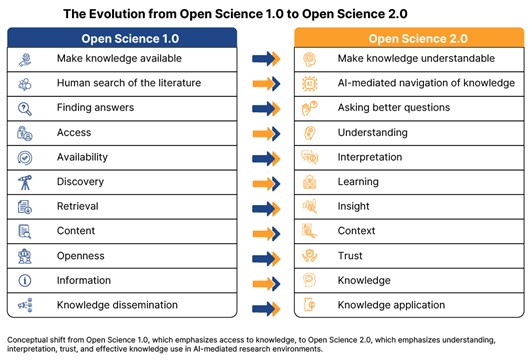
From Access to Understanding: The Real Gap
The foundational logic of open science was straightforward: remove the paywall and knowledge flows freely. It did make stumbling upon or accessing knowledge easier for those looking for it. But it wrongly assumed that access and comprehension move together, that making research available is equivalent to making it usable. AI sharpens this tension in both directions simultaneously. On the one hand, it dramatically improves discoverability, since users can surface relevant research faster than with any traditional search interface. On the other hand, AI-mediated discovery abstracts away the underlying work, compressing nuance and uncertainty into synthesized outputs which are efficient but not always complete, contextualized, or critically examined. Increasingly, researchers, clinicians, policymakers, and members of the public will not read papers — they will ask questions and receive answers.
Consider a physician seeking treatment guidance for a rare condition. An AI system may synthesize hundreds of studies in seconds and produce a plausible recommendation. Yet, what the physician ultimately needs is not merely an answer, but an understanding of the strength of the evidence, areas of uncertainty, and the limits of current knowledge. The challenge is no longer locating information, but knowing how much confidence to place in it, and how to apply it responsibly.
A policymaker consulting an AI-enabled discovery system about climate adaptation, or a clinician seeking guidance on a treatment option, may receive a useful synthesis of the available evidence without ever encountering the uncertainties, methodological limitations, competing interpretations, or unresolved debates contained in the underlying research. While the article remains the authoritative record, with its function as an instrument of validity and priority claims intact, it is no longer the primary interface through which science is experienced. Access without interpretability leaves a knowledge system that is formally open but functionally opaque to many of its intended beneficiaries. The next phase of open science must grapple with this reality.
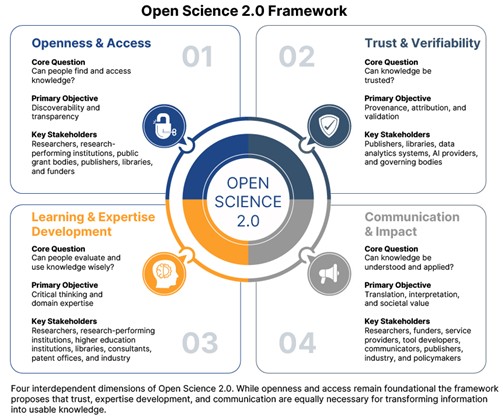
1. Openness and Access: The Foundation Holds and Needs Extending
Open access remains essential. Freely available research is more readily indexed and integrated into AI systems than content behind paywalls, and the equitable argument for openness is as compelling as ever. But the scope of what “open” means is expanding — open data, open methods, open peer review, and open citation metadata are all part of a richer infrastructure of transparency. So too are the licensing and structured availability of scholarly content for responsible AI integration, a conversation the publishing community is actively navigating, and rightly so. The goal is not simply to appear in AI outputs but to ensure those outputs lead back to credible, properly attributed, peer-reviewed sources, and that the value of rigorous scholarship remains visible within AI systems.
2. Trust and Verifiability: The New Imperative
One of the most significant consequences of AI-mediated access is the transformation of how accountability for science communication is structured. When journals, publishers, science journalists, and institutional communicators served as the primary channels through which research reached audiences, those actors exercised editorial judgment, deciding what to amplify, how to frame it, and what context to provide. However, in an AI-mediated environment, that structure of accountability becomes diffuse. No single actor (not the funder, not the publisher, not the science communicator) determines how a finding is presented to a user. This is done by the AI system, shaped by its training data, its design choices, and the query posed; and we have already said that we don’t know how these systems make decisions. The result is a communication landscape in which the contextual judgment that responsible science communication requires has no obvious home.
Here, it is important to say this is not an argument for nostalgia. It is an argument for proactively investing in the signals that AI systems depend on to represent research accurately:
- high-quality metadata,
- structured content,
- contextual tagging, and
- clear provenance.
Trust in an AI-mediated knowledge environment is not inherited from prior reputational structures, it has to be actively built into the infrastructure. So, publishers and libraries are uniquely positioned to lead here.
3. Learning and Expertise Development: The Upstream Investment
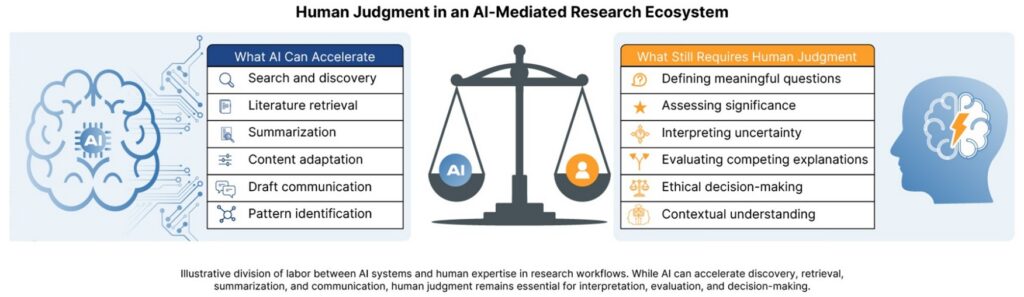
Discussion of AI and research practice tends to focus on what happens at the moment of query, how results are evaluated and how outputs are applied. But what happens before a researcher types a question into an AI interface may matter more than anything that follows. Effective use of AI as a research tool depends on a prior capacity — the ability to think carefully about what question to ask, what assumptions it encodes, and what kind of evidence would genuinely answer it. A researcher with deep domain knowledge approaches an AI interface very differently from a novice, with more precisely formed queries, more reliable evaluation of outputs, and a framework against which to test plausible-sounding but incomplete answers. A common misconception is that AI reduces the need for expertise because it makes knowledge easier to access. In reality, the opposite may be true. As retrieval becomes easier, the value of judgment increases. When information is abundant and answers are readily available, the ability to ask meaningful questions, evaluate evidence critically, recognize uncertainty, and apply knowledge appropriately becomes even more important. AI changes the interface with science, but it does not eliminate the need for human expertise.
This kind of intellectual formation is built through practices that are under pressure in the current environment, namely extended engagement with long-form scholarship, deep reading that prioritizes comprehension over retrieval, and the gradual construction of a point of view through encounters with multiple and conflicting sources. These are precisely the practices that AI most efficiently displaces. The longer-term cognitive costs are also real, if less immediately visible. Institutions and libraries have a particular responsibility here. In our view, evolving information literacy programs – beyond source evaluation and citation management, toward the active cultivation of the intellectual habits that allow researchers to use AI tools well – are a forward-looking investment in epistemic capacity. Deep reading and sustained engagement are not retrieval mechanisms, they are insight mechanisms. This distinction matters, and it deserves institutional protection.
Investment in longer-form synthesis content, including review articles, carefully structured monographs, and edited collections, matters even more now. These formats support the cognitive infrastructure on which serious research thinking depends, and their value should not be underestimated at a time when shorter, faster formats dominate. These often form the basis upon which editorials and opinion pieces are written, which are meant to be much more accessible to non-specialists. Integrating plain-language outputs, visual abstracts, and policy-ready formats into standard editorial workflows becomes essential.
Ultimately, funders have perhaps the greatest systemic leverage. Making communication plans a standard and substantive component of research design (rather than a box-checking afterthought), and developing metrics that capture genuine communicative reach (alongside the quality of knowledge translation) would send powerful signals about what the ecosystem values. Transformative would be to support the development of communication capacity across the research community, and recognize the professional science communication sector as a legitimate beneficiary of that investment.
4. Broader Communication and Impact: A Shared Responsibility
A scientific article and a piece of science communication are fundamentally different content. The article establishes what was done, how, with what result, requiring the authors’ own interpretation and judgment, enabling peer scrutiny, supporting reproducibility, and anchoring priority claims. It was never meant to explain to a clinician why a finding should change practice, help a policymaker understand the weight of evidence behind a regulatory question, or give an engaged public a meaningful sense of what a research program is actually trying to achieve. Researchers themselves will increasingly need plain-language communication skills. The ability to articulate the significance of one’s work accessibly, without sacrificing accuracy, is not a lesser form of scholarship. In many respects, it is the harder one, requiring contextual framing and a long-term vision of societal implications that technical writing does not demand. Training researchers in these skills, and valuing them institutionally alongside conventional publication metrics, is among the most productive investments the scholarly ecosystem can make.
At the same time, not every researcher is, or needs to be, an accomplished communicator, and expecting otherwise sets an unrealistic bar. Professional science communicators and science journalists remain indispensable. They bring specialized skills in narrative, audience understanding, and critical contextualization that most researchers have neither the training nor the bandwidth to develop. As the volume of research output grows and AI-mediated synthesis becomes more prevalent, the risk of oversimplification and misrepresentation increases, making skilled human intermediaries more valuable, not less. These professionals should be supported, resourced, and recognized as a core part of the scholarly communication ecosystem.
AI can assist everyone in scicomms work by generating draft summaries, identifying where explanations assume too much prior knowledge, and adapting content for different formats and audiences. New tools that produce infographics and visual abstracts from prompts based on the research article, together with text to video tools and the integration of animations and “cartoonification” convey the message with appeal and immediacy. But the judgment about what to emphasize, what to qualify, and what a particular audience genuinely needs to understand cannot be delegated to a tool alone, as it requires someone who understands both the science and the audience.
Open Science 2.0: Building Understanding Together
The open science movement’s foundational achievement, making research available, was necessary and worth defending. But availability alone was never sufficient, and the AI-mediated information environment has made that insufficiency impossible to ignore. Open Science 2.0 is defined by a broader ambition which requires active investment in infrastructure, skills, and norms across every actor in the system, from the metadata standards that make research legible to AI, to the communication training that helps researchers and professionals translate findings for the audiences that need them. AI will continue to reshape how research is accessed, synthesized, and applied; that transformation is already well underway. But access is not understanding, and without understanding there can be no trust. Building all three, together, across a genuine community of practice that includes researchers, professional communicators, publishers, librarians, and funders, is the defining opportunity for scholarly communication in the decade ahead. The future of scholarly communication will be shaped not simply by how effectively we open knowledge, but by how effectively we help people make sense of it. In an age where information is abundant and increasingly mediated by AI, the most valuable outcome of open science may not be access to knowledge, but the ability to understand it well enough to act wisely.


Discussion
4 Thoughts on "Open Science 2.0: Building Understanding in an AI-Mediated World"

I find this perspective very useful to share. Thank you for taking the time to formulate and communicate it. It gives me food for new thoughts.

Thank you for reading, @Tiberius Ignat! I’m so looking forward to seeing what the industry representatives have to say @R2R next year! Speaking about trust was accelerated by AI, but this conversation has been needed for a while, I believe.

This perspective greatly resonates with us at AAAS (see also: https://www.aaas.org/news/next-frontier-public-access-building-channels-meaning). Thank you for your piece!

Thank you all for the thought provoking post. It’s hard to disagree with the points you make, especially with the increase in the number of scholarly publications. The keywords for me are Trust and Provenance. And of course the issues are not limited to our industry. News organizations, social media, and even photo agencies are all struggling with similar issues.