- Image via Wikipedia

For anyone following the e-book device world, the plethora of announcements is overwhelming. In addition to the Kindle and Barnes & Noble’s Nook, we have the Apple iPad coming soon, new developments from Sony, and countless offerings from established companies and start-ups.
On top of these are the multipupose smartphones, led by the Apple iPhone, which display text rather well. I am myself surprised by the quality of experience on my iPod Touch, which, though it is unlikely to supplant print or larger reading devices for me, has opened up my reading experience during all those times when I am just waiting around to do something else.
Now, how much time do we Americans spend waiting in line, waiting for children and spouses, waiting at the Division of Motor Vehicles — not to mention when put on hold by Verizon, AT&T, and Comcast? Your call is very important to us; why don’t you read a book while you wait?
It was thus with great interest that I learned that the Kindle and Stanza are either ready (Kindle) or being readied (Stanza) for reading on a computer. Yes, a software version of the Kindle (which is already running on the iPhone) is available for PC users, and Stanza, which burst into prominence with its iPhone application, is in beta for the Mac. There will be other such applications: software book readers, with some e-commerce capability attached. No potential venue for the sale and consumption of text is being left to its, er, own devices.
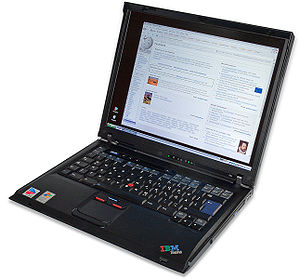
So the next big e-book device is the laptop. A laptop, of course, is a computer, and every new piece of software written for it is in fact a virtual machine. Thus a laptop with Stanza running on it is no longer merely a laptop: it is now an e-book device and bookstore.
This brings us back to the old saw that no one wants to read a book (or a “long-form text,” at any rate) on a computer screen. This makes me wonder what it is that I do with my time. Like millions of people around the world today, I spend the vast majority of my waking hours reading text off a screen: desktop, laptop, smartphone, and iPod Touch. When I travel for business, I see people reading long documents on their laptops and have noted that some of them are books (whether authorized copies or not is another matter). Soon I will have Stanza on my laptop and perhaps other readers (waiting for Eucalyptus!). People do read on a screen, though not necessarily everybody. But it’s not everybody that is the target for Amazon and others: the target is simply enough people to make the investment in this particular sales venue economically viable.
What laptops have mostly lacked thus far are good software for the viewing of books, a large selection of titles to choose from, and a means to sell books efficiently to laptop users. (Let me pause to say that there has long been a large selection of public domain texts for computer screens from Project Gutenberg, Michael Hart’s truly visionary project.) These problems are now solved. We will see more and more laptops as reading devices in the months ahead.
This is not without other implications. If you are a business traveler and must carry a laptop or, at a minimum, a netbook, how likely a candidate are you for a dedicated e-reading device or even a portable media device like the forthcoming Apple iPad? As a business traveler, you already carry a smartphone of necessity, which is another publishing venue. It’s unlikely that already burdened travelers will put a Kindle or Nook in their carry-ons; the laptop has been given a new lease.
For people interested in scholarly publishing, there is a surprising implication, namely, that the old gray mare, the PDF, may have a couple more laps around the track left in her yet. The PDF remains today the primary means by which scholarly material is presented to readers, but it does not migrate easily to the small screen of mobile devices. But a PDF bookstore, designed with laptop reading in mind, is now very much a commercial oppportunity. Such a laptop with reading software would have to display more formats than PDF, but the pressure for academic publishers to invest in converting their slow-selling PDFs may diminish a bit.
There is a moral to this tale, and that is that the digital revolution does not lead in a straight line or in a single direction. It moves forward, back, forward, back, and often to the side. What is fashionable may not survive; what already exists may prove heartier than the best new idea. For publishers, it’s important to realize there is no such thing as a macrostrategy — and don’t let the tech companies tell you otherwise. Each strategy must be tailored for the specific circumstances of a particular organization.
![Reblog this post [with Zemanta]](http://img.zemanta.com/reblog_e.png?x-id=93c69e63-19de-456d-b1f0-b5a10be605e2)

Discussion
14 Thoughts on "The Next E-book Device Is Already Here"


Yay! I never understood why I would need a special ebook reader when I already have a laptop. I still prefer paper books over electronic ones, but would be much more likely to purchase an ebook once in a while if I knew I already had the machine required to read it on…

Right Joe! It is still early days, but one may assume that e-book readers will have very little impact on the academic sector. Students have got access to laptops and libraries; why would they need a Sony e-book reader, a HP Slate or a Barnes& Noble Nook as well?

My understanding is that the Romance ebook market is overwhelmingly desktop/laptop-driven (Kassia can tell you more).
Cross-platform is the only way to go, imo, http://Kobobooks.com got that first…but everyone else is cottoning on too.

One tool I use on the laptop for reading NewYorkTimes is Readability http://lab.arc90.com/experiments/readability/
It removes all the clutter and the settings are customizable. This gives a pretty close ebook reader experience.

Another mention for Readability. Use it everyday…

Excellent take. Related to some thoughts I eked out on the topic of eBooks recently:
http://blog.silverchair.com/2010/03/12/what-is-an-%E2%80%9Cebook%E2%80%9D/

One of the benefits of e-books is that anyone can create and provide one for themselves – anyone can become writer and creator in their own right.
I just released my first e-book as well, and it’s going excellent. It allows individuals get their site began and increasing FAST.

E-books promote reading. People are spending a longer period before side of screens and less time before side of printed guides. E-books are good for the environment. E-books preserve plants. E-books eliminate the need for filling up our landfills with old guides. E-books preserve transport costs and the pollution associated with shipping guides across the country and the world.