Editor’s Note: Today’s post is by Marion Schnelle and Deirdre Watchorn. Marion is head of social media at De Gruyter Brill, where she manages the company’s corporate channels and supports dozens of editors in running more than 30 subject accounts. Deirdre is an insights professional with over 20 years’ experience consulting for multinational brands and marketing teams globally, who has led the insights and analysis team at De Gruyter since 2019.
At one time, there was little doubt about where academics gathered to connect with peers, share research, and discover new voices. Platforms like Twitter (now X) offered a vibrant, informal commons: a single, global space where researchers could build reputations, collaborate across borders, and participate in real-time scholarly debate.
But now, that clarity has gone. The digital landscape for academics is fragmented, tiring, and uncertain. While this shift is often framed as a simple migration to newer platforms, the reality is more complex — and the implications for scholarly communication are far-reaching.
A recent research report published by De Gruyter Brill, based on nearly 1,800 scholars worldwide, paints a picture of a community caught in transition. Social media still matters, but for many, it has become a space of pressure, fatigue, and diminishing returns.
The Double Bind
The pressure to be visible online remains strongest for early-career researchers (ECRs). Many still view social media as essential for being seen, cited, and connected — even as they question its value. This creates a bind: a sense of needing to stay active while feeling drained and skeptical about the payoff.
As one respondent put it, “I actively dislike Twitter and Facebook — I considered using them to promote my books, but quickly changed my mind. I still feel I ought to be there for visibility, but it’s exhausting.” Another described becoming “more passive — just following friends, family, and some professional contacts. It feels necessary to stay connected, but I rarely have the energy to contribute.”
For those without established networks — particularly in the Global South — social media has historically been a leveling force. As these spaces fragment, sustaining visibility without that common arena is becoming harder. One respondent summed it up: “Because of the Twitter takeover, I created Mastodon and later Bluesky accounts. I don’t want to be on corporate-driven networks, but I worry I’m missing important conversations.”
The Decline of X and Facebook
The survey found that 67% of regular social media users had reduced their time on the platforms, with many abandoning X and Facebook entirely. The reasons are familiar: toxicity, declining professional value, and algorithmic changes that deprioritize academic content.
Nearly half of respondents (49%) said these platforms had become too hostile for meaningful academic exchange, discouraging participation in debates and making it harder to discover new work. As one put it, “As the quality of X has declined, I have used it less. Unfortunately, none of the alternatives is sufficiently populated by colleagues to be useful to me.”
The demise of ‘academic Twitter’ as a trusted, constructive space represents more than a nostalgic loss — it removes a key route for collaboration, sharing research, calls for papers, and events across disciplines.
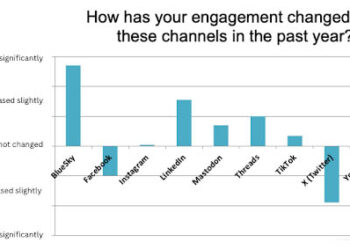
At the same time, LinkedIn has become more prominent. While it is not yet part of most researchers’ daily routines, it is now the third most-used platform in our data — and the leading one for work-related activity. Some respondents described shifting their professional networking and science communication there, particularly as X has lost ground: “I have shifted from Twitter to LinkedIn and LinkedIn is really a very good platform for science.” For many, LinkedIn is less about everyday discourse and more about targeted opportunities: peer connections, professional development, and job searching.
Fragmentation and the Workload Gap
In the absence of a single dominant platform, our study finds that activity is splintering. Some academics are experimenting with Bluesky, Mastodon, or even Substack. Engagement levels in these spaces can be high — sometimes higher than on legacy platforms — but their reach is limited.
For individuals, institutions, and publishers alike, this creates a new kind of pressure: the need to track multiple channels, rebuild networks, and adapt to different cultures of interaction. Senior academics can often lean on established reputations and personal networks. For ECRs and researchers in the Global South, the effort to maintain visibility is greater — and the time, energy, and resources to do so are not evenly distributed.
The Return to Controlled Channels
Perhaps the most striking finding is the quiet resurgence of older, more controlled, and perhaps more trusted forms of communication. Email, newsletters, peer networks, and ‘in real life’ events are reclaiming space once ceded to social media. “I prefer email and in-person contact,” said one researcher, “social media is too chaotic to be productive.”
Three-quarters of respondents preferred receiving email or newsletters from publishers, compared to just 41% who favored social media. For many, these channels offer a sense of control, relevance, and community — even if they lack the instant reach and serendipity of the big social media platforms.
The Emotional Toll
The research also reveals the emotional costs of constant connection. Respondents spoke of anxiety and the ‘performative’ nature of maintaining a professional presence online. One commented, “I’ve become more conscious in managing my screen time… it’s necessary for my career, but it’s exhausting to keep up.”
This strain is not just a personal well-being issue — it shapes the health of scholarly communication. If fatigue pushes people away from informal networks, the ecosystem loses diversity, vibrancy, and reach.
What This Means for Scholarly Communications
These findings point to more than a change in personal habits. They suggest a reconfiguration of how research is informally shared and discovered — with potentially profound consequences. The once-reliable routes for circulating research, spotting emerging trends, and connecting across disciplines are slowing down. Without shared spaces, visibility risks becoming uneven, with early-career and underrepresented scholars most likely to lose out.
For publishers, societies, and institutions, the loss of these open, centralized venues also means the loss of an important communication channel. Academic Twitter was never perfect, but it allowed organizations to see where conversations were happening, where communities were forming, and where needs were emerging. In a more fragmented environment, those signals are harder to detect, and the work of maintaining connections is greater. This shift also raises questions for the communications professionals who were hired to monitor and build networks on these platforms: how their roles evolve as usage patterns change remains an open question.
Fragmentation itself is not necessarily a bad thing — niche platforms can foster deeper, more focused communities. But for individual researchers, keeping a foot in multiple spaces comes at a cost, and for the scholarly ecosystem as a whole, it dilutes reach and weakens the serendipity that once characterized online exchange. This leaves the scholarly communications community facing an urgent question: if the old ‘commons’ is breaking down, what comes next?
Where To Next?
The answer is unlikely to be a single platform replacing Twitter. More realistic is a patchwork of channels: listservs, newsletters, Substack, and community-driven tools that provide continuity across spaces. None of these alone will recreate the reach of the old platforms, but together they point to a different kind of ecosystem — smaller, more distributed, and potentially more resilient.
In this new landscape, the task for publishers, societies, and institutions is not to reinvent social media, but to recognize and support the models that already exist. That means valuing multiple forms of visibility — through email, newsletters, conferences, or niche communities — and reducing the burden on individual researchers, particularly those without established networks, who cannot be ‘everywhere at once.’ Much of this activity is already scholar-led, which makes it even more important for publishers to listen carefully and respond to the needs of research communities.
Those organizations that step forward to sustain these emerging models will play a defining role in how scholarship is shared and discovered in the years ahead.
Discussion
4 Thoughts on "Guest Post — The Great Pullback: Why Academic Social Media’s Fragmentation Matters"

I don’t see any decent alternatives to Twitter other than Bluesky here. I’d say it’s exhaustion rather than fragmentation. If you’re not on Bluesky but want to be on academic social media then come join! If the thing holding you back is that there aren’t enough other people on there then come join and help with that. There’s a good community there. The more academics join the better it is for publishers too!

Thanks so much for reading and for sharing your thoughts Simon. I agree that Bluesky is one of the few platforms showing real momentum right now – it’s been great to see that community grow. In our research, many people talked about both exhaustion and fragmentation: that sense of being spread too thin across spaces, even as new ones like Bluesky take off. We’ve noticed the same trend ourselves – since setting up our subject accounts earlier this year, we’ve already seen over 11k followers join us on Bluesky, which really shows how active the academic community there has become.

Certainly the golden age of academic social media that took place on Twitter from about 2010 and that peaked again around Covid (due to the mass of published papers on the virus) are now behind us.
But there were always other ways, X was important and for some organisations and individuals remains something hard to let go of, but the cost-benefit has slipped too much away from being worthwhile.
Communicating your research was always about using the right medium connected to the right audience using the appropriate language and X did not have exclusive rights to that.
Whilst Bluesky might not have been the shot in the arm to reignite academic conversations on social media, it still remains useful for those engaging with the engaged. What is needed, are more academic organisations on there sharing their information, but that requires resources and a will to use another platform.
Whilst LinkedIn has surprising become the home for many still wanting to share knowledge and have conversations. A clunky, poorly designed platform, that sends you creepy messages as to who has been looking at your profile. Yet it’s fairly safe and works for the most part, without this we might have been talking about new scientific breakthroughs on MySpace. The odd bot might send me a message or comment on how ‘valuable’ my insights are, but it’s pretty manageable.
But at a time when academics and resources are squeezed and cut back, more consideration needs to go into the important issue of communicating research in these troubled times.
This is not just about impact, but also a global issue relating to misinformation and fake news, which can only grow with the aid of AI. The blunt this problem, we need to share evidence, engage in dialogue and ensure that fact ranks above fiction in the search results.
How we do that depends on many things, but I think much of it comes down to empowering academics to chose the right platforms and tools to engage with the right audiences. Whether that be politicians, policy makers, charities, local authorities or the public.
There is, and has never been one size fits all. There are wicked problems, that cannot be solved by one individual or organisation. And whilst social media’s power has waned in the academic community, it is important to remember that there have always been other ways to reach people through blogs, discussion forums, videos and podcasts. Social media was to a large extent the train tracks that carried the freight of outputs and still does so, just in a more fragmented way as this post highlights.

It’s LinkedIn that I now find exhausting as it seems to be keen to throw everything and the kitchen sink into it. Bluesky (at the moment), still feels relatively clean because it has one job: posts, and sticks to it. I have no doubt that will get worse over time.
One trick I have found on bluesky is making use of lists. So I have my main followers, then I have other lists on topics such as climate change or academia that have other people on it, so I can pop over there if I’m really interested or there’s an event I want to check out without it getting mixed up with a completely different group of posts.