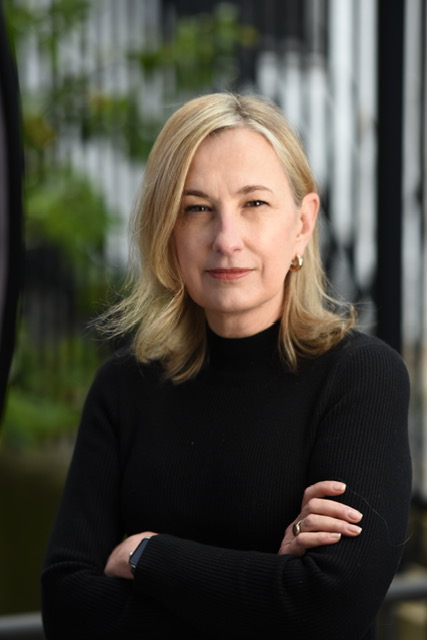
Editor’s Note: Today’s post is by Wendy Queen and Trevor Owens. Wendy is Chief Transformation Officer at Johns Hopkins University Press. Trevor Owens is the Chief Research Officer at the American Institute of Physics.
This is my first contribution to The Scholarly Kitchen, and I come to it as someone whose work, education, and outlook are rooted in the humanities. I hold a deep belief in the power of narrative, context, and cultural memory to shape the way knowledge lives and moves in the world. Whether through archives, publishing, or digital infrastructure, I am drawn to the spaces where humanistic inquiry reveals deeper dimensions of how we understand science, scholarship, and ourselves.
While this piece focuses on the intersection of the humanities and the sciences, I want to be clear that I do not view the humanities solely in relation to other disciplines. The humanities stand on their own as vital fields of inquiry that help us understand meaning, identity, memory, language, and culture. They are essential, not because they serve other domains, but because they offer their own ways of seeing and making sense of the world. My interest in nearly all conversations grows from that foundation. When the humanities enter into dialogue with the sciences, I couldn’t be more certain that both can be enriched without either losing their depth, integrity, or purpose.
That is why I was especially excited to speak with Trevor Owens, Chief Research Officer at the American Institute of Physics. His career brings together history, technology, and community stewardship. In our conversation, we explored how the tools and sensibilities of the humanities, including oral history, archival practice, storytelling, and sociocultural analysis, are helping to preserve the record of the physical sciences. These methods are also influencing how scientific stories are told, who has the opportunity to tell them, and why they continue to shape our understanding of science today.
Origins: Story, Method, and Memory
Wendy: Trevor, your work sits at the nexus of so many of the questions and challenges we’re facing across scholarly communication right now. How can we preserve and tell the stories of science, how should we build systems that support both disciplinary depth and cross-disciplinary conversation, and how might we invite new voices into the narrative? I wanted to talk with you now because you’re not just reflecting on those questions, you’re actively building the infrastructures and models that might help us answer them. Your career has spanned libraries, museums, and now the American Institute of Physics. What drew you to work at the intersection of the humanities and the sciences?
Trevor: I’ve always been drawn to interdisciplinary domains. I trace this back to a problem with my first semester college course schedule. There were no open seats left in the history courses that I wanted to take. But a student adviser suggested I could take a history of science course through the University of Wisconsin’s Integrated Liberal Studies program. Not only did that sound interesting, but I would also get science credit for taking a history course. A few weeks into Dave Lindberg’s captivating talks on the beginnings of Western science and I’d declared my history of science major. Since then, through work at the Roy Rosenzweig Center for History and New Media, the Library of Congress, and the U.S. Institute of Museum and Library Services, and teaching at the University of Maryland’s iSchool and American University’s History Department, I’ve found myself working on the infrastructure of memory: how we collect, preserve, and interpret records of the past to shape a better future.
Along the way, I earned a Ph.D. in education with a focus on social science research methods. As a result, my formal training is first and foremost as a methodologist. I think when we have the full toolkit of the humanities and the social sciences on the table, we can do a lot of powerful things to help advance society. At AIP, I am specifically focused on how we can use those research methods and tools to empower positive change in the physical sciences. What brought me to AIP — and what continues to energize me here — is the opportunity to help the leaders in the physical science communities that we support think in generational terms, help cultivate and sustain a legacy mindset in these communities, and elevate the human stories at the heart of scientific endeavor.
Building the Infrastructure of Story
Wendy: Your story reminds me how often disciplinary curiosity begins not with intention, but with encounter. It might happen by being placed in a class we didn’t expect to take, walking into a library without a particular goal, or finding ourselves in a conversation that quietly but completely shifts our understanding. These moments may seem small at the time, but they often open entire paths of inquiry. I love how that first history of science course did more than introduce a topic. It unlocked a way of thinking that combined method, curiosity, and interpretation. It became a foundation that has clearly shaped your work ever since.
What you describe as the “infrastructure of memory” is especially resonant. It captures something essential about the humanistic view of knowledge: that memory is not passive, and it is not fixed. Memory is created through choices. It is influenced by who decides what is worth preserving, how stories are told, and what questions we ask of the past. It is shaped by people, by systems of power, and by the intentions that guide how we engage with evidence over time.
This framing reminds us that preserving knowledge is never just a technical act. It is an interpretive and cultural act as well. Archives, oral histories, and digital collections are built through decisions that carry meaning. They reflect values and signal priorities. And they give future scholars the materials they need to understand not just the content of scientific work, but also the communities, identities, and relationships that provide texture and context.
Your work invites us to see that legacy is not just about looking back. It is also about actively shaping the stories science tells about itself and ensuring that those stories are as inclusive, thoughtful, and rich as possible.
At AIP, how do you approach making the history and philosophy of science more accessible and meaningful to both scientists and humanists?
Trevor: One of the things I found most compelling about the opportunity to serve as AIP’s first chief research officer was that AIP has a clear and direct purpose behind its research activities. AIP is both a federation that advances the success of our Member Societies and an institute that conducts research and analysis to empower positive change in the physical sciences. The humanities and social science research we conduct and support serves that mission: fostering positive change in the physical science community.
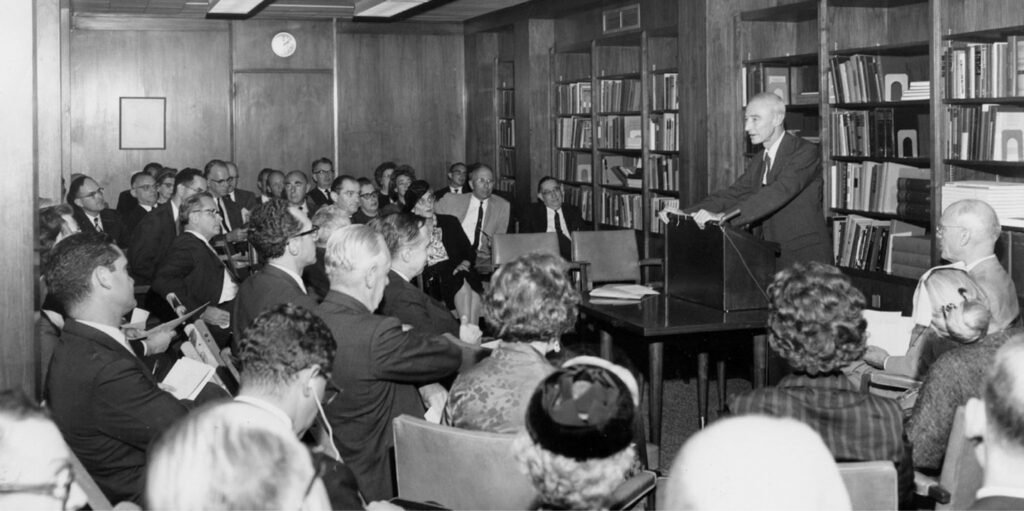
This intention is not new. It goes back to the roots of our social science, history, and library programs, which were established in the 1960s. More than half a century ago, leaders from the physical science communities that we support understood the value that history and the social sciences could bring to the physical sciences. They charged us to build and steward these efforts. Speaking at the dedication of AIP’s Niels Bohr Library in 1962, J. Robert. Oppenheimer observed that “the discoveries in the sciences are among the great epics, and they should be available in our tradition,” and that “this new library will be the home” for that work.
Starting from that foundation means that our research teams today are not just exploring history, social trends, or policy in the abstract — they are grounded in the question of how our work can serve the physical science community. That orientation helps us make history and philosophy more meaningful to both scientists and humanists because we have a clear direction on the kind of change we want to see in the world as a result of our work.
Wendy: The way you connect AIP’s mission with a long-standing humanistic commitment to tradition and legacy really struck me. In the humanities, we often ask: Who gets remembered? Whose stories are preserved? You’re applying those same questions within scientific communities, and in doing so, showing that scientific progress isn’t just about data points and discoveries. It’s also about identity, culture, and values. I find that deeply encouraging.
Can you share an example of what some of that work looks like in practice? That is, how have you successfully combined humanistic inquiry with scientific context to reach new audiences or produce new insights?
Trevor: One compelling example comes from our work on AIP’s history newsletter. For many years, our team has produced a semiannual newsletter highlighting research, archival acquisitions, stories about our grants to historians and archives, and news for the history of the science community. We still compile those two full issues each year, but we’ve also evolved our approach by launching both a monthly digest and a weekly spotlight edition.
The monthly edition offers a roundup of newly released oral histories and photographs now available online, alongside links to recent articles that interpret or contextualize items in our collections. It’s designed to keep our community updated on what’s new and newly available for research and engagement.
The weekly edition, on the other hand, focuses on a single story or interview that we believe can speak across disciplinary lines. These pieces are developed to resonate with both historians of science and physical scientists with an interest in their own disciplinary history. For example, we recently published a short interview with historian Joe Martin, drawing out core themes from his 2018 book Solid State Insurrection: How the Science of Substance Made American Physics Matter. Side note, it’s a really great book and anyone interested in the history of the development of disciplinary fields should read it. We similarly celebrated the launch of an important new edited volume titled Women in the History of Quantum Physics. In another case, we offered an overview of a Royal Institution event on the origins and development of geophysics. For Pride Month, we featured an excerpt from an oral history with astronomer Jan Eldridge and a story about Frank Kameny’s work as an astronomer.
This isn’t just content for content’s sake. Each of these pieces is crafted with the intention of working to better connect our communities and draw attention to significant work that we believe should reach a wider audience. After we highlighted the Royal Institution event, their team shared that they saw a significant uptick in remote engagement in the event. That kind of response shows how we’re using humanistic storytelling and scientific context to extend reach, deepen engagement, and bridge audiences. To this end, I should note that if anyone in The Scholarly Kitchen community has ideas for books that make use of historical or social science research methods that would be of interest to physical scientists, I’d love to hear from you. My contact info is on my AIP bio page. We are very much interested in helping connect work in that space with others in the physical science community.
Part 2 of this conversation will continue next week.